
A Model T with a flat battery will still run. That one fact surprises more modern mechanics than anything else about the car, and the explanation is the Model T magneto: a generator built into the flywheel that makes its own current whenever the engine turns. Pair it with four buzzing coils in a wooden box and a simple rotary switch on the camshaft, and you have an ignition system that needs no battery, no distributor and almost no adjustment. It is also an elegant little lesson in electromagnetism, which is the part worth slowing down for.
Car Features
8 min read
The Model T Magneto and Coil Box Ignition Explained
Sixteen magnets, four buzzing coils and a roller on the camshaft: how the Model T made its own spark without a battery.
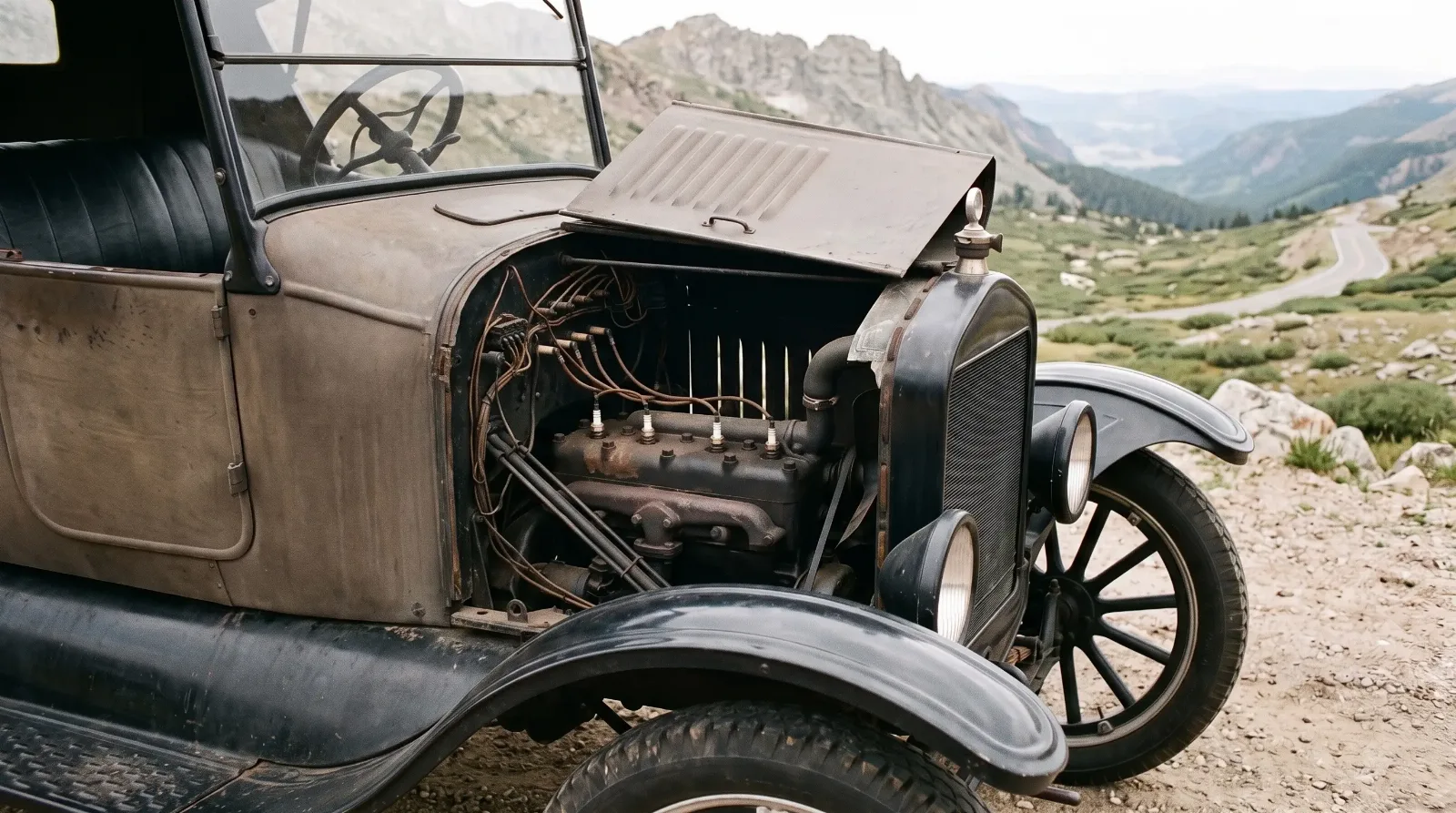
This piece goes through the system in the order the current travels: from the flywheel, to the coil box, to the timer, to the plugs. The general layout of the four cylinders under the hood is covered elsewhere. Here we stay with the electrons.
How the Model T magneto makes current
The principle is Faraday's: move a magnet past a coil of wire and a voltage appears in the coil. Reverse the direction of the magnetic field and the voltage reverses too. Do that rapidly and repeatedly and you have alternating current.
Ford's version bolts 16 V-shaped permanent magnets to the face of the flywheel. Fixed to the engine, just behind them, sits a ring of 16 coils, each an iron core wound with flat copper ribbon. The magnets alternate in polarity, so as the flywheel turns, each coil sees north, then south, then north again. Sixteen magnets arranged that way make eight complete cycles of alternating current for every turn of the crankshaft.
That ratio tells you what the output looks like. At an illustrative 1,000 rpm, eight cycles per revolution works out to about 133 cycles per second, more than twice the frequency of household current in the US. The voltage depends on how fast the magnets sweep past the coils: about 4 volts at low engine speed, rising to over 30 volts when the engine is turning briskly. Ford never moved the magnets' position on the flywheel through the entire production run.
The 16 coils are linked one to the next in a continuous loop that ends at the magneto post on top of the transmission cover, so their small voltages add. Even so, 4 to 30 volts is nowhere near enough to jump a spark plug gap. That is the coil box's job.
The coil box: turning a few volts into a spark
On the dash sits a wooden box holding four trembler coils, also called vibrator coils, one for each cylinder. Each coil is potted in pitch to keep out moisture and hold the windings still.
Inside each one are two windings around a common iron core. The primary has relatively few turns of heavy wire. The secondary has a great many turns of fine wire. When current flows through the primary, it magnetizes the core. When that current is interrupted suddenly, the magnetic field collapses, and the collapsing field induces a high voltage in the secondary. That is a step-up transformer, and the ratio of turns sets how far up the voltage goes.
The trembler is what makes the interruption happen. On top of each coil is a springy steel contact, held closed by its own tension. When current flows, the magnetized core pulls the contact open, which breaks the circuit. The field collapses, the secondary fires, the core lets go, the spring closes the contact, and the whole thing repeats. It buzzes like a doorbell for as long as current is flowing. The result is not a single spark per firing but a short stream of them, which helps light a cold or poorly mixed charge.
"The trembler coil is a doorbell with ambitions. It keeps interrupting itself, and every interruption is a spark. Crude, and it works on fuel and timing that would make a modern system sulk."
Emily Chen
The timer: picking which cylinder fires
Four coils need something to decide which one is live. That is the timer, sometimes called the commutator, mounted on the front end of the camshaft. Inside a round housing are four contact segments, one for each coil. A roller on the camshaft sweeps around the inside and touches each segment in turn.
The circuit is simpler than it sounds. Current from the magneto goes into the coil box and through all four primary windings, but only one coil has a path to ground at any moment: the one whose segment the roller is touching. That coil buzzes, its secondary fires, and the high voltage goes straight through a wire to its own spark plug. Then the roller moves to the next segment.
Notice what is missing: there is no distributor sending one high-voltage output to four plugs. Each cylinder has its own coil and its own high-tension lead, and the switching happens on the low-voltage side. Some modern writing calls the timer a distributor. It is not.
| Part | Where it is | What it does |
|---|---|---|
| Magneto | Flywheel and engine block | Makes low-voltage AC, about 4 to 30 V |
| Coil box | On the dash | Four trembler coils step the voltage up |
| Timer | Front of the camshaft | Grounds one coil at a time |
| Spark lever | Left lever on the steering column | Rotates the timer to advance or retard |
| Spark plugs | One per cylinder | Each fed by its own coil |
Timing is set by rotating the timer housing slightly relative to the camshaft. That is what the left lever on the steering column does. The spark quadrant has 28 notches, each worth about 2.85 degrees of crankshaft rotation, so the full range is about 80 degrees. Retard it before cranking so the engine does not kick back; advance it once running so the charge fires early enough to use the stroke.
What the magneto could not do
Alternating current is perfect for a transformer coil and useless for a battery. A battery charges only on direct current, and the magneto had no rectifier. So while the magneto could run the ignition, and from 1915 the headlights too, it could not charge anything. One side effect followed directly from the voltage curve: lamps fed from the magneto glowed in step with engine speed, dim at idle and bright on the move. One owner recalled adequate light at 30 mph and only a glow at 10.
That limit is why Model Ts kept the hand crank as standard equipment for so long. When electric starting arrived in 1919, it came with a separate generator and battery, because the magneto could not feed a starter. The magneto stayed in the car regardless, which is why even a late Model T with a starter can be switched to the magneto, cranked by hand and driven home with the battery flat.
How it compares, and why Ford dropped it
The Model A of 1928 replaced the whole arrangement with a conventional 6-volt battery, a generator, a single coil and a breaker-point distributor. That system gives one clean spark per firing and timing that stays put. It also needs a working battery to run.
The Model T magneto traded precision for independence. It made its own current, it tolerated poor fuel and sloppy timing, and its parts could be cleaned, adjusted and swapped by an owner with a screwdriver. For a car that was meant to run at the edge of the map, that was the right trade. If you are wondering how much performance this system supported, the top speed article covers what the car could actually do on the road. And because the same flywheel also carries the transmission's triple gears, the planetary gearbox is the longer story of what that one spinning disc was asked to do.
Sources and notes
- Model T Ford electrical specifications and magneto, Model T Central
- Model T ignition timing and the 28-notch quadrant, Model T Central
- Ford Model T engine, Wikipedia
- Equipment for testing magneto coils, Highland Park, circa 1913, The Henry Ford
- More on the Model T, reader letter on magneto headlights, American Heritage
- Ford Manual for Owners and Operators of Ford Cars (1919), Project Gutenberg
Related Reading
Have a
Ford Model T
for Sale?
Reach thousands of serious classic car collectors across the US.
Sell It Here →
Selling a classic? Here's how: compare the places to sell classic cars
Are You a Classic Car Dealer?
List your full inventory and connect with targeted classic car buyers.
Join as a Dealer →

About the author
Emily Chen
Bay Area engineer with a deep focus on vintage Japanese and European performance cars. Approaches classic car research and restoration with an analytical eye.
Related Listings - Ford Model T

Comments
Be the first to comment on this article.