
Picture De Soto Park in Tampa in the winter of 1919 to 1920: touring cars nosed in under the trees, canvas tents staked beside running boards, cook fires going, and on more than one radiator cap a tin can tied or soldered in place like a badge. These were the tin can tourists, the first Americans to treat the automobile as a way to live on the road for a season rather than just a way to get from one town to the next. They organized at that park that winter, and the group they formed outlasted the Model T by four decades. Their story belongs to the Model T era because the cheap, rugged, endlessly repairable Ford was the kind of car that made a working family's winter in Florida thinkable at all.
Car Features
7 min read
Tin Can Tourists: The Model T Era and America's Early Auto Campers
Organized in a Tampa park in the winter of 1919 to 1920, the tin can tourists were America's first auto campers, born in the years of the Model T.
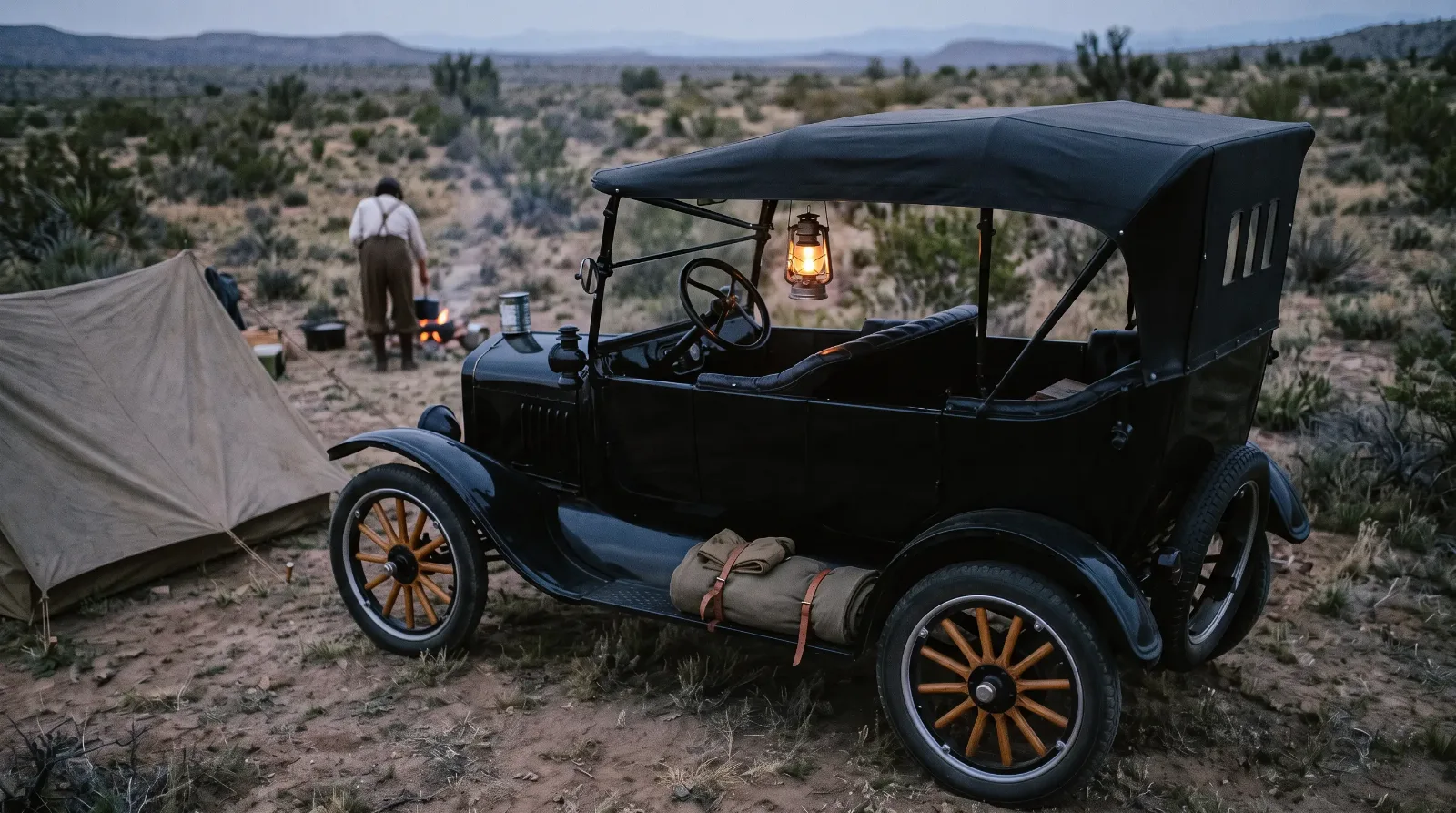
A club born in a Tampa campground
The Tin Can Tourists of the World were organized at De Soto Park in Tampa, Florida, during the winter of 1919 to 1920. The club's own pages give slightly different versions of the start. One anniversary post dates the founding to 1919, with a state charter a year later. The fuller club history describes 22 camping outfits gathered on December 1, 1919, and an organizing meeting in January 1920. Either way the place and the season are the same.
The founder is recorded as James M. Morrison of Illinois, who became the first "Royal Chief," a title that tells you something about the tone of the thing. This was a fraternal order for people sleeping in tents, and it borrowed the ceremony of the lodges its members knew from home. Its stated objective was "to unite fraternally all auto campers." The first annual convention followed at De Soto Park in the winter of 1920 to 1921.
The name needs a careful answer. The club's history ties "tin can" to two things: the canned food that campers lived on, and the tin cans members fixed to their radiators as an identifying sign. You will also read that the name was a nod to the Model T's "Tin Lizzie" nickname. The club's own history does not make that link. It cites a 1936 magazine piece saying the name came from the campers' food, not their cars. The safer reading is the club's own: cans of food and cans on radiators. The nickname has its own tangled history, told in our Tin Lizzie story.
Why tin can tourists belong to the Model T era
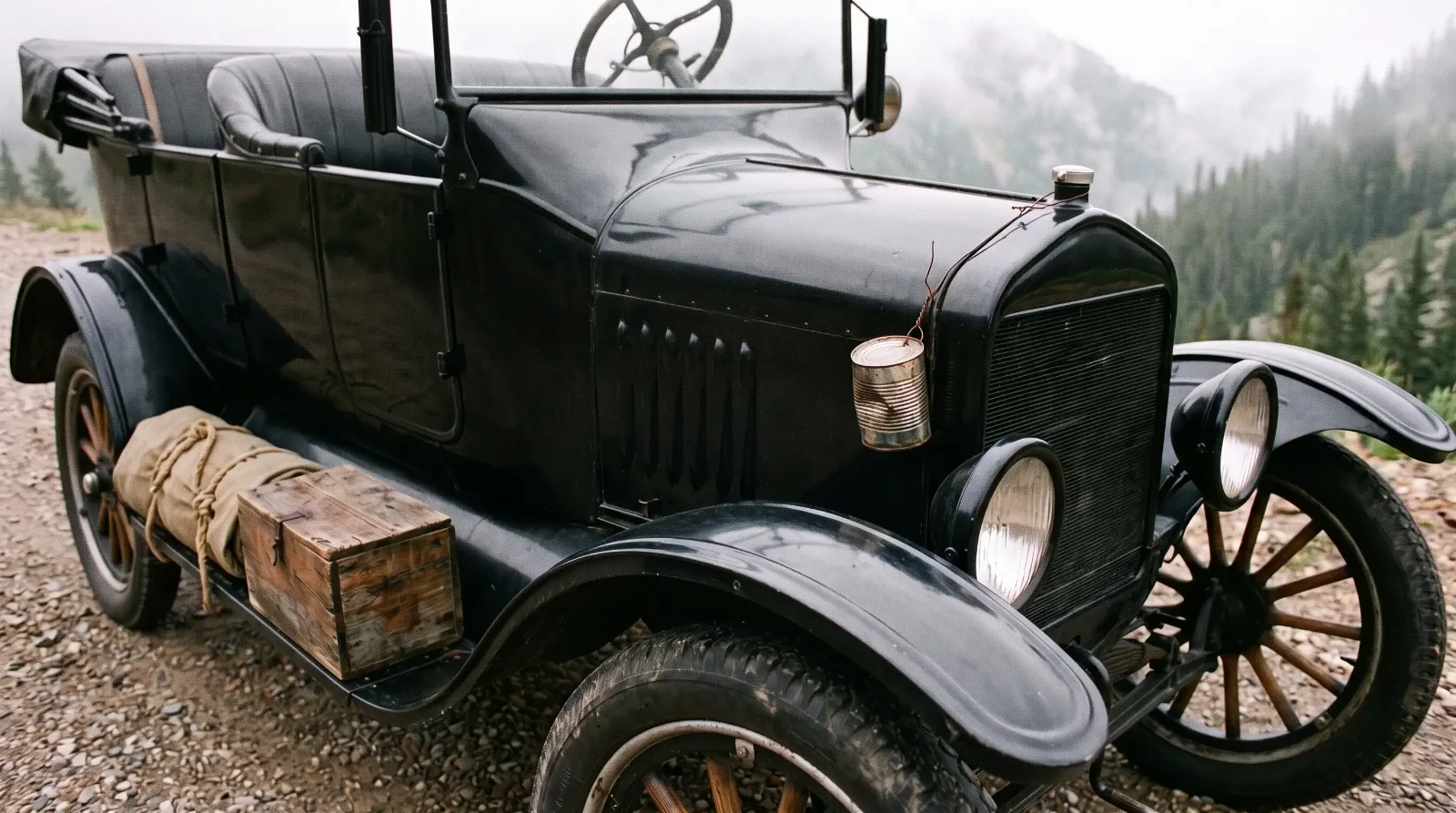
Nobody kept a count of what members drove over the decades, so it would be wrong to call it a Model T club. Still, the club's own history says most of those at the early De Soto Park gathering were Model T owners, and the timing is not a coincidence. The club formed in the years when the Model T was the dominant car in America. Ford built 1,817,891 Model Ts in the US in calendar 1923 alone, the peak year, and in 1923 a Model T Touring car listed at $298. For the first time a family of modest means could own a car able to carry them, their tent and their supplies a thousand miles south for the winter.
The Model T suited the life in practical ways. It was simple enough to fix at the side of the road with ordinary tools, parts were sold in almost every town, and it rode high enough to cope with the rutted roads between the Midwest and Florida. The touring body, open on the sides with a folding top, could be loaded to the fenders. The founder himself came from Illinois, and the club's summer reunions in the north, at places such as Traverse City, Michigan, suggest how many members made the long run south and back each year.
The camp itself was part of the attraction. In a city park, with water, a place for the tent and a crowd of other travelers, a family on a tight budget could spend weeks somewhere warm without paying for a hotel. The cheap car changed who could make that trip, and who could drive it, a shift described in women at the wheel.
"What strikes me about the tin can tourists is how ordinary they were. They were not explorers. They were people who had just got their first car and realized it could take them somewhere warm for the winter. That idea started in a Tampa park, and it has never really left us."
Patrick Walsh
Conventions, reunions and a long decline
After the first convention the club settled into a rhythm of winter meets in Florida and summer reunions further north, following the migration of its members. Sarasota hosted the winter gatherings from 1932 to 1938. By then the Model T had been out of production since May 1927, and the cars arriving in the campgrounds were newer models. Membership is said to have peaked in the mid-1930s. The figures collected in the club history do not agree: one timeline gives 150,000 members by the mid-1930s, a 1939 magazine caption gives 97,000, and a 1938 club booklet counts about 43,500 names on its filing list since membership cards began in 1933. None of them has been reconciled, and all should be read as rough.
The club kept going long after the camping style that created it had changed. Its last convention was held at Eustis, Florida, in 1968. By then the roadside motel, the trailer park and the interstate had replaced the tent beside the touring car, and the fraternal order of autocampers had become a memory.
| Year | Tin Can Tourists milestone |
|---|---|
| Winter 1919 to 1920 | Club organized at De Soto Park, Tampa; James M. Morrison of Illinois first Royal Chief |
| Winter 1920 to 1921 | First annual convention, De Soto Park |
| 1927 | US Model T production ends in May |
| 1932 to 1938 | Winter meets held in Sarasota, Florida |
| Mid-1930s | Peak membership (figures disputed) |
| 1968 | Last convention, Eustis, Florida |
| 1998 | Club revived by Forrest and Jeri Bone at Camp Dearborn, Milford, Michigan |
| 2019 | About 2,300 members |
The revival, and what it remembers
In 1998 Forrest and Jeri Bone revived the Tin Can Tourists at Camp Dearborn in Milford, Michigan. The modern club promotes and preserves vintage trailers and motor coaches, though members do not need to own one, and by 2019 it had about 2,300 members. It is a different kind of club from the tent camps of Tampa, but it keeps the name and the spirit of the Tampa original.
What the revival remembers is more than a style of camping. The first tin can tourists showed that a mass-produced car could change the way ordinary people used their time, not just how they got to work or market. The Model T put millions of Americans behind the wheel; the tin can tourists were among the first to take that freedom and point it south for a whole season. It is a small chapter, but it explains a lot about how Americans still think about the road trip, the campground and the RV park.
For the bigger picture of how the Model T and the Model A changed American life, from the farm to the factory to the open road, read the long version.
Sources and notes
Related Reading
Have a
Ford Model T
for Sale?
Reach thousands of serious classic car collectors across the US.
Sell It Here →
Selling a classic? Here's how: sell my classic car
Are You a Classic Car Dealer?
List your full inventory and connect with targeted classic car buyers.
Join as a Dealer →

About the author
Patrick Walsh
Automotive journalist covering classic car shows, events, and the enthusiast community across North America.
Related Listings - Ford Model T
Comments
Be the first to comment on this article.