I have pulled apart more Monte Carlo dashboards than I can count, and the thing that always strikes me is how much effort Chevrolet put into a cabin most people assumed was just a dressed-up Chevelle interior. The monte carlo 1970 interior luxury pitch was not an afterthought bolted onto a muscle-car chassis. It was the actual sales argument, the reason a buyer paid more for this car than a well-optioned Malibu, and understanding what Chevrolet actually built into that cabin changes how you should think about restoring or buying one today.
The Strato-bucket seats and console as the centerpiece
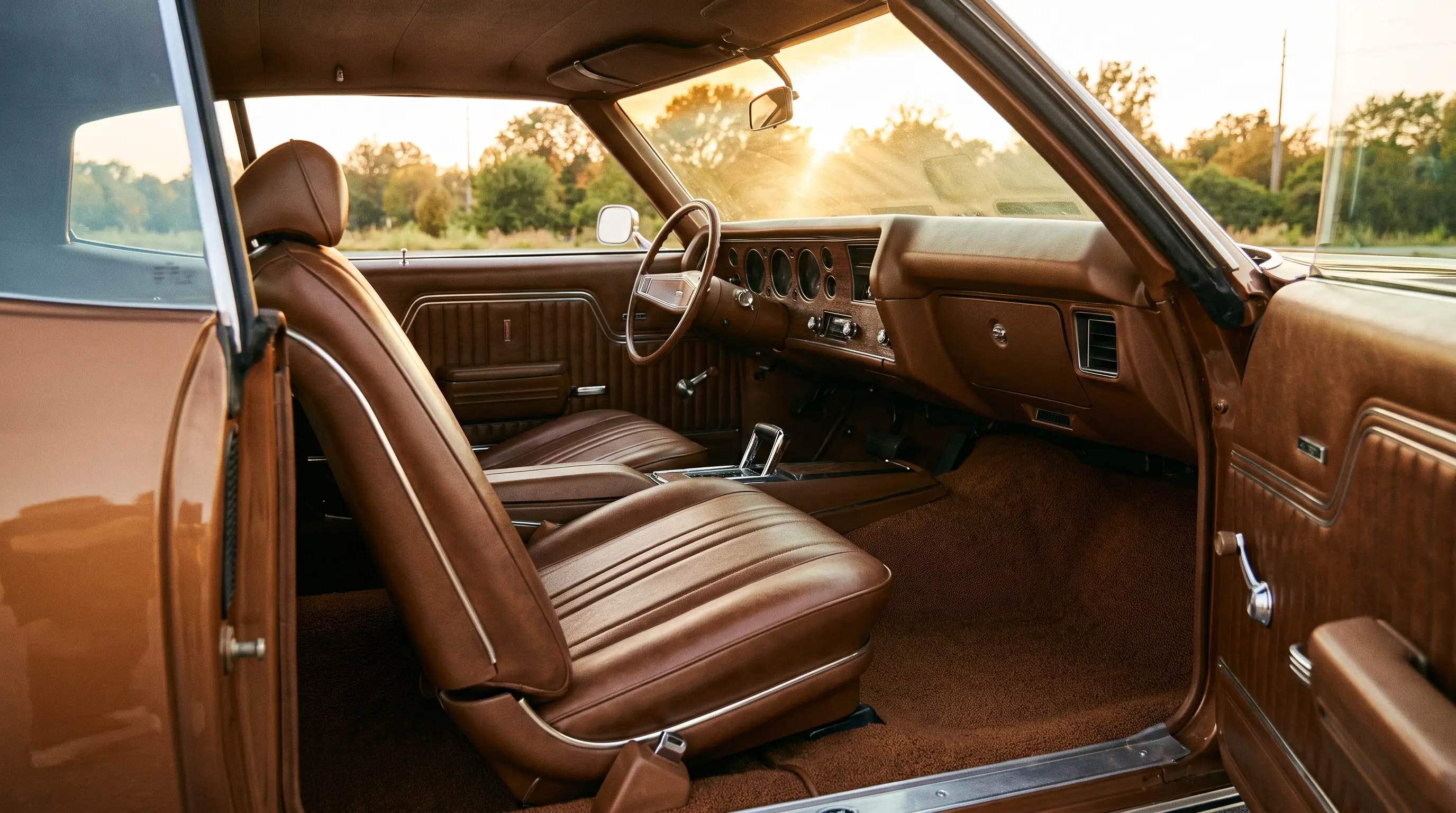
Chevrolet's Strato-bucket front seats, paired with a full-length center console housing the shifter and additional storage, were the single biggest departure from a standard bench-seat family car interior available at the time. These were not the thin, flat buckets found in cheaper compact cars of the era. They were shaped with genuine lateral support and deep cushioning, designed to read as a driver-focused cockpit even though most Monte Carlos left the factory with an automatic transmission and a buyer more interested in comfort than lap times. The console itself did real work, houses ash trays, a storage bin, and in higher trims additional gauges, turning what could have been dead space between the seats into a visual anchor for the whole cabin.
Simulated wood grain and why it mattered more than it should have
Genuine wood trim was reserved for far more expensive luxury cars in 1970, so Chevrolet leaned hard on simulated wood grain appliques across the dashboard face and door panels to signal luxury without the manufacturing cost of the real thing. From two feet away in a dealership showroom under fluorescent lighting, that distinction mattered far less to a shopper than the visual effect it created, and Chevrolet's designers understood this completely. The wood grain pattern ran continuously across the dash to visually widen the cabin, a trick borrowed from higher-end competitors and applied here at a price point most personal luxury coupe shoppers could actually afford. Restoring this trim correctly today means sourcing period-correct appliques rather than a generic modern wood-look vinyl, since the pattern, grain direction, and gloss level all differ enough between decades that a trained eye spots a mismatch instantly.
Fabric and color choices that sold the luxury story
Interior color and material choices carried as much weight as the hardware itself. Chevrolet offered cloth and vinyl combinations in shades built to feel upscale rather than utilitarian, deep-loop carpet replacing the thinner cut-pile found in cheaper Chevrolet products, and door panels with additional padding and stitched detailing that a standard Chevelle simply did not get. None of this was expensive in isolation, but stacked together across the entire cabin, it created a cohesive impression that a buyer was sitting in something meaningfully nicer than the mid-size Chevrolet lineup it was actually built from underneath. That layered approach, small upgrades compounding into a bigger perceived leap, is the actual engineering behind a "luxury pitch" that had almost nothing to do with mechanical sophistication and everything to do with material choices a buyer could see and touch.
Sound deadening and why the cabin felt different at speed
Beyond what a shopper could see, Chevrolet added extra sound deadening material and a firmer body mount setup specifically aimed at making the Monte Carlo feel quieter and more composed at highway speed than its Chevelle-family relatives. This is the kind of detail that never made it into a brochure headline but showed up immediately the first time a buyer took one for a test drive next to a standard Chevelle. Wind noise, road noise, and the general sense of mechanical isolation all mattered enormously to the personal luxury coupe buyer, arguably more than outright performance numbers, and Chevrolet's engineers clearly treated cabin refinement as a genuine priority rather than a marketing afterthought layered on top of an unchanged chassis.
"None of this was expensive in isolation. Stacked together across a whole cabin, it was enough to make a buyer feel like they had stepped up a full class from an ordinary Chevelle, and that feeling is exactly what Chevrolet was selling."
- Jim Vasquez
The instrument cluster and how it borrowed from higher trims
Chevrolet gave the Monte Carlo an instrument cluster laid out to feel more purposeful than a standard Chevelle's, with clean, legible gauge faces set against the same simulated wood grain treatment used across the rest of the dash. Higher trim packages added supplemental gauges beyond the base speedometer and fuel readout, giving the cabin a more complete, driver-oriented feel even on cars that most owners drove gently and rarely pushed hard enough to need that extra instrumentation. It was another example of the same underlying strategy at work throughout this cabin: borrow the visual language of a more expensive, more purposeful car, apply it convincingly at a lower cost, and let the buyer's eye do the rest of the selling. That approach required real design discipline to pull off without looking cheap, and forty-plus years later, an original, unmolested instrument cluster remains one of the more difficult interior components to source in good condition, since so many were damaged by sun exposure or swapped out for later aftermarket gauge clusters over the decades.
What this means for anyone restoring the cabin today
The interior details covered here are exactly where a restoration lives or dies on authenticity, because the individual components, seat foam density, console material, wood grain pattern, all get replaced piecemeal over fifty years by well-meaning owners using whatever reproduction parts happened to be available at the time. A shop that understands the original luxury pitch treats every one of these small choices as part of a single coherent design statement rather than a checklist of parts to replace with whatever fits. Readers wanting the full debut-year context behind why Chevrolet built this cabin the way it did should where this started for the complete history. Anyone ready to sit in one of these cabins in person can start with classic Monte Carlo for sale listings and judge the luxury pitch for themselves, ideally with the door open and a hand on the console before any decision gets made from photos alone.
Sources and notes
- Auto Catalog Archive - 1970 Chevrolet Monte Carlo Brochure
- Legendary Auto Interiors - Monte Carlo Interior Catalog
- Wikipedia - Chevrolet Monte Carlo
- Curbside Classic - 1970 Chevrolet Monte Carlo
- Ate Up With Motor - Disco-Era Darling: The Chevrolet Monte Carlo
- SS396.com - 1970 Monte Carlo Restoration Information