Open the door on a serious Monte Carlo lowrider and the exterior stops being the whole conversation. The interior is where a lot of the real craft lives, and tuck-and-roll upholstery is the signature technique that separates a car somebody lowered from a car somebody built. We have sat in G-bodies where the paint outside was tasteful and clean, but the moment you dropped into the driver's seat and saw the diamond-stitched door panels and pleated headliner, you understood the owner's priorities went a lot deeper than the shell.
What tuck-and-roll actually means
Tuck-and-roll is a specific upholstery style where fabric or vinyl is stitched into parallel rolled channels, often with foam padding underneath to give each roll a soft, pillowed shape. The technique traces back to hot rod culture in Southern California decades before it became a lowrider staple, but lowrider builders took it further, applying it not just to seats but to door panels, headliners, trunk displays, and even dashboard sections. On a Monte Carlo, with its wide flat door panels and generous rear seat area, a skilled upholsterer has real canvas to work with.
The material choices matter as much as the stitch pattern. Classic tuck-and-roll used vinyl for durability and that distinctive glossy sheen under show lights, while higher-end builds moved to velour, crushed velvet, or even leather for a plusher, more formal feel that matched the Monte Carlo's original personal luxury positioning. Some builders leaned into that original identity on purpose, treating the interior work as an extension of what Chevrolet was already selling in 1978 through 1988, just taken to a level the factory never offered.
"A good tuck-and-roll job takes longer than the paint. Nobody believes that until they have watched somebody actually do it."
- Hector Morales
The hydraulic display as interior craft
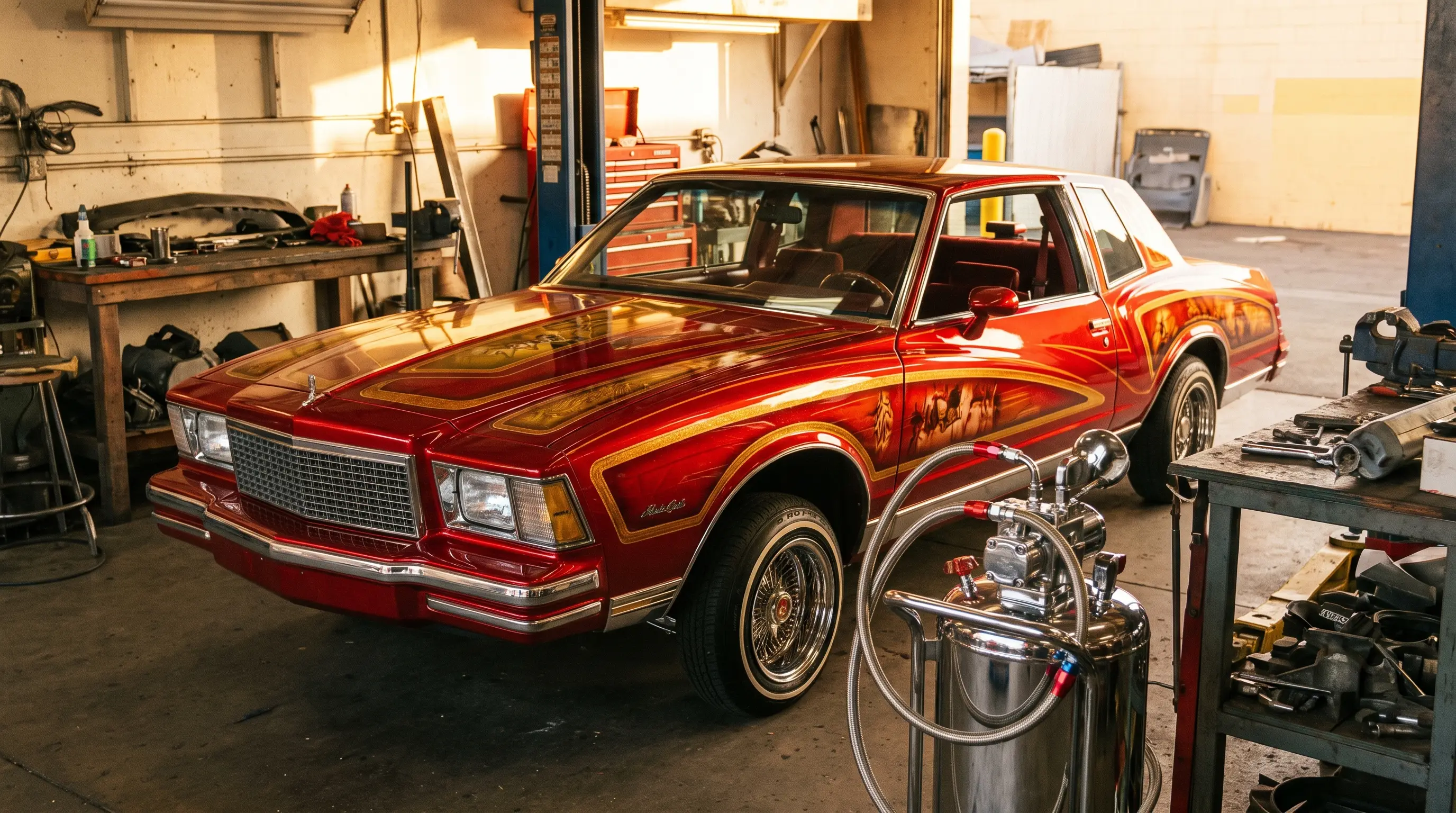
For a lot of Monte Carlo builds, the interior conversation does not stop at the seats. The trunk became its own showcase, with hydraulic pumps, chrome plumbing, and battery banks arranged with the same attention to symmetry and finish as the cabin itself. Mirrored panels, engraved plates, and neon accent lighting turned what could have been an ugly mechanical necessity into a second interior worth photographing on its own. Popping the trunk at a show was sometimes as big a moment as opening the driver's door.
This is where the Monte Carlo's G-body trunk space became a genuine advantage. Compared to some smaller platforms, the G-body offered enough room to build an elaborate multi-pump setup without the plumbing feeling cramped or the battery bank looking like an afterthought bolted in wherever it fit. Builders who wanted a show-caliber hydraulic presentation found the Monte Carlo cooperated with that ambition the way it cooperated with murals on the exterior.
Steering wheels, dashboards, and the small details
Beyond upholstery and hydraulics, the small custom touches carried real weight in how a Monte Carlo's interior got judged and remembered. Wood-grain or chain-link steering wheels, custom shift knobs, engraved dash bezels, and aftermarket gauge clusters all signaled a builder who thought through every surface a passenger's hand or eye might land on. None of these pieces individually made a car legendary, but together they created a cohesive statement that a rushed build could never fake.
Color coordination between the interior theme and the exterior paint scheme became its own discipline. A candy paint job outside with a mismatched or generic interior read as incomplete to anyone paying real attention, so serious builders planned the cabin alongside the body work from the start rather than treating it as a separate later step. That planning discipline is part of what the monte carlo lowrider story is really about, a culture where every component had to answer to the same vision.
Materials that shaped the era
The specific materials builders reached for tell their own story about the decades this culture spans. Vinyl dominated through the 1970s, chosen for cost and durability under Southern California sun. Velour became fashionable through the late 1970s and into the 1980s, offering a softer, plusher texture that matched the personal luxury identity Chevrolet was already marketing the Monte Carlo around. By the 1990s, some higher-budget builds moved toward leather, chasing a more upscale finish that could hold up to serious show scrutiny while still surviving daily use for owners who actually drove their cars regularly rather than trailering them to events.
Color choices followed their own logic too, often built around the exterior paint rather than chosen independently. A candy red exterior might pair with a matching red or contrasting white interior, while builds leaning into a specific cultural or religious theme sometimes carried that motif from the murals outside straight through to embroidered or painted imagery on the headliner and door panels. That level of coordination, planned from the earliest stages of a project rather than bolted on afterward, is part of what separates a truly complete build from one that just looks good in photographs from one angle.
Why the interior is the harder sell to buyers today
When a Monte Carlo with an original period custom interior comes up for sale today, it presents a real dilemma for buyers. Restoring worn tuck-and-roll work to its original quality requires finding someone who still practices the traditional technique properly, and that skill set is rarer now than it was during the style's peak decades. A torn or sun-faded interior on an otherwise solid car can be the single biggest cost line in a full restoration budget, sometimes rivaling the paint work itself.
That is worth knowing before you fall in love with a set of photos. If you want the full story on where the Monte Carlo came from before it ever met a lowrider builder's imagination, that context helps explain why the factory's own luxury ambitions for the car made it such fertile ground for this kind of interior craft in the first place. And if you are ready to start your own project, there are classic Monte Carlos on the market in every condition from turn-key show cars to honest projects waiting for their first custom interior.
Finding a specialist willing to do it right
For anyone taking on this kind of restoration today, the search for the right upholsterer matters as much as the search for the right car. A generalist auto trim shop can handle basic seat repairs, but true tuck-and-roll work, especially matching the depth and consistency of an original period build, requires someone who has actually apprenticed under the technique rather than learned it from a modern instructional video. These specialists exist in most regions with an active lowrider community, but they are not always easy to find through a simple search, and word of mouth within local car clubs remains the most reliable way to track one down.
A craft that outlived its trend cycles
Interior styles in lowrider culture have shifted over the decades, from vinyl to velour to leather and back again as tastes cycled through, but tuck-and-roll itself never really left. It remains the technique builders reach for when they want a Monte Carlo's cabin to say the same thing the paint outside is already saying, that this car was finished with intention from the frame rails to the headliner.
Sources and notes
- Chevrolet Monte Carlo, Wikipedia
- The History of Lowrider Cars, Gauge Magazine
- 1972 Monte Carlo Becomes a Nationwide Lowrider Showstopper, Motorious via Yahoo Autos
- Carros y Cultura: Lowriding Legacies in Texas, Texas Standard / Bullock Texas State History Museum
- Amigos Car Club Collection, University of San Diego Lowrider Archival Project