
Mustang II engines get judged by one sentence: there was no V8 in 1974. That sentence is true, and it is the least useful thing you can say about them. Ford offered three engines across five model years. A 2.3-liter four was the base engine, a 2.8-liter Cologne V6 was the step up, and the 302 V8 arrived for 1975. None of them made big power. All of them were rated in SAE net horsepower under early emissions rules, which is why the numbers look thin next to anything from 1970. This piece covers what each engine made, year by year, and why the published figures refuse to agree. For the rest of the car, start with our Mustang II guide.
Car Features
8 min read
Mustang II Engines: 2.3 Four, Cologne V6 and the 302
Mustang II engines year by year: the 2.3 Lima four, the 2.8 Cologne V6 and the 302 V8, what each was rated at and why the sources disagree.
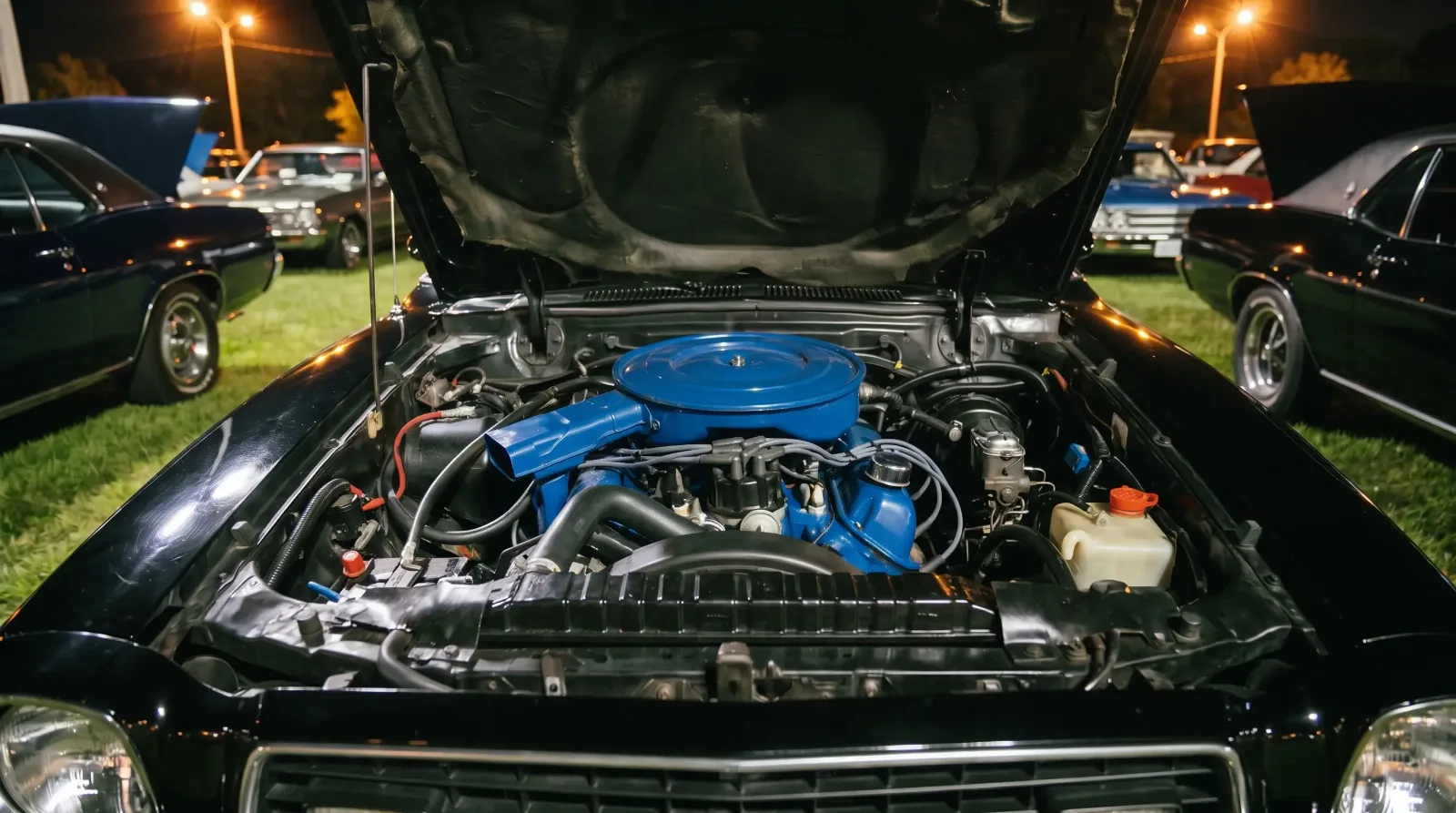
The Mustang II engines at a glance
Start with the table, then the detail. Every rating below is SAE net. The industry switched from gross to net ratings for 1972, so a 1971 Mustang number and a 1974 Mustang number were measured on different terms. Put them side by side and you are comparing a brochure figure with a figure taken with the accessories and exhaust fitted. They don't line up, and they were never meant to.
| Engine | Size | Years | Rated output (SAE net) | Notes |
|---|---|---|---|---|
| 2.3 Lima SOHC four | 140 cid (2.3 L) | 1974 to 1978 | 88 hp (1974); 83 hp (1975); about 88 to 93 hp (1976 to 1978) | Base engine; built in Lima, Ohio |
| 2.8 Cologne V6 | 171 cid (2.8 L) | 1974 to 1978 | 105 hp (1974); 97 hp (1975); about 93 to 104 hp (1976 to 1978) | Standard in the 1974 Mach 1 |
| 302 Windsor V8, two-barrel | 302 cid (4.9 L, sold as 5.0) | 1975 to 1978 | 122 hp (1975); 134 to 140 hp (1976); 139 hp (1977 and 1978) | 1978: 139 hp @ 3,600 rpm, 250 lb-ft @ 1,600 rpm |
Two things jump out. The ratings drop in 1975, and that is the catalytic converter, not a change of engine. And the 1976 to 1978 cells are ranges instead of single figures, because the reference sources disagree by a few horsepower. More on that at the end.
The 2.3 Lima four: the base engine
The base engine was a 2.3-liter overhead-cam four, 140 cubic inches, built at Ford's Lima Engine plant in Lima, Ohio. It debuted for 1974 in the Mustang II and the Pinto at the same time. So it did not come down from the Pinto, whatever the parking-lot version says. The two cars launched it together.
In 1974 it was rated at 88 hp. For 1975 Ford fitted catalytic converters and the rating fell to 83 hp. That is 5 hp gone from an engine that had none to spare. The later years settle back somewhere between 88 and 93 hp, depending on which source you read.
Ford didn't fight that number. It leaned into economy instead. The 1975 MPG model paired the 2.3 with a 3.18:1 axle in place of the standard 3.40:1, and the EPA rated it at 23 mpg city and 34 highway. In a showroom a year after the oil embargo, that was the job of the four. Behind it you could have a four-speed manual or the C3 three-speed automatic.
You will see it claimed that this was the first fully metric engine built in the United States. Leave that one alone. The sources contradict each other, and one says the Lima-built versions were made to imperial measurements. Until somebody settles it with Ford paperwork, it is a bar argument, not a fact.
What nobody argues about is how long the 2.3 lasted. It carried over into the 1979 Fox Mustang, picked up a turbocharger there, and in SVO form ran a Garrett T03 turbo and an air-to-air intercooler at about 14 psi. Ford only dropped the four from the Mustang when the 1994 car arrived. The engine people laughed at in 1974 stayed in the lineup for twenty model years.
The 2.8 Cologne V6: the Mach 1 engine
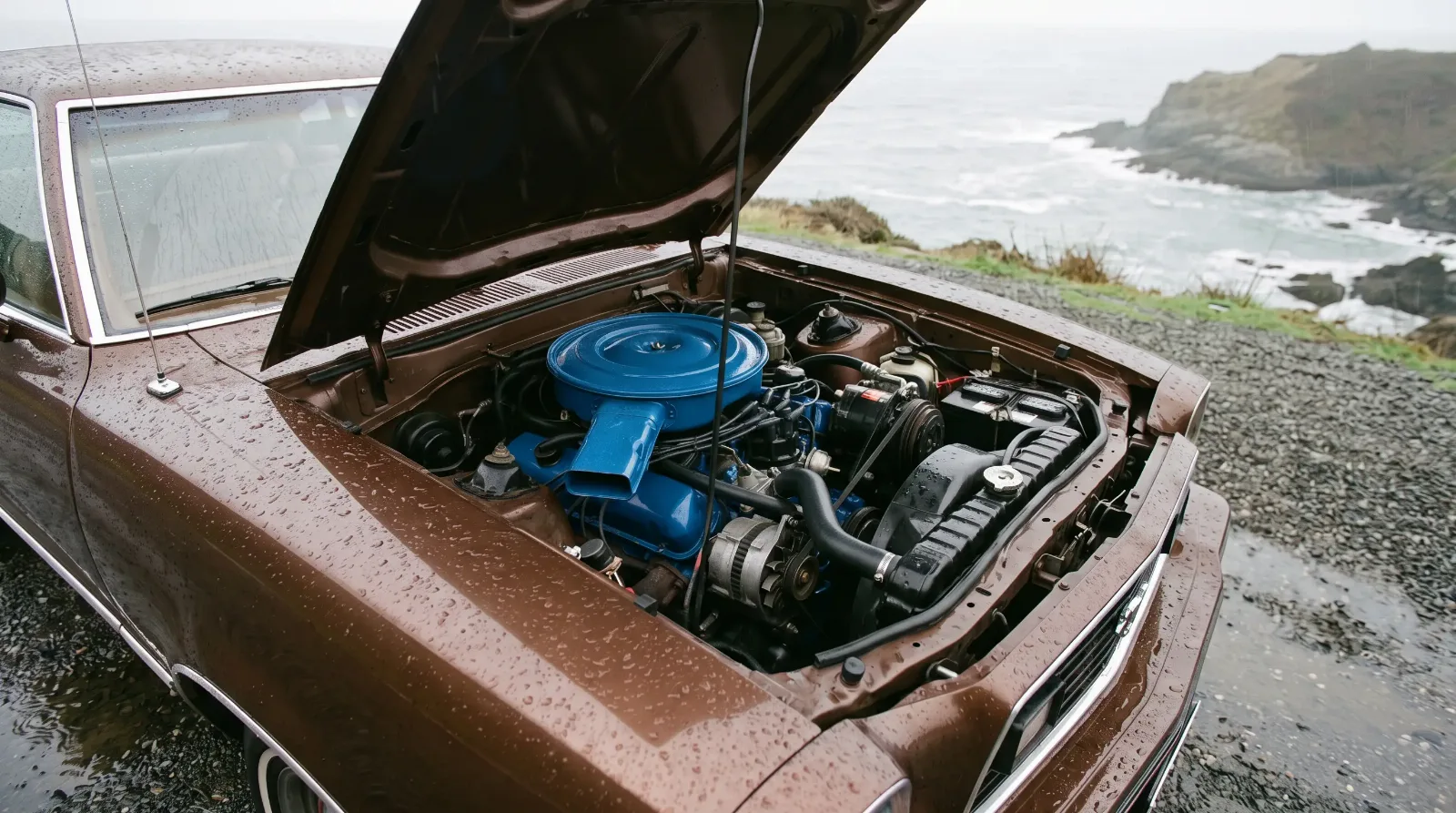
The step up was a 2.8-liter V6, 171 cubic inches, from the Cologne engine family, which takes its name from Cologne, Germany, where Ford built it. It was the option engine on the notchback and the hatchback, and it was standard in the 1974 Mach 1. That year it made 105 hp, 17 more than the four.
Then 1975 took its cut. With catalysts fitted, the V6 fell to 97 hp. For 1976 to 1978 the sources list anything from 93 to 104 hp, and I would not build an argument on any single figure in that range. In some years the gap to the four shrank to a handful of horsepower. What the V6 still had was two more cylinders and 31 more cubic inches, and in a car this size that shows up as smoothness more than speed. That is what a V6 buyer was paying for.
The Cologne V6 also outlived the Mustang II, briefly. It went into the 1979 Fox car rated at 109 hp, and Ford dropped it late in that model year because of supply problems.
The 302 V8, 1975 to 1978
The V8 came back for 1975, and the full story of that decision is in our piece on the V8 returns. Here I only care about the engine. It was the 302 cubic inch Windsor small-block, 4.9 liters, marketed as a 5.0, breathing through a two-barrel carburetor. Ford had to rework the front fenders, the engine bay and the header panel to get it in.
For 1975 it was automatic only, and a V8 car had to have power steering and power brakes. The rating is where the sources fight. Some print 140 hp for 1975, and a later Ford fact sheet says 130. Two independent sources and a third reference give 122 hp, and 122 is the number I trust for that first year. By 1977 and 1978 the rating was 139 hp. The 1978 figures are the cleanest on record: 139 hp at 3,600 rpm and 250 lb-ft at 1,600 rpm, fed by a Motorcraft 2150 two-barrel.
That torque peak is the number worth reading. Peak torque at 1,600 rpm means this engine did its work low in the rev range, where a small car with an automatic spends most of its life. It was never a revver, and nothing in its spec sheet pretends otherwise.
The stopwatch agrees. Road & Track timed a 1975 V8 car at 10.5 seconds to 60 mph, with a top speed of 106 mph. Consumer Guide ranked the 1975 V8 last in its Low-Priced Sport Car class. A four-speed manual became available with the V8 for 1976, through a new Sports Performance Package, and the C4 automatic was the box behind the 302 when you didn't take the stick. The 1978 King Cobra came only with the 302, four-speed standard and the C4 optional. Under that big hood decal sat the same 139 hp two-barrel engine any other 1978 V8 car had.
"Everybody quotes the 139 hp and laughs. Read the other line on the sheet: 250 lb-ft at 1,600 rpm. That is a street engine. It was built to pull a car away from a light with an automatic, and it did that fine. It was never built to win a drag race, and nobody at Ford said it was."
Dan Reeves
Why the ratings disagree, and how to read them
Pull up three Mustang II spec pages and you will get three answers for the same engine in the same year. The 1976 V8 is the worst case: 134, 139 and 140 hp all appear. Most of that is reference sites copying from different brochures and different years, then repeating each other. I have not seen a primary Ford table that settles every year, so treat a spread of about 5 hp as noise, not as a hidden higher-output engine.
What is not noise is the 1975 drop. Catalysts cost the four 5 hp and the V6 8 hp, and the V8 came back in that first catalyst year, so it never had a pre-converter rating to lose. Any comparison between a 1974 car and a 1975 car has to start there.
If you are trying to work out which engine a car left the factory with, the VIN is quicker than the spec pages. The Mustang II used the same 11-character layout as the earlier cars, with a single engine letter after the body code: Y for the 2.3, Z for the 2.8 and F for the 302. A car that reads Y and has a V8 in it has had an engine swap at some point.
None of these engines is why the Mustang II still turns up in garages decades later. The part builders kept was underneath the engine, and that is a separate story: the Mustang II front end's second life in hot rods. The engines did what Ford asked of them in 1974. Ford just wasn't asking for much.
Sources and notes
- Ford Mustang (second generation): engines and ratings by year, Wikipedia
- Mustang facts, 1974 to 1982, Ford Motor Company press release (archived copy)
- 1975 Ford Mustang: the V8 returns, MustangSpecs
- 1976 Ford Mustang engine specifications, MustangSpecs
- Preserving the breed: the 1974-78 Mustang II, Mac's Motor City Garage
- Classic Ford VIN decoder: 1973 to 1980 engine codes, CarCheckerVIN
Related Reading
Have a
Ford Mustang
for Sale?
Reach thousands of serious classic car collectors across the US.
Sell It Here →
Selling a classic? Here's how: where to sell your classic car online
Are You a Classic Car Dealer?
List your full inventory and connect with targeted classic car buyers.
Join as a Dealer →

About the author
Dan Reeves
Performance engine builder from North Carolina's motorsports corridor, focused on swaps, forced induction and making real, repeatable power.
Related Listings - Ford Mustang

Comments
Be the first to comment on this article.