
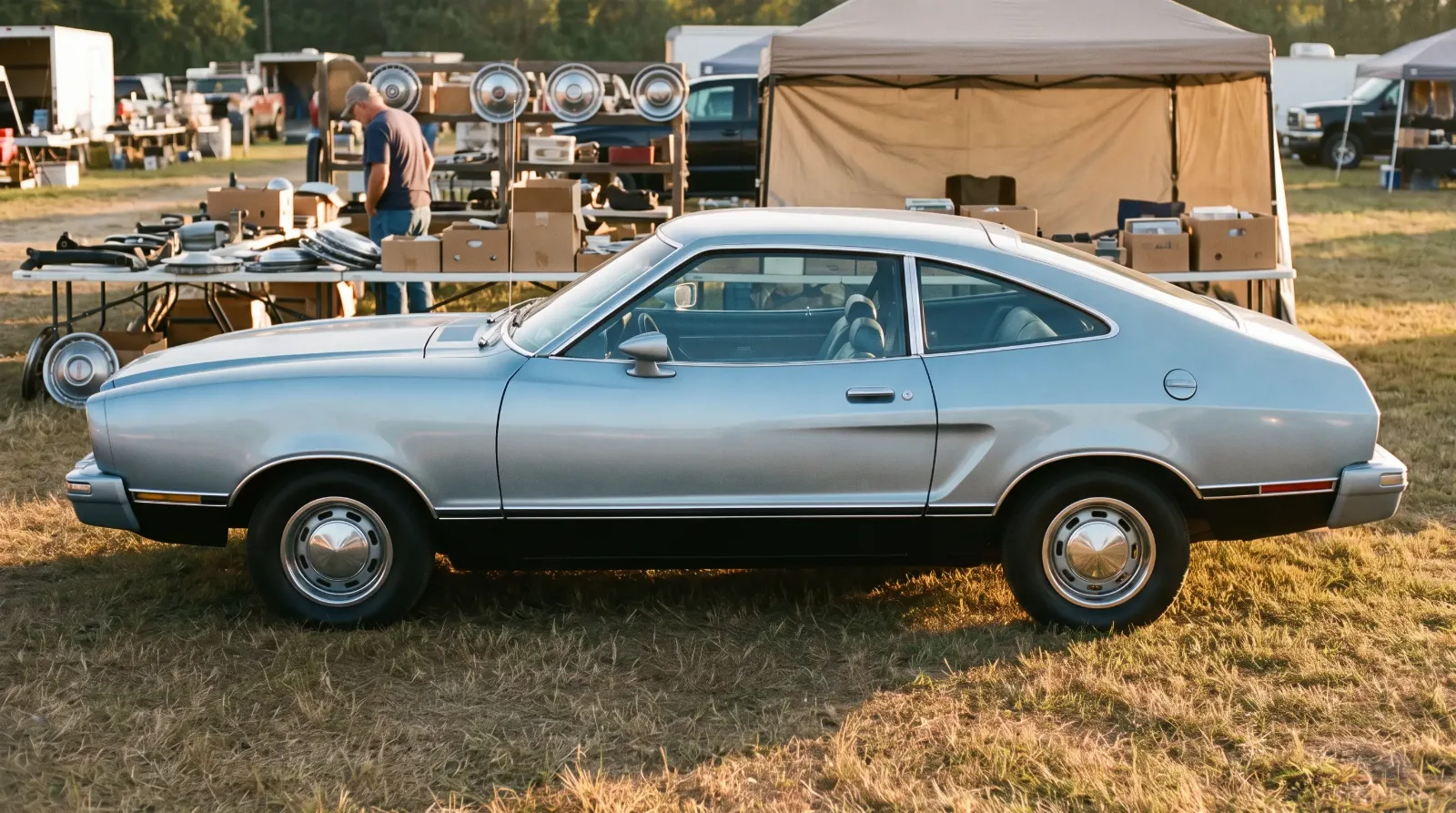
The 1975 Mustang II V8 fixed the one thing a lot of people could not forgive the 1974 car for. For a full model year Ford had sold a Mustang with no V8 on the order form, and for 1975 the 302 came back. It was not a fast car. By the standard of the cars that wore the name ten years earlier it was not even a quick one. But it put eight cylinders back between the fenders, and that did more for the Mustang's future than the horsepower figure ever could.
Car Features
8 min read
The 1975 V8 Returns
The 302 came back for 1975: new fenders and header panel, automatic only, power steering and brakes required, 122 hp in the first catalyst year.
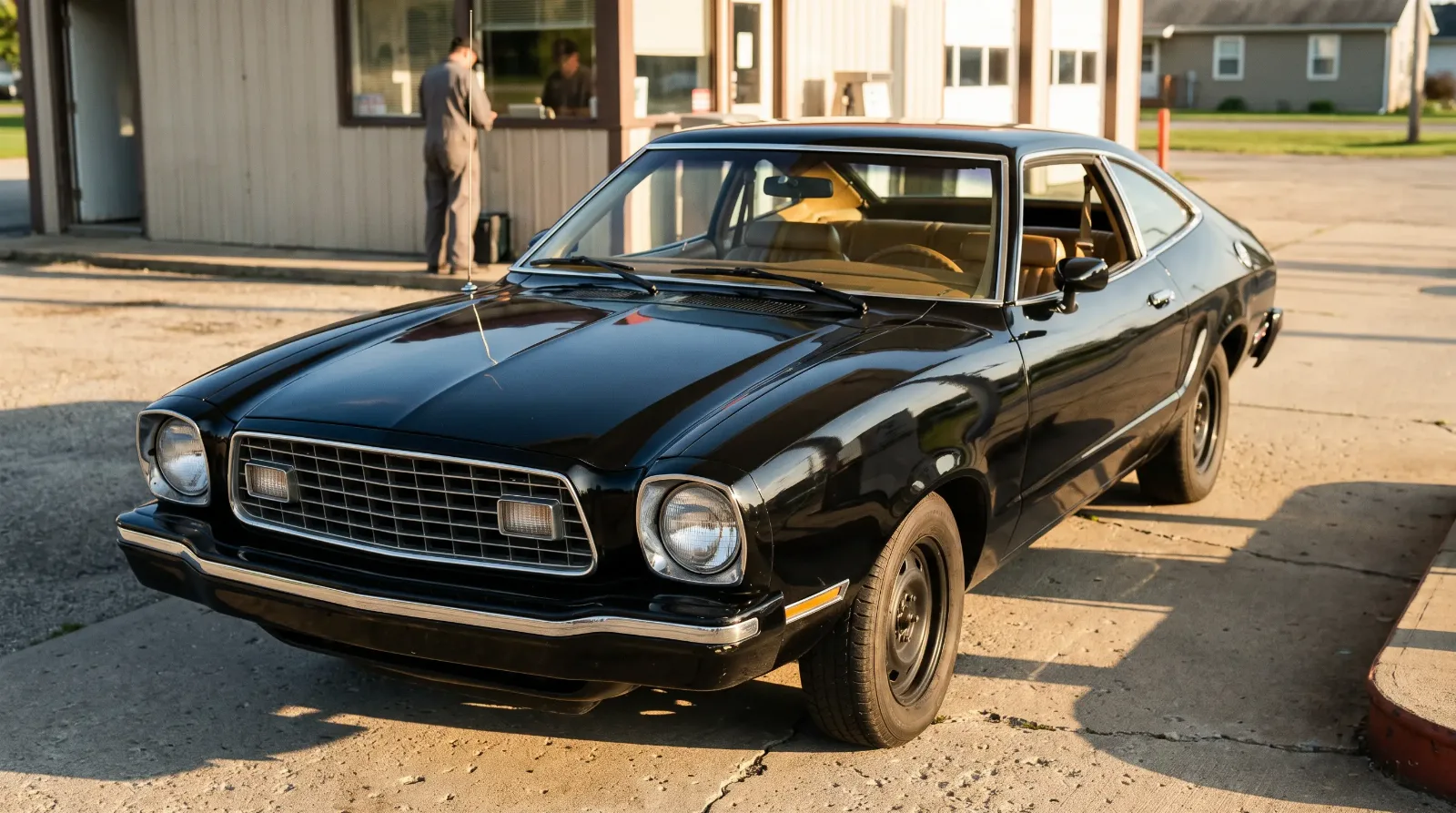
The full story of the 1974 to 1978 Mustang is told elsewhere, from Iacocca's brief to the last King Cobra (the 1974 to 1978 Mustang gets its own long read). This piece stays on one narrow question. What did it take to put a V8 back in the car, what strings did Ford attach to it, and what did a 1975 buyer actually get for checking that box?
A Mustang with no V8 was never going to last
Start with what 1974 offered. The 2.3 liter Lima four made 88 hp. The 2.8 liter Cologne V6 made 105 hp. That was the whole menu for U.S. buyers, and it made 1974 the first Mustang model year without a V8. Ford still sold a V8 Mustang that year, just not here. It went to Mexico.
Here is the part people forget. The 1974 car sold. Ford built 385,993 of them, the best Mustang total since 1967. So the V8 did not come back to rescue a sales flop. My read is simpler than that. A Mustang without a V8 was a Mustang with a hole in the brochure, and a hole like that does not stay quiet for long.
The Mach 1 made the hole obvious. In 1974 its standard engine was the 2.8 V6, and the V6 was as big as it got. Anybody who remembered what the Mach 1 badge stood for in 1969 could do that math in the showroom. For 1975 the badge finally had a V8 to back it up, at least on the option sheet: the 302 was an option on the Mach 1 like the rest of the line.
Making the 1975 Mustang II V8 fit
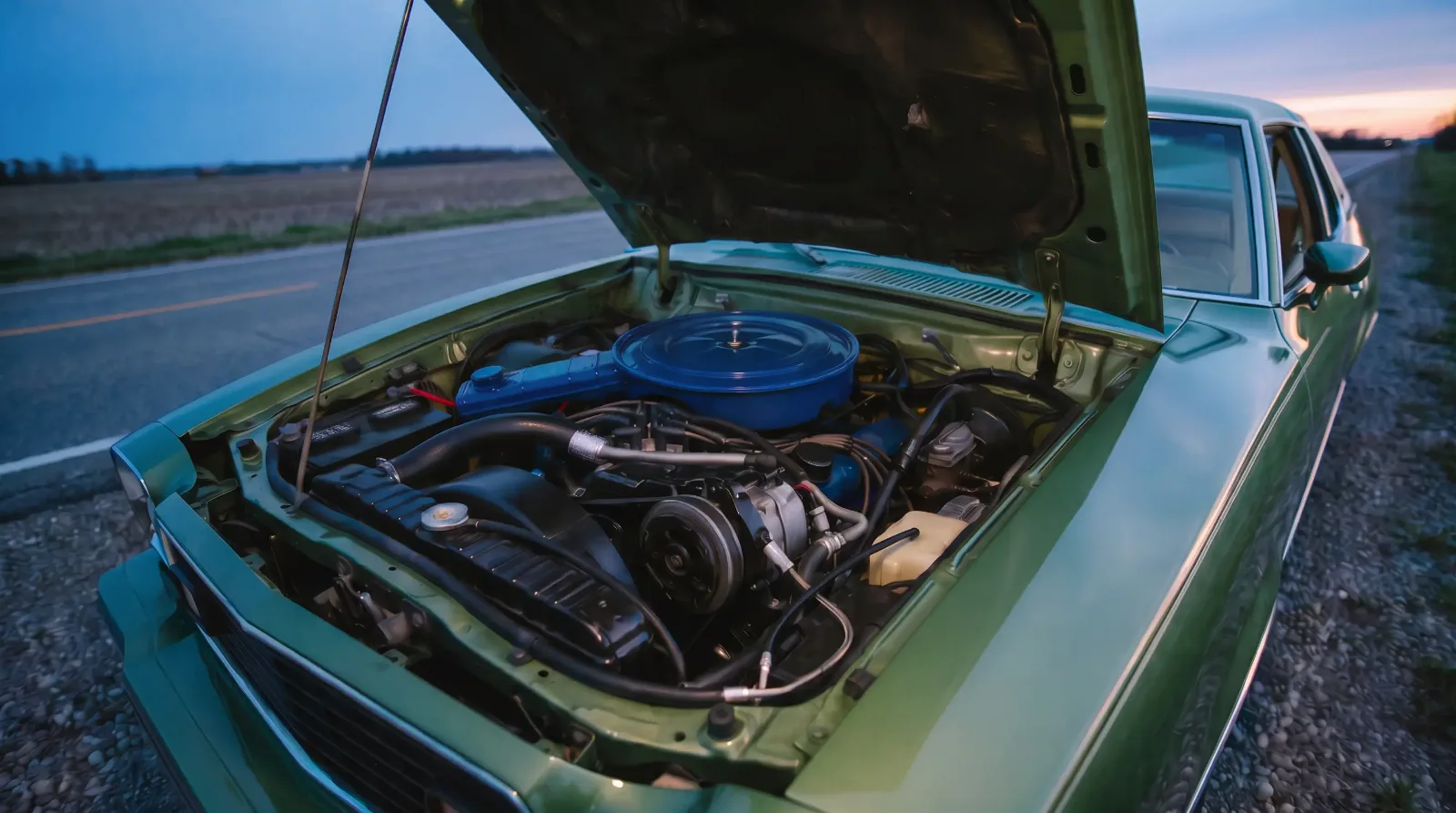
The engine was the 302 cubic inch Windsor small-block. That is 4.9 liters, though Ford marketed it as a 5.0, and it breathed through a two-barrel carburetor. Nothing exotic. It was the same family of small-block Ford had been putting in Mustangs since the start, detuned for a new decade.
Getting it into the Mustang II was the real job. This car was drawn around a four and a V6, on a 96.2 inch wheelbase, and the nose was sized to match. Ford had to change the front fenders, the engine bay and the header panel to make room. You don't re-stamp sheet metal for a whim, so the 302 was not a last-minute bolt-in. It was a production change with tooling behind it.
That change reached every car on the line, not just the V8 cars. For 1975 the grille opening got thinner and the grille itself got shallower on all models, four-cylinder hardtops included. So the V8 left its fingerprints on the face of every 1975 Mustang. If you are trying to tell a 1975 from a 1974 at a car show, that grille is the first place to look. Who drew the original shape, and where Ghia came into it, is a separate story, and our design piece has the details.
| Item | 1975 Mustang II V8 |
|---|---|
| Engine | 302 cid Windsor V8 (4.9 L, marketed as 5.0) |
| Induction | Two-barrel carburetor |
| Rated output | 122 hp (SAE net) |
| Transmission | Automatic only (C4) |
| Required options | Power steering and power brakes |
| 0 to 60 mph | 10.5 seconds (Road & Track) |
| Top speed | 106 mph |
| VIN engine letter | F |
Automatic only, with power steering and brakes attached
Checking the V8 box in 1975 came with a list. The 302 was automatic only, and the automatic behind it was the C4. A V8 car also had to have power steering and power brakes. No stick, no manual steering, no manual brakes. Ford did not hand you a stripped light car with a big engine in it.
I have not seen a Ford document that spells out why, and I won't make one up. The effect is plain enough. The 1975 V8 car was built to cruise. It was a smooth, quiet Mustang with some low-speed pull, and it was not built for the guy who wanted to row his own gears. That guy had to wait for 1976, when a new Sports Performance Package paired a four-speed manual with the V8.
122 horsepower in the first catalyst year
The 302 came back in a bad year to be an engine. For 1975 Ford fitted catalytic converters, and the whole lineup lost ground. The four dropped to 83 hp. The V6 fell to 97 hp. The V8 was rated at 122 hp. Some references print 140 hp for 1975, but the better sources agree on 122 for that first year, and that is the figure I go with.
On the road the numbers matched the rating. Road & Track timed a 1975 V8 car at 10.5 seconds from 0 to 60 mph, with a top speed of 106 mph. Consumer Guide ranked the 1975 V8 last in its Low-Priced Sport Car class. Consumer Reports, looking at the Mustang II as a small car rather than a sporty one, said in effect that buyers could find better subcompacts.
None of that surprises anybody who has driven one. The 302 in this car is not about top end. It is about the first fifty feet. A V8 with a two-barrel and an automatic gets a light car moving without drama, and in traffic that is what you feel. On paper it was a 25 hp gap over the V6. Behind the wheel it felt like more.
"Nobody bought a 1975 V8 car for the stopwatch. They bought it because it sounded like a Mustang again, and in that decade that was worth more than the horsepower number on the window sticker."
Mike Sullivan
What the V8 year changed, and what it didn't
The V8 did not hold the sales line. Ford built 188,575 Mustang IIs for 1975, less than half of the 1974 total. By body, that was 85,155 hardtops, 30,038 2+2 hatchbacks, 52,320 Ghias and 21,062 Mach 1s. What the factory figures don't show is how many of those cars got the 302. I have not seen a breakdown I would trust, and the same goes for what the V8 option cost in 1975. If someone quotes you an exact number for either, ask where it came from.
What the V8 did change was everything after it. Once the 302 was back in the car, it stayed. By 1978 it was rated at 139 hp. The Cobra II arrived for 1976 with any engine you wanted, and the 1978 King Cobra came with the 302 only, with 4,313 built. None of those cars would have made sense without the 1975 engineering that made room for the V8 in the first place.
The 302 carried on into the first Fox Mustang for 1979 before Ford swapped it for a 255 cubic inch V8 for 1980. That 255 made 118 to 120 hp, less than the 1975 engine did. So the first catalyst-era 302 was not the low point after all.
Today the 1975 V8 car gets less attention than the Cobra II and the King Cobra that followed it, and I think that is backwards. It was the year Ford admitted a Mustang needs a V8, and it changed the front of every car to prove it. If you go looking at the 1975 Mustangs that still turn up, open the hood before you look at anything else. An F-code car with its factory automatic and power options intact is the one that tells this story straight.
Sources and notes
- Wikipedia: Ford Mustang (second generation)
- Wikipedia: Ford Mustang Mach 1 (302 optional from 1975)
- MustangSpecs: 1975 Ford Mustang (V8 requirements, front-end changes)
- Mac's Motor City Garage: Preserving the breed, the 1974-78 Mustang II
- FordMuscle: Looking back, the 1974-78 Mustang goes back to basics
- Ford Motor Company: Mustang facts 1974-1982 (archived press release)
Related Reading
Have a
Ford Mustang
for Sale?
Reach thousands of serious classic car collectors across the US.
Sell It Here →
Selling a classic? Here's how: the best sites to sell a classic car
Are You a Classic Car Dealer?
List your full inventory and connect with targeted classic car buyers.
Join as a Dealer →

About the author
Mike Sullivan
Detroit-area muscle car enthusiast and restoration specialist with three decades of hands-on experience working on American iron.
Related Listings - Ford Mustang

Comments
Be the first to comment on this article.