
You dragged something out of a barn. Now you have to decide what it becomes. That decision is bigger than paint color or budget, because one of the two roads you can take does not have a return lane. Strip the original finish off a car and you can never put it back. You can fake it, but you can never put the real one back. So before you touch a wire brush, understand what you are actually choosing between, and why the answer is not automatically "restore it."
Car Features
7 min read
Preserve vs Restore a Barn Find
Recommission first, then decide. What preservation-class judging rewards, and why stripping a barn find's originality is a one-way door.
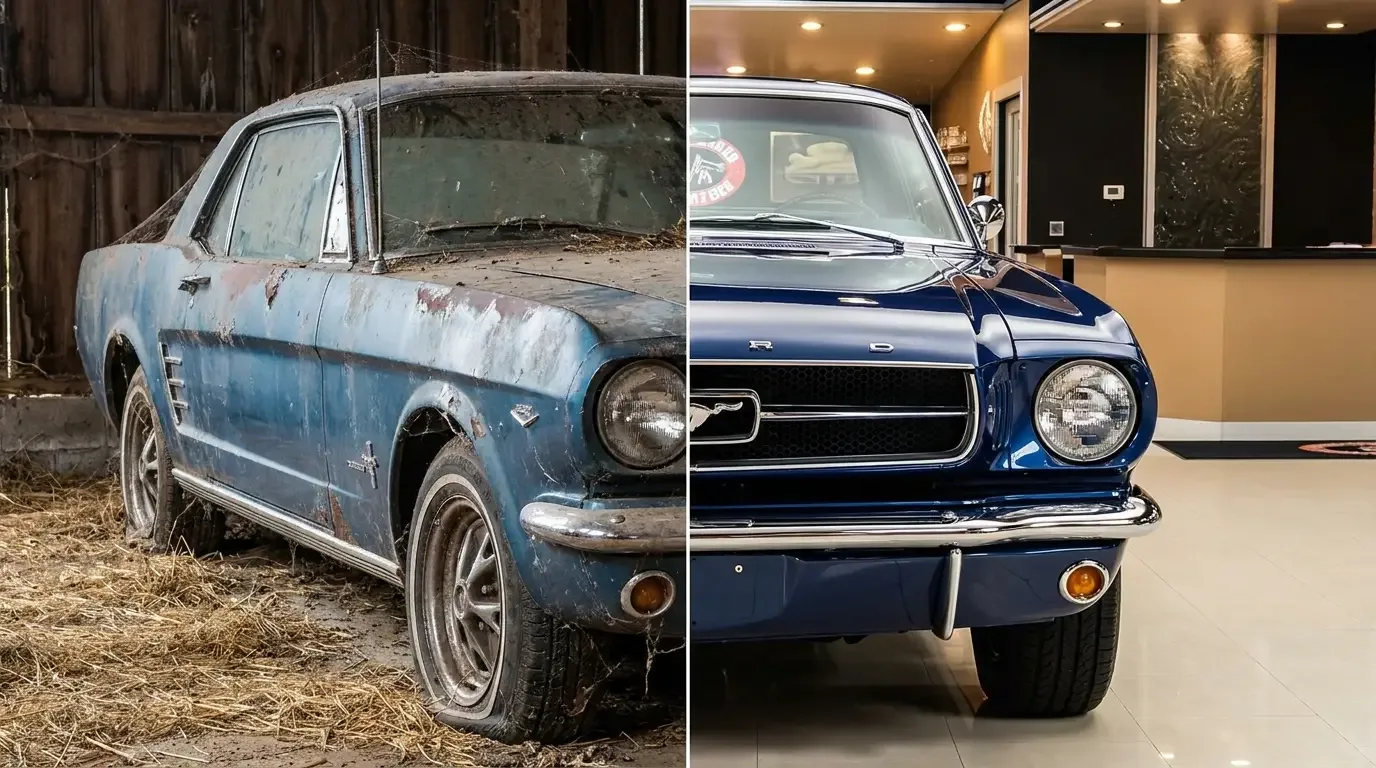
Preserve or restore is the first real fork in the road once you know what is a barn find and you have the thing home. I have wrenched on both kinds. I have brought a survivor back to running without disturbing a fleck of its original lacquer, and I have taken a rough one down to bare metal because it was too far gone to save. Both were the right call. The trick is telling them apart before you commit.
Recommission first, decide second
Whatever you eventually do, the first job is the same: get it safe to run and drive without destroying anything you might want to keep. That is recommissioning, not restoration, and the two get confused constantly.
Recommissioning means you go through the mechanical systems, the ones that kill people or fires, and you leave the cosmetics alone. Fuel that has turned to varnish gets flushed. Brake lines that have rusted from the inside get replaced. Old rubber, tires, and fuel hoses that crack under pressure get swapped. You drain and refill fluids, you check that the engine turns freely before you ever crank it, and you fix what stops the car from being a hazard. You do not sand, you do not repaint, you do not reupholster.
Here is the part people miss. Recommissioning a genuine survivor keeps every option open. A repaint closes one forever. So you always recommission first, get the thing running and stopping, then take a hard look at what you have before you decide whether it earns full restoration or deserves preservation.
What preservation-class judging actually rewards
People assume a show car has to be perfect. In a preservation class, the opposite is closer to the truth. Preservation judging rewards originality and honesty, not shine. A car that still wears its factory paint, its original interior, its date-stamped glass and its untouched engine bay scores because it is a document. It shows how the car actually left the line, not how a shop imagines it did decades later.
What gets rewarded in that world:
- Original finish, even faded, in place of a modern respray.
- Factory-correct hardware, markings, and assembly-line paint slop that a restoration would erase.
- Untouched interiors with honest wear over replaced upholstery.
- Documentation and provenance that prove the car is what it claims to be.
- Mechanical function, because a preserved car is still expected to run and drive.
Patina is the word everyone throws around. To a judge it means the genuine, earned aging of original surfaces. It is not the same as neglect, and it is definitely not the artificially distressed fake patina some builders spray on. Real patina cannot be manufactured, and that is exactly why it carries value. If you sand it off, you are not improving the car. You are deleting the one thing a fresh restoration can never reproduce.
"I tell every owner the same thing. You can always restore it next year. You can never un-restore it. The paint you strip on Saturday is gone for good, and no check you write on Monday buys it back."
Mike Sullivan
The one-way door, and how to decide which side you are on
Stripping originality is permanent. That is the whole argument in one sentence. Everything else is just figuring out whether a given car should walk through that door or not.
A car leans toward preservation when the original finish is largely intact, the interior is complete and honest, the numbers match, and it has documentation. Those cars are rare and getting rarer, because most of them already got restored in the 1980s and 1990s before anybody understood what they were throwing away. If yours survived that era untouched, think very hard before you change that.
A car leans toward full restoration when it is genuinely too far gone. Rust that has eaten structural metal, an interior that is missing or destroyed, a car that was already resprayed badly at some point so there is no original finish left to protect. If the originality is already lost, you are not destroying anything by making it correct and beautiful again. Restore that one and enjoy it.
Between those extremes sits the honest truth about most barn finds, which is that they are rough and ordinary rather than sleeping treasure. It is worth reading Barn Find Myth vs Reality before you talk yourself into preserving a car that was never special to begin with. Not every dusty survivor is a museum piece. Some are just a used car that sat too long.
| Factor | Lean Preserve | Lean Restore |
|---|---|---|
| Original finish | Largely intact, honest patina | Already resprayed or gone |
| Interior | Complete, original, wearable | Missing, destroyed, or replaced |
| Structure and rust | Solid metal, surface rust only | Structural rot, cut panels |
| Numbers and documents | Matching, well documented | Unknown or mismatched history |
| Rarity | Scarce, hard to replace correctly | Common, easy to source parts |
Tips before you commit to either road
The mistakes I see are almost always made in the first weekend, when somebody is excited and reaches for the sander before they think. A little patience up front saves a car that can never be un-saved later.
The history of the car matters too, not just its metal. Where it came from and who owned it can push a borderline case toward preservation, so learn the barn find story before you decide it is just another restoration candidate. A car with a real past is worth keeping honest.
My rule after decades of this is simple. When in doubt, preserve. You lose nothing by waiting, and you can always restore later if it turns out the car does not deserve the extra care. Go the other way and you are betting a permanent decision on a first impression. That is a bad bet, and it is one you only get to make once per car.
Sources and notes
- Concours d'elegance preservation-class judging guidelines and category descriptions.
- Marque club and registry guidance on originality, matching numbers, and documentation.
- Period factory assembly and finish references used to define "original" condition.
- Restoration-shop and preservation-specialist interviews on recommissioning practice.
- Collector-market and auction observations on survivor versus restored valuation.
Related Reading
Have a
Classic Car
for Sale?
Reach thousands of serious classic car collectors across the US.
Sell It Here →
Are You a Classic Car Dealer?
List your full inventory and connect with targeted classic car buyers.
Join as a Dealer →

About the author
Mike Sullivan
Detroit-area muscle car enthusiast and restoration specialist with three decades of hands-on experience working on American iron.
Comments
Be the first to comment on this article.