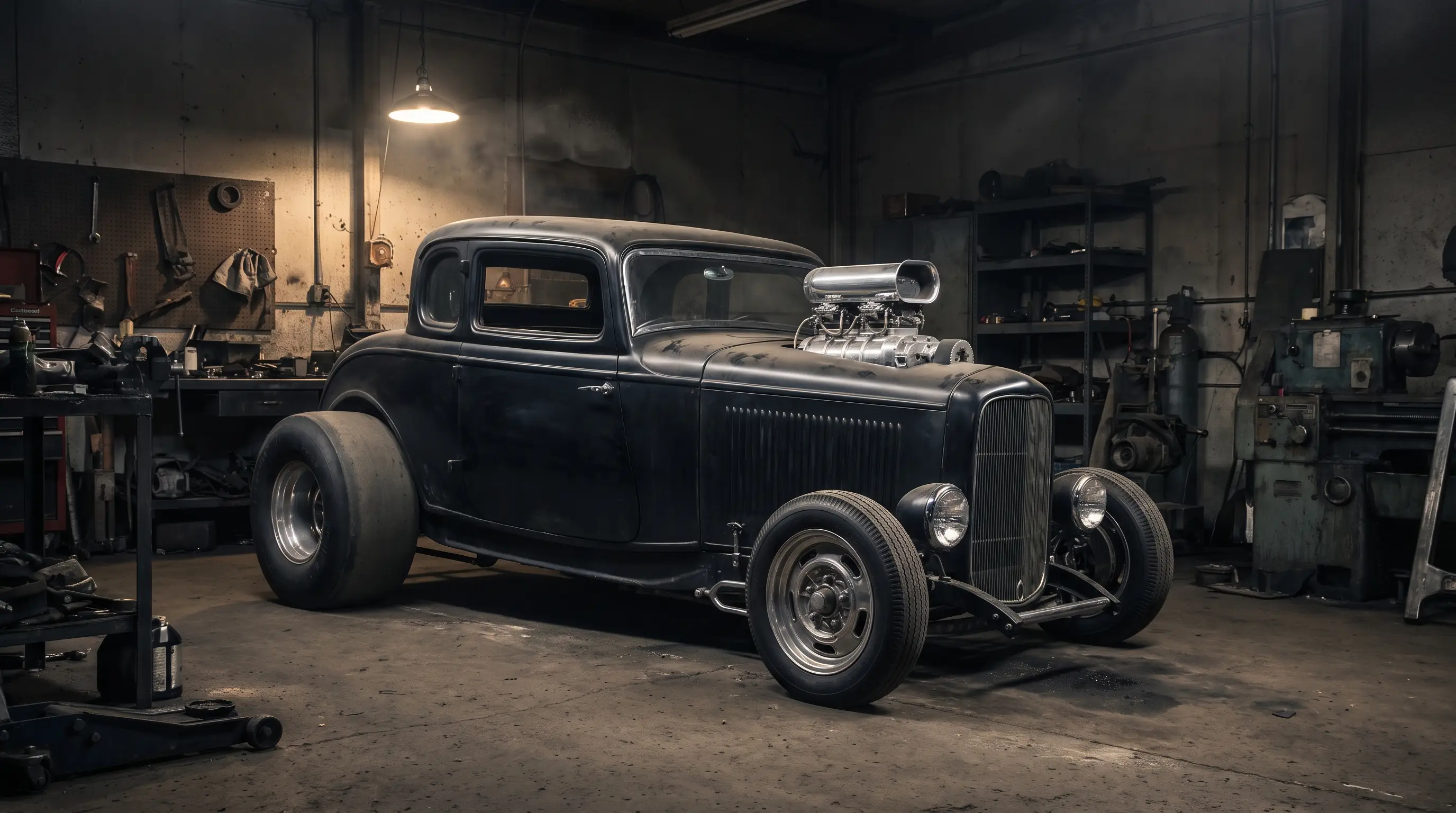
Ray Delgado bought his 1932 Ford three window coupe from a widow in Bakersfield who told him her husband had spent nearly a decade building it and never got to finish. It sat under a tarp for six years after that. Ray finished the job, and today his 32 ford pro street build runs a blown small block wrapped in patina paint that looks untouched but is not, sitting on a set of rear slicks that make the car's already legendary proportions look even more dramatic. The Deuce coupe has been the single most recognizable shape in hot rodding for close to a century, and giving it the Pro Street outlaw treatment turned out to be one of the boldest things builders ever did with it.
A shape that already carried decades of history
The 1932 Ford, known to every hot rodder simply as the Deuce, had already been the foundation of American hot rodding since the late 1940s, long before Pro Street existed as a term. Its combination of a compact wheelbase, a distinctive grille shell, and a body that hot rodders had been chopping and channeling for generations made it a natural fit once the Pro Street movement arrived in the late 1970s. Building a Deuce coupe in outlaw Pro Street style meant taking a shape everyone already recognized and pushing it somewhere nobody expected, tubbed rear fenders, a huge blower poking through the hood, and slicks filling out wheel wells that traditionalists had spent decades keeping period correct.
That tension between tradition and outlaw excess is exactly what made these builds controversial within hot rod circles. Purists who valued the Deuce's traditional hot rod lineage sometimes bristled at seeing it turned into a Pro Street drag machine, while builders chasing the outlaw look saw the '32 as the ultimate canvas precisely because of its history.
What made the outlaw style different
Outlaw Pro Street builds pushed further than mainstream Pro Street in almost every dimension, wider tires, bigger engines, and less concern for street legality or daily drivability. A 32 Ford in outlaw trim often ran without bumpers, without a full interior, and sometimes without a working exhaust system quiet enough for a residential street. These were show and strip cars first, cruisers a distant second, and owners generally knew that trade off going in.
| Detail | Typical outlaw Pro Street 32 Ford |
|---|---|
| Base platform | 1932 Ford three window or five window coupe |
| Common engine | Small block or big block Chevy, often supercharged |
| Body style split | Three window coupe favored for its sleeker roofline |
| Outlaw traits | Minimal interior, wide slicks, reduced street compliance |
| Cultural role | Bridge between traditional hot rodding and Pro Street excess |
The people who kept the tradition contentious and alive
What kept the 32 Ford Pro Street scene interesting for decades was the ongoing argument between camps. Traditional hot rodders had strong opinions about how a Deuce should look and drive, and outlaw Pro Street builders largely ignored those opinions in favor of raw spectacle. Both sides showed up at the same events, parked near each other, and argued about it, which is part of why the car has such a rich, contested history. The pro street trucks story covers a similar dynamic in a different corner of the movement, where practicality and outlaw excess collided in their own way.
"A Deuce coupe in outlaw trim is not trying to be tasteful. It is trying to be the loudest thing in the room, and most of the time it succeeds."
- Patrick Walsh
Color, patina, and the debate over how a Deuce should look
Finish choices on outlaw 32 Fords sparked their own set of arguments within the community. Some builders chased flawless, deep candy paint jobs that turned the car into a mirror finish showpiece, while others deliberately left bodywork rough, favoring bare metal, faded original paint, or intentional patina to signal the car's outlaw, unpolished attitude. Ray's own coupe falls into that second camp, and he says people at shows either love the look immediately or ask him when he plans to finish the paint, not realizing the unfinished look is the finished product.
That divide over finish mirrors the larger split between traditional hot rodding and outlaw Pro Street culture. Traditionalists tend to favor historically accurate paint and trim choices that would have looked plausible on a real 1950s or 1960s hot rod. Outlaw builders care less about historical plausibility and more about raw presence, which is part of why a patina finished Deuce sitting on modern slicks with a supercharger jutting through the hood reads as such a striking contradiction. It looks like two different eras of hot rodding fighting for control of the same car, and in a real sense, that is exactly what is happening.
Understanding the movement before you buy
Anyone new to this corner of the hobby should spend time understanding where Pro Street came from before diving into a specific build like a '32. For readers who want the full story on the movement's origins and what separates a genuine Pro Street car from a modern imitation, that background makes evaluating any individual build, including a Deuce coupe, far easier.
A shape that keeps drawing new builders
Despite nearly a century of history behind it, the Deuce coupe has never stopped attracting new builders willing to take on an outlaw Pro Street version. Every few years a fresh example surfaces at a major show, built by someone who grew up hearing stories about cars like Ray's and decided to add their own chapter. That steady trickle of new builds is part of why the outlaw vs traditional argument never fully dies down. There is always a new coupe, and a new builder with strong opinions about how it should look, ready to reignite the same conversation that has been running since the late 1970s.
Buyers ready to start looking can browse classic Pro Street cars on the market to compare available Deuce builds against other Pro Street platforms. Ray still gets asked at every show whether he would ever sell his coupe, and every time he says the same thing: he did not spend six years finishing another man's dream just to hand it off to someone who might let it sit under a tarp again.