
A rat rod earns its look with rust, junkyard iron and welds you did yourself in the driveway. None of that saves you when a light turns red and the pedal goes soft. Brakes and steering are the two systems where a cheap build has to stop being cheap. You can run a patina cab and a mismatched drivetrain and nobody gets hurt. Run marginal brakes and you are gambling with the car in front of you. This is where the budget stops being the point.
Car Features
7 min read
Rat Rod Brakes and Safety Basics
Cheap builds still need safe brakes. Front disc conversions, dual master cylinders, steering and seatbelts done right, without blowing the budget.
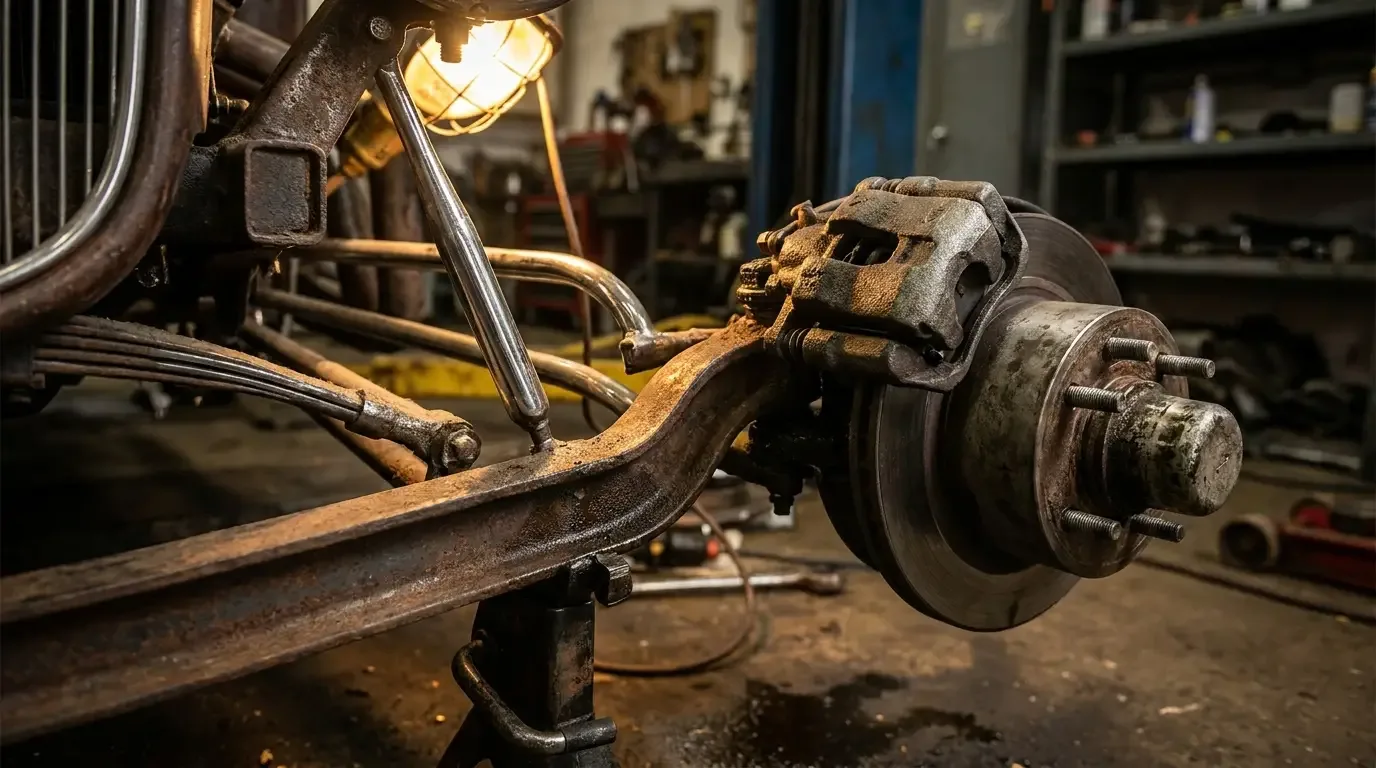
The good news is that doing it right is not expensive. A safe brake and steering setup on a rat rod costs less than most people spend on wheels. The parts are out there in junkyards and on the shelf. What it takes is refusing to skip the steps. If you want the wider legal picture, read up on are rat rods legal before you register anything. This piece is about the mechanical side: making the thing stop and steer.
Why marginal brakes kill the fun
Old cars were slow. A stock 1930s sedan had four drum brakes sized for a car doing 45 downhill with a tailwind. Drop a small-block in it, add modern tires and merge onto a highway, and those drums are now stopping twice the speed with twice the weight transfer. Single-circuit brakes are the real trap. One line, one master cylinder, one point of failure. A blown line or a leaking wheel cylinder and you have no brakes at all, not weak brakes.
Fade is the other killer. Drums trap heat. Grab them hard twice off a freeway ramp and the third stop is longer than the first. You feel the pedal sink and your stomach with it. On a light car with a heavy engine the front does most of the work, and if the front is drums, the front is where you run out of car.
Disc conversions on the front
Put discs on the front. That is the single biggest safety upgrade you can make and it is cheap. Front discs shed heat, resist fade and give you predictable pedal feel every stop. You do not need a boutique kit. A junkyard disc-brake spindle and hub off a common donor bolts a lot of this together for scrap-yard money.
- Common donor path: mid-size domestic sedans and trucks from the 1970s through 1990s give up single-piston floating calipers, rotors and hubs that fit a wide range of hot-rod front ends.
- Match the bolt pattern front to rear before you buy wheels. Sorting that out after the fact is how people end up with two sets of rims.
- Rebuild or replace the calipers. A seized piston or a torn dust boot is not worth saving to keep a stuck caliper. Rebuild kits are a few dollars.
- New rotors and pads. Do not run a warped junkyard rotor because it turns. You will feel the pulse and you will chase it forever.
Rear drums are usually fine to keep if they are in good shape, because the rear does less of the stopping. Inspect the wheel cylinders for weeping, replace the shoes if they are glazed, and turn or replace the drums. If you want rear discs too, fine, but front discs come first every time.
The dual master cylinder is not optional
If your build still has a single-circuit master cylinder, that is the first thing to change. A dual (tandem) master cylinder splits the system into two circuits, usually front and rear. Lose one, you still have the other. It is the difference between a scary stop and no stop.
Match the master cylinder bore to what you are running. Disc front and drum rear typically wants a proportioning valve so the rear does not lock before the front bites. And you want the right residual pressure setup for the combination. Get the geometry right too: pedal ratio matters, and a mismatched master and pedal gives you a rock-hard pedal that stops nothing or a soft one that goes to the floor.
"I do not care how the car looks. I care that when I stand on the pedal, all four corners answer. Single master cylinder on a car that does highway speed is a no from me. Change it before you drive it, not after the first close call."
Mike Sullivan
Steering, and the stuff people skip
Brakes get the attention. Steering fails quieter and worse. A rat rod front end often mixes parts: a dropped axle, a steering box off one car, a drag link fabricated to fit. Every joint in that chain is a place to get it wrong. Play in the box, a worn tie-rod end or a bump-steer problem from bad geometry will have the car darting at speed, and no brake job fixes that.
Check the whole chain from the wheel to the box. The steering shaft needs a real U-joint, not a welded slip-fit that can pull apart. Tie-rod ends and drag-link ends should be rated parts, torqued and cotter-pinned or safety-wired, never just threaded on and called good. If you fabricated a mount, gusset it. The load path from the tire to the frame has to be solid.
Seatbelts and the last line
Put belts in it. A three-point or a lap-and-shoulder harness bolted to the frame, not to sheet metal that will tear. Rusty patina bodies do not hold a bolt, so mount belt anchors to the frame or to a welded-in cross member with proper backing plates. It is a couple of bolts and it is the cheapest life insurance on the car.
Once the brakes, steering and belts are sorted, the rest of ownership is paperwork and upkeep. When you get there, our guide to Registering and Insuring a Rat Rod covers the DMV and coverage side. And if you want the bigger picture of where these cars came from and why they are built the way they are, go back to the story of the rat rod.
🔧 Inspection Priorities
- Master cylinder type. Confirm dual-circuit (tandem). A single-circuit master is a total-failure risk. Swap runs roughly $40 to $120 for a common unit.
- Front brakes. Discs preferred. Check for warped rotors, seized calipers, torn boots. Junkyard disc conversion plus new rotors and pads is often under $200.
- Brake lines and hoses. Look for rust-pitted hard lines and cracked rubber flex hoses. Replace anything questionable. Line and fitting kits are cheap; a burst line is not.
- Steering joints. Check the box for play, tie-rod and drag-link ends for slop, and confirm a real U-joint in the shaft. Rated ends run $15 to $40 each.
- Seatbelt anchors. Verify belts bolt to frame or welded structure with backing plates, never to rusty sheet metal. Belts and hardware, around $30 to $80 per seat.
Sources and notes
- Federal Motor Vehicle Safety Standard references for dual-circuit brake requirements (NHTSA / FMVSS 105).
- Period and current hot-rod and rat-rod build press covering disc conversions and master-cylinder swaps.
- Builder and wrench-turner interviews on junkyard disc-brake donor parts and steering fabrication.
- Chassis and brake-system reference manuals for proportioning, residual pressure and pedal-ratio setup.
- General DMV and vehicle-inspection guidance on brake, steering and seatbelt requirements.
Related Reading
Have a
Classic Car
for Sale?
Reach thousands of serious classic car collectors across the US.
Sell It Here →
Are You a Classic Car Dealer?
List your full inventory and connect with targeted classic car buyers.
Join as a Dealer →

About the author
Mike Sullivan
Detroit-area muscle car enthusiast and restoration specialist with three decades of hands-on experience working on American iron.
Comments
Be the first to comment on this article.