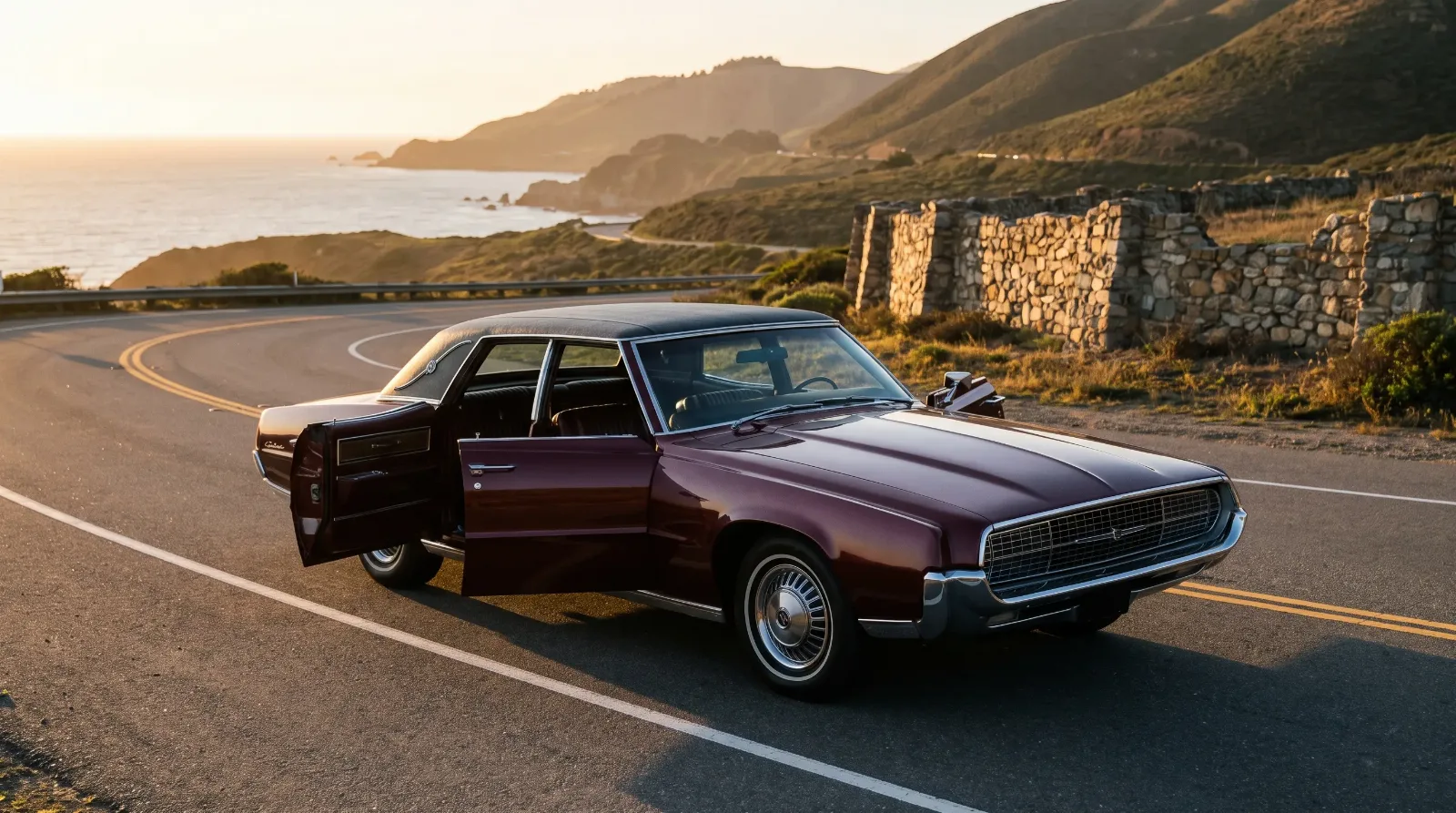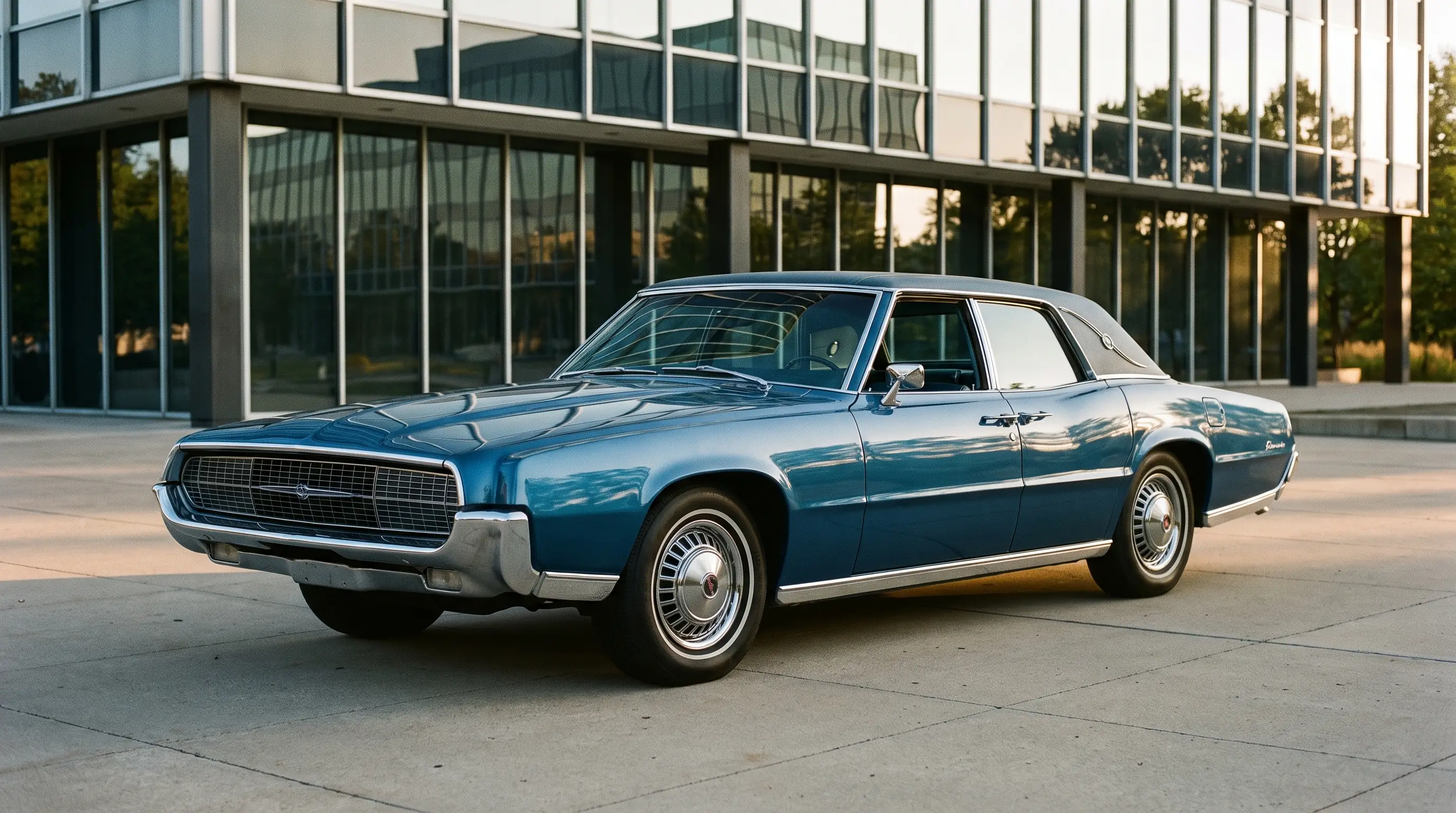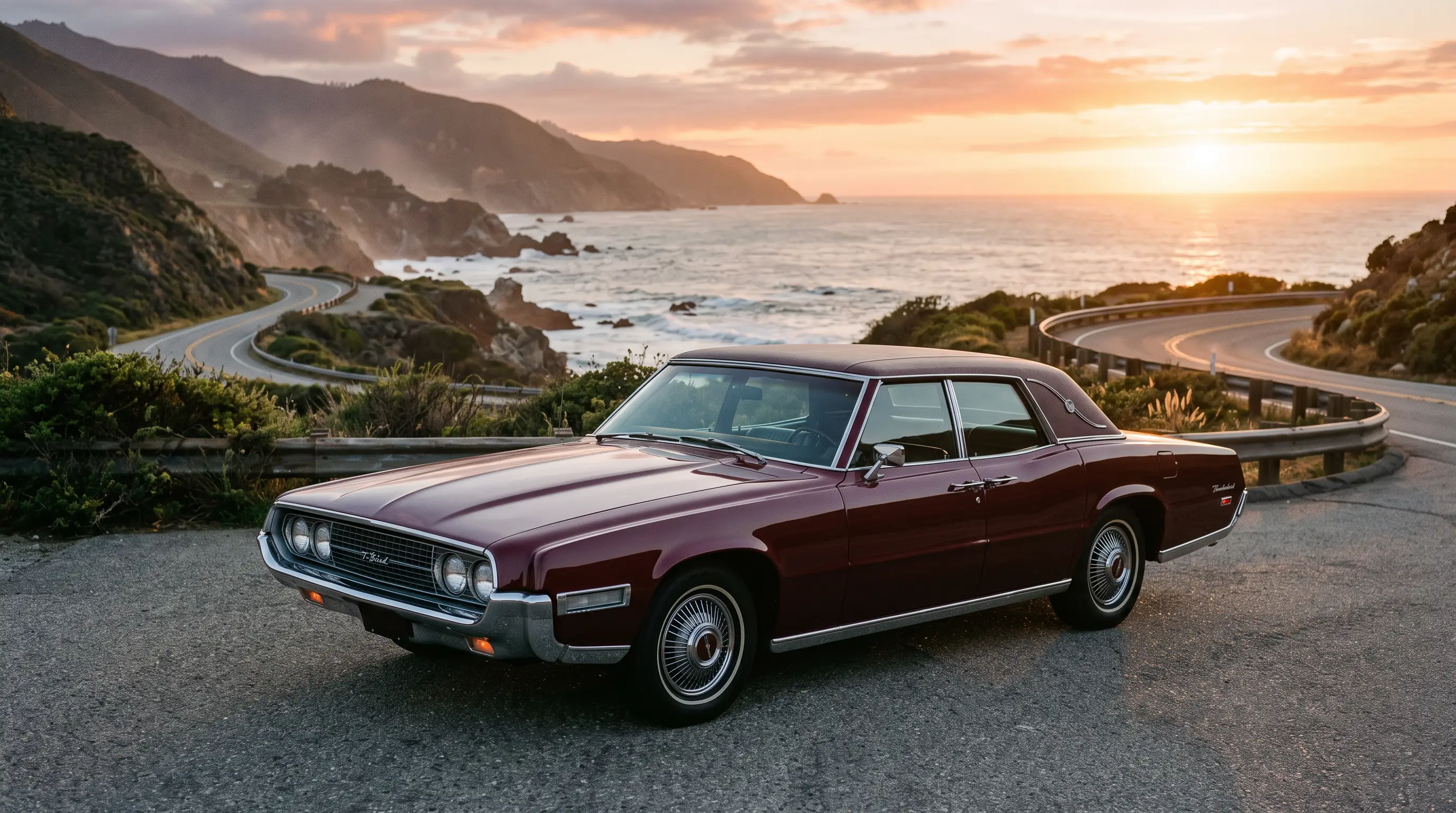
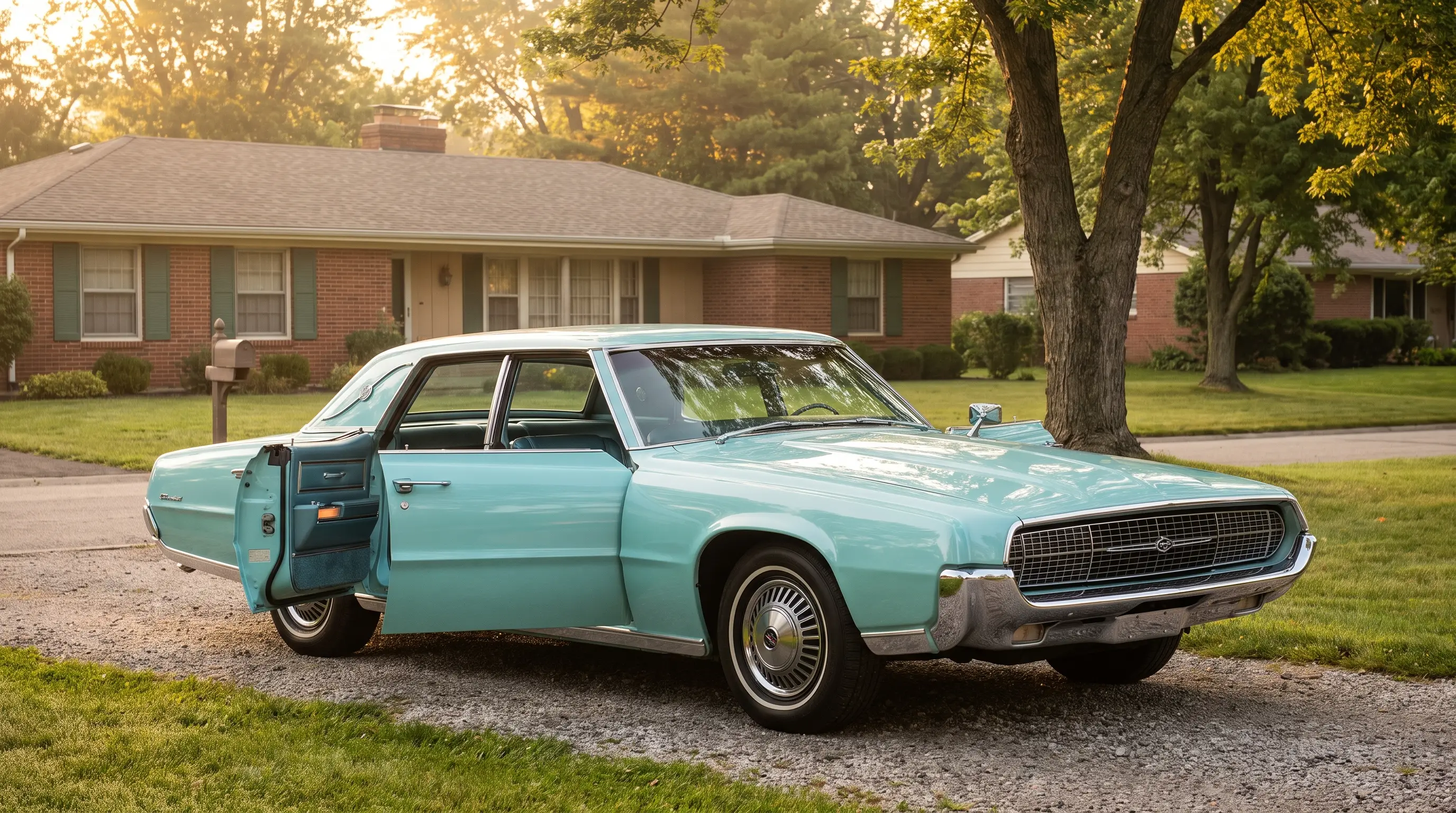
Every so often at a club meet, somebody walks up to the fifth-generation four-door Thunderbird parked in the corner, watches the rear door swing open the "wrong" way, and asks me if it's been modified. It hasn't. Those thunderbird suicide doors are exactly how Ford built the car, and the fact that people still do a double take sixty years later tells you how genuinely unusual this configuration was, even at the time. The 1967 through 1971 four-door Thunderbird remains the only Thunderbird ever built with rear doors at all, and it's the only one built with doors hinged that way, which makes it a genuine one-off in the whole run of the nameplate.
What "suicide doors" actually means
The nickname refers to rear-hinged doors, doors that pivot open from their front edge instead of the rear edge like a conventional door. Open one from the outside and it swings forward, toward the front of the car, rather than backward. The morbid name comes from decades-old folklore about the doors supposedly flying open at speed and throwing occupants out, a story that gets repeated far more often than it gets examined. In practice, the Thunderbird's four-door used proper latches and door checks like any other Ford product of the period, and there's no meaningful evidence these cars were more dangerous than conventionally hinged four-doors of the same era. The nickname stuck because it's colorful, not because it's accurate.
What the design actually did, and did well, was solve a real packaging headache. A wide rear door opening on a formal, pillarless hardtop body needs to avoid two problems: a door that swings so far into a tight space it becomes a hazard in parking lots, and a B-pillar bisecting the greenhouse that would ruin the clean, open look Ford wanted for the car's side profile with both doors up. Hinging the rear door at the back solved both. The door opens wide enough for genuine access without swinging as far forward into an adjacent parking space, and the two doors could meet in the middle without a fixed pillar between them, preserving the hardtop's uninterrupted glass area.
Why the pairing worked on this specific car
Rear-hinged doors weren't unique to Ford or to this era. Various manufacturers had used the layout going back decades, on everything from prewar coachbuilt sedans to later luxury cars. What made the Thunderbird application distinctive was the combination with a genuinely pillarless hardtop body style, which very few other four-door cars of the period attempted at all. Most four-door hardtops of the 1960s, from Ford and everyone else, still used conventionally hinged doors. The Thunderbird paired the rear-hinge layout specifically with the pillarless format to chase a completely clean profile, something you can trace back through our complete history of the fifth generation's redesign, where Ford's stylists were explicit about wanting the four-door to read as an extension of the two-door's formal identity rather than a compromised, ordinary sedan silhouette.
Living with the layout
Owners of these cars today describe the doors as unusual on first use and completely unremarkable after a week of daily driving. The doors require a slightly different entry motion, pulling the handle and stepping forward into the opening rather than back, but they don't demand any real adaptation beyond that. Where the layout does matter is in maintenance and parts availability. The latch mechanisms, door checks, and window regulators for the rear doors are specific to this application and were never shared with any other Ford product, since no other Ford used rear-hinged doors on a four-door body during this period. That makes parts sourcing a genuine consideration for anyone taking one of these cars on as a project, since a broken rear door mechanism can't be robbed from a donor Galaxie or LTD the way many other Thunderbird parts can.
| Detail | Rear-hinged (suicide) door | Conventional front door |
|---|---|---|
| Opening direction | Forward, from the front edge | Outward, from the front edge, standard hinge at front |
| Shared parts with other Ford models | None | Some shared components across Ford's full-size line |
| Body pillar between doors | None, pillarless design | N/A |
| Unique to this generation | Yes, only Thunderbird ever built this way | No |
How the mechanism actually worked
The rear door's hinge assembly mounted at the back edge of the door opening, near the C-pillar area of the body, rather than at the front near where the two doors met in the middle. A separate, more robust latch system held the door closed against wind pressure at highway speed, since a rear-hinged door faces different aerodynamic loads than a conventionally hinged one, with air pressure at speed tending to push the door toward closed rather than open, which actually works in the design's favor for safety rather than against it, contrary to the folklore about doors flying open.
Door check straps, the mechanisms that hold a door open at a set position rather than letting it swing freely, were engineered specifically for this application rather than adapted from an existing Ford part bin. That level of dedicated engineering for what was, in production terms, a relatively low-volume body style tells you Ford took the four-door program seriously enough to invest real development resources in it, rather than treating it as a quick afterthought bolted onto the existing platform.
The reputation versus the reality
I've been going to Thunderbird meets for a long time, and the four-door is still the car that draws the most questions and the most raised eyebrows, usually from people who assume Ford built it as a marketing stunt rather than a genuine attempt to extend the Thunderbird nameplate into a growing segment of buyers who wanted formal styling with real family practicality. The suicide door layout gets treated as evidence of that stunt mentality, when really it was a considered engineering solution to a specific styling problem that a more conventional door hinge simply couldn't solve as cleanly.
"Folks hear 'suicide doors' and picture something dangerous or half-baked, and then they watch one open and close a few times and realize it's just a well-engineered solution wearing a scary nickname it never deserved."
- Wayne Coburn
Finding one today
The four-door body style shows up far less often in today's collector market than the two-door hardtop and Landau coupes, which means patience matters if you specifically want one. Most sellers advertising a Thunderbird from this generation are moving two-door cars, so when a four-door does surface it tends to draw dedicated interest from buyers who understand exactly what makes the configuration significant. If you're casting a wider net, you can still find a classic Thunderbird from either body style, but know going in that the four-door with its distinctive doors is the rarer find of the two, and worth the extra search time for anyone who wants a genuinely unique piece of Thunderbird history rather than the more familiar coupe.