
The tail fin is the single most recognizable gesture in American automotive styling, and it did not arrive by accident. It came out of a specific design culture built inside General Motors by one enormous, deliberate man: Harley Earl. Before Earl, the shape of a car was largely an engineering afterthought, decided by the people who built the chassis. After him, the way a car looked became a reason to buy it. The fin was the proof.
Car Features
6 min read
The Tail Fin Story: How Harley Earl Changed Car Design
How Harley Earl and GM styling gave American cars their tail fins, from the 1948 Cadillac to the fin era peak, and why the shape mattered.

To understand classic car tail fins, you have to start with the studio that produced them rather than the metal itself. Earl treated the automobile as sculpture, and he treated the buying public as an audience that could be led. The fin was his way of putting motion and aspiration into a stationary object. It is worth tracing where the idea came from, because the popular story gets it half right and the interesting part is in the other half.
Who Harley Earl actually was
Earl came to Detroit from Southern California, where he had designed custom bodies for movie stars through his father's coachbuilding shop. Alfred Sloan, running General Motors, hired him in 1927 to create what GM called the Art and Colour Section, the first dedicated styling department at a major automaker. Earl's first production job was the 1927 LaSalle, a car that borrowed openly from the Hispano-Suiza and proved that a factory car could be styled like a coachbuilt one.
What made Earl different was not taste alone. It was method. He introduced modeling clay to the design process so shapes could be sculpted in three dimensions rather than drawn flat. He built long, low mock-ups to study proportion. He understood, earlier than almost anyone, that a company could sell the same mechanical package again and again if it changed how the car looked each year. That idea, later called planned obsolescence, is inseparable from the fin, because the fin gave stylists something to make taller, wider, and more dramatic every single season. If you want the wider context, this piece sits inside the classic luxury design language story that GM's studio effectively wrote for the whole industry.
The airplane that started it
The origin most often repeated is the true one, though the details matter. In 1941, before the United States entered the war, Earl arranged for a group of his designers to see the Lockheed P-38 Lightning, then a classified military aircraft. The P-38 had a twin-boom fuselage with twin vertical tails, and its purposeful, aggressive rear silhouette stayed with the team. Frank Hershey, one of Earl's lead designers, is the man most consistently credited with translating that aircraft memory into the small tail fins that appeared on the 1948 Cadillac.
Those first fins were modest by later standards, little more than raised humps on the rear fenders housing the taillamps. Cadillac management reportedly worried buyers would reject them. They did not. The fins gave the car an identity from behind, and identity was exactly what a luxury buyer wanted. That cautious 1948 gesture is where the whole escalation begins, and it deserves its own close reading, which is why we go deeper in next: Cadillac's 1948 Tail Fin and the Fin Arms Race That Followed.
Why the fin worked as a luxury signal
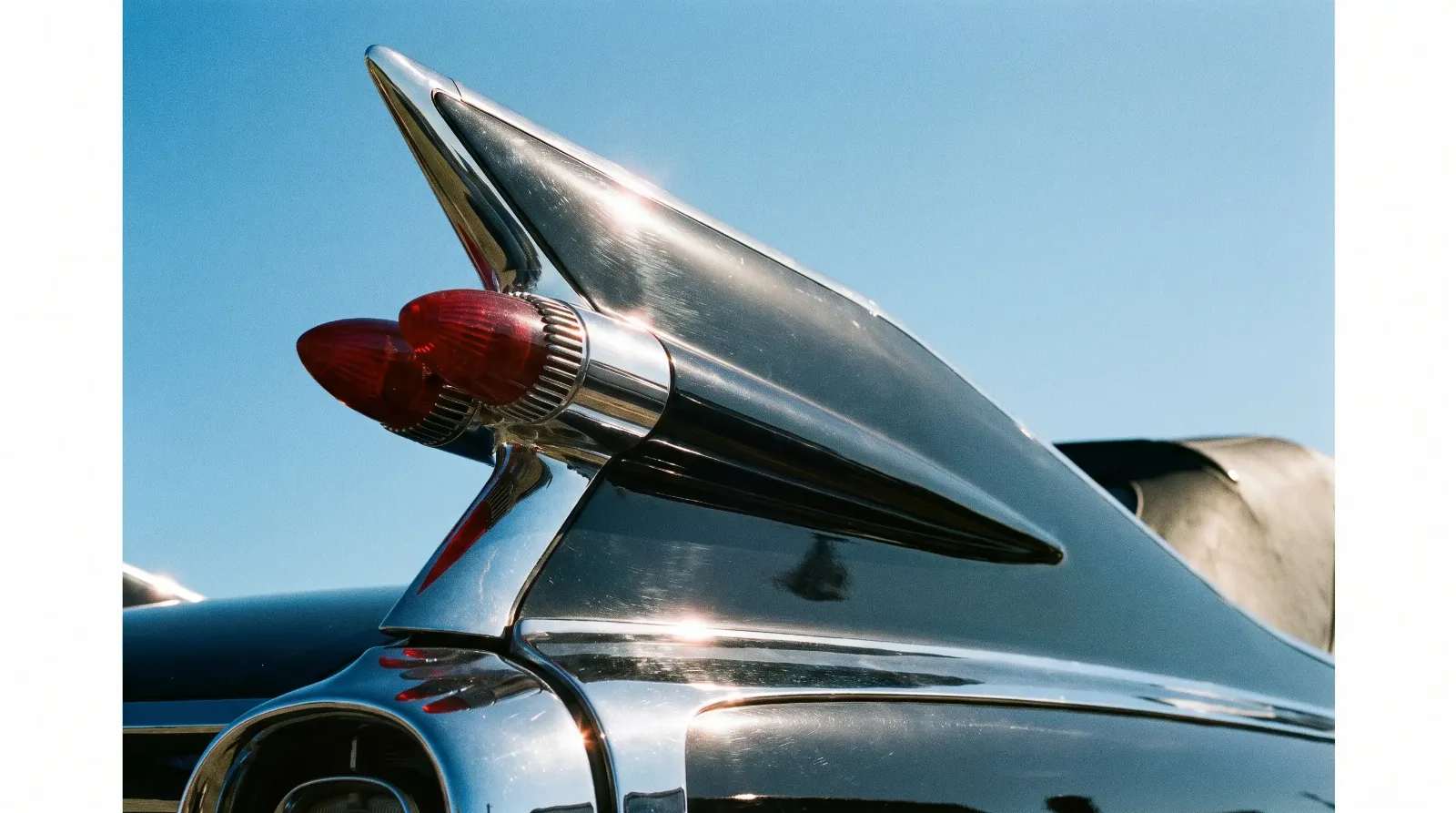
A tail fin did nothing for the car mechanically. Claims that fins improved high-speed stability were mostly marketing, and at the road speeds these cars traveled the aerodynamic effect was negligible. What the fin did was social. It marked the car as new, as expensive, and as styled by people who thought about such things. In a period when a Cadillac and a Chevrolet often shared a great deal underneath, the fin was one of the loudest ways to say which end of the price ladder you occupied.
Earl grasped something about postwar America that ran deeper than sheet metal. Buyers wanted optimism made visible. The jet age and the space race supplied the vocabulary, and Earl's studio supplied the shapes: bullet taillights, chrome that suggested exhaust and afterburners, and fins that grew each year as if the car were straining toward flight. The look was not subtle, and it was not meant to be.
| Milestone | Year | Significance |
|---|---|---|
| Harley Earl hired by GM | 1927 | Art and Colour Section founded, first factory styling department |
| P-38 Lightning viewing | 1941 | Twin-tail aircraft silhouette influences GM designers |
| First Cadillac tail fins | 1948 | Modest fender fins housing taillamps, credited to Frank Hershey |
| Fin era peak | circa 1959 | Fins reach their tallest and most theatrical scale |
What Earl left behind
Earl retired from General Motors in 1958, and his successor Bill Mitchell steered GM styling toward crisper, more restrained lines through the 1960s. The towering fin faded quickly once it peaked, and by the middle of the 1960s it looked dated. That short life is part of what makes the fin such a clean case study. It rose, escalated, and collapsed inside roughly a decade, driven almost entirely by the styling-first culture Earl had built.
The larger legacy is the idea, not the shape. Earl established that design could be a primary reason to buy a car, that a studio full of artists deserved a seat next to the engineers, and that a company could renew desire every model year through appearance alone. Every brand's design department today descends from the room he set up in 1927. If you want to see how these ideas ripple across nameplates and decades, they run through the full classic luxury car story as a recurring theme.
"A fin does nothing a wind tunnel would thank you for. That was never the point. Earl understood that a car parked at the curb is still communicating, and the fin was the loudest sentence he could give it."
Sarah Whitfield
Look at a 1948 Cadillac beside a 1959 one and you can read the whole arc in the rear fenders. What began as a quiet nod to a fighter plane became, in ten years, the defining excess of American luxury. Harley Earl did not just style cars. He taught an industry to sell the way a car makes you feel from thirty feet away, and the fin was his signature.
Related Reading

Have a
Classic Car
for Sale?
Reach thousands of serious classic car collectors across the US.
Sell It Here →
Are You a Classic Car Dealer?
List your full inventory and connect with targeted classic car buyers.
Join as a Dealer →

About the author
Sarah Whitfield
Third-generation classic car collector specializing in pre-war American and European coachbuilt automobiles. Researcher and concours enthusiast.


Comments
Be the first to comment on this article.