
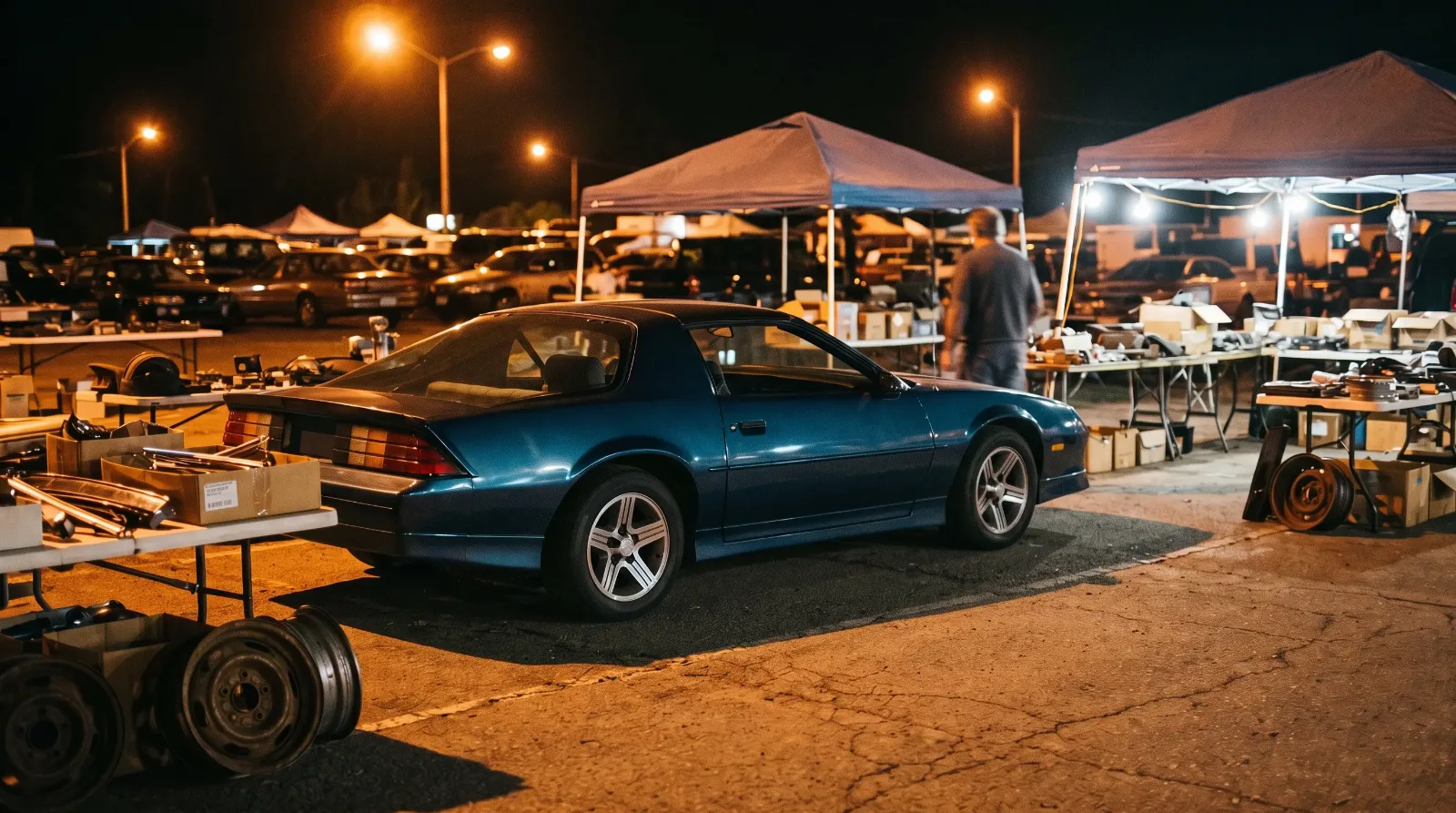
Picture the scene that plays out at every swap meet. A seller offers a "real IROC 350" and taps the VIN through the windshield as if that settles the matter. It does settle the matter, though not the way he hopes. The eighth character is an H, which on a 1987 car means a 305 with a four-barrel carburetor, not the 350. He has read the plate. He has not decoded it. A third gen camaro vin decoder is not a magic box, but it is the cheapest piece of homework you will ever do on a 1982 to 1992 Camaro, and the 17 characters on that dash plate answer more questions than most sellers expect. Here is how to read them, position by position, and where the record runs out. This is one chapter of the restoration guide, and it is the chapter I would read before spending a dollar.
Third-Gen Camaro VIN Decoder: Reading a 1982 to 1992 VIN
How to read the 17-character VIN on a 1982 to 1992 Camaro, position by position: engine digit, year and plant letters, and what the plate never tells you.
Where the VIN lives and what to check first
The public VIN on a third-generation Camaro is on a steel plate on the driver's side of the dash, readable through the windshield. GM moved it there from the door jamb for 1968 and kept it there. Before you read a single character, look at how the plate is fastened. Factory plates were held with rosette rivets, which show a star pattern when you look from under the dash. Round rivets are a warning sign that the plate has been off the car at some point, and a plate that has been off is a plate that may have come from somewhere else.
The other old friend, the cowl tag, also survived into this generation, but only for a while. It was used from 1967 until 1985, and on 1982 to 1985 cars it sits on the radiator support rather than the cowl. On a 1986 to 1992 car, do not go hunting for one.
From 1981 on, GM used the 17-character VIN, so every third gen follows the same basic frame. What changed during the run was the order of a few characters in the middle, and that is where people trip.
A position-by-position third gen Camaro VIN decoder
The first three characters are the same on every car: 1 for USA, G for General Motors, 1 for Chevrolet. Position 9 is a check digit, a number calculated from the others to catch typos and fakes. Position 10 is the model year, position 11 is the plant, and positions 12 through 17 are the production sequence, which started at 100001.
Positions 4 through 7 are where the generation splits. On 1982 to 1984 cars the prefix reads 1G1AP87: A is the restraint code (manual belts), P is the series (Sport Coupe, with S for the Berlinetta), and 87 is the two-door coupe body. From 1987 the prefix becomes 1G1FP, then a body digit (2 for coupe, 3 for convertible), then a restraint digit (1 for manual belts through 1989, 3 from 1990, the first year a driver's airbag was offered in an F-body). A typical 1987 VIN reads 1G1FP21H1HN100001; a 1990 coupe reads 1G1FP23.
The 1985 and 1986 cars are the awkward middle. Their VINs read 1G1FP87, with F in position 4 and the old P87 series and body code behind it. Some reference tables for those years still list position 4 as the A restraint code, carried over from 1984, but recorded sales of real 1985 IROC-Z cars show VINs such as 1G1FP87F0FN117032. If a 1985 or 1986 plate reads 1G1AP, look harder.
| Position | 1982 to 1984 | 1987 to 1992 |
|---|---|---|
| 1 to 3 | 1G1 (USA, GM, Chevrolet) | 1G1 (USA, GM, Chevrolet) |
| 4 | A (restraint, manual belts) | F |
| 5 | Series: P Sport Coupe, S Berlinetta | Series: P for all models |
| 6 | 8 (body, with 7) | Body: 2 coupe, 3 convertible |
| 7 | 7 (87 = two-door coupe) | Restraint: 1 manual belts (to 1989), 3 with driver airbag (1990 on) |
| 8 | Engine | Engine |
| 9 | Check digit | Check digit |
| 10 | Model year | Model year |
| 11 | Plant: L Van Nuys, N Norwood | Plant: L Van Nuys, N Norwood (through 1987) |
| 12 to 17 | Sequence from 100001 | Sequence from 100001 |
The engine digit: the one that settles arguments
Here is the part that matters most to a buyer. From 1987 the series letter is P for every Camaro, so a Z28 and an IROC-Z are not identified in the VIN at all. Both are option codes, Z28 and B4Z, which live on the paperwork, not the plate. The engine character in position 8 is the clue that does show up, and it rules out a lot of tall tales.
For 1982 the codes were 2 for the 151 four with throttle-body injection, 1 for the 173 V6 two-barrel, H for the 305 V8 four-barrel and 7 for the 305 Cross-Fire injection V8. For 1985 and 1986, F is the 305 Tuned Port Injection, H and G are 305 four-barrels, S is the 173 V6 with multiport injection and 2 is the 151 four. For 1987 to 1992, 8 is the 350 TPI, F is the 305 TPI, E is the 305 with throttle-body injection (1988 to 1992), H is the 305 four-barrel (1987 only), S is the 173 V6 (1987 to 1989) and T is the 191 V6 with multiport injection (1990 to 1992).
The in-between years follow the same pattern. The 1983 table repeats the 1982 codes, so a 1983 Z28 with a 7 in the eighth spot is a Cross-Fire car. The 1984 table drops the 7 and lists G, the 305 four-barrel H.O., alongside H. The 1988 table is the 1987 one with E in place of H, and 1990 and 1991 read like 1992.
"An 8 in the eighth spot does not make a car an IROC. It only makes it a 350 car. The window sticker makes it an IROC, and I have yet to meet a seller who lost the sticker on the good car."
Wayne Coburn
The flip side is just as useful. A car sold as a 1987 350 IROC-Z with an F in position 8 started life as a 305. That does not make it a bad car. It makes it a different car, and it should be priced as one.
Year and plant letters, and the gaps in the record
The model-year letters run C for 1982, D for 1983, E for 1984, F for 1985, G for 1986, H for 1987, J for 1988, K for 1989, L for 1990, M for 1991 and N for 1992. The letter I is skipped. Trust the plate over the internet here: one widely used online reference gets 1982 wrong, listing D as its year code.
The plant letter is simpler. L is Van Nuys, California, which built third gens in every year, and N is Norwood, Ohio, which built them from 1982 to 1987 only. A 1990 Camaro with an N in position 11 has a problem that no amount of paperwork will fix.
What the VIN will never tell you
The VIN tells you the year, the plant, the body, the engine and the place in the production line. It does not tell you the trim package, the axle ratio, the color, the T-tops or the transmission. For those you need the option list, the window sticker and any dealer or build paperwork that survived. The broader history of the generation is covered here, and it helps to know which options were even possible in a given year before you believe the ones a seller lists.
Once the numbers agree, the real work starts, and third-gen restoration has its own list of brittle plastics, leaking hatches and tired T-tops to worry about. If you also own an older Camaro, the 13-character VINs and trim tags of the 1970 to 1981 cars are a different puzzle, and the longer story walks through them. Either way, the plate is where the honesty starts. The paperwork is where it ends.
Sources and notes
Related Reading

Longtime Corvette owner, judge and club figure who knows the cars, the records and the people behind them.
Related Listings - Chevrolet Camaro
Comments
Be the first to comment on this article.