
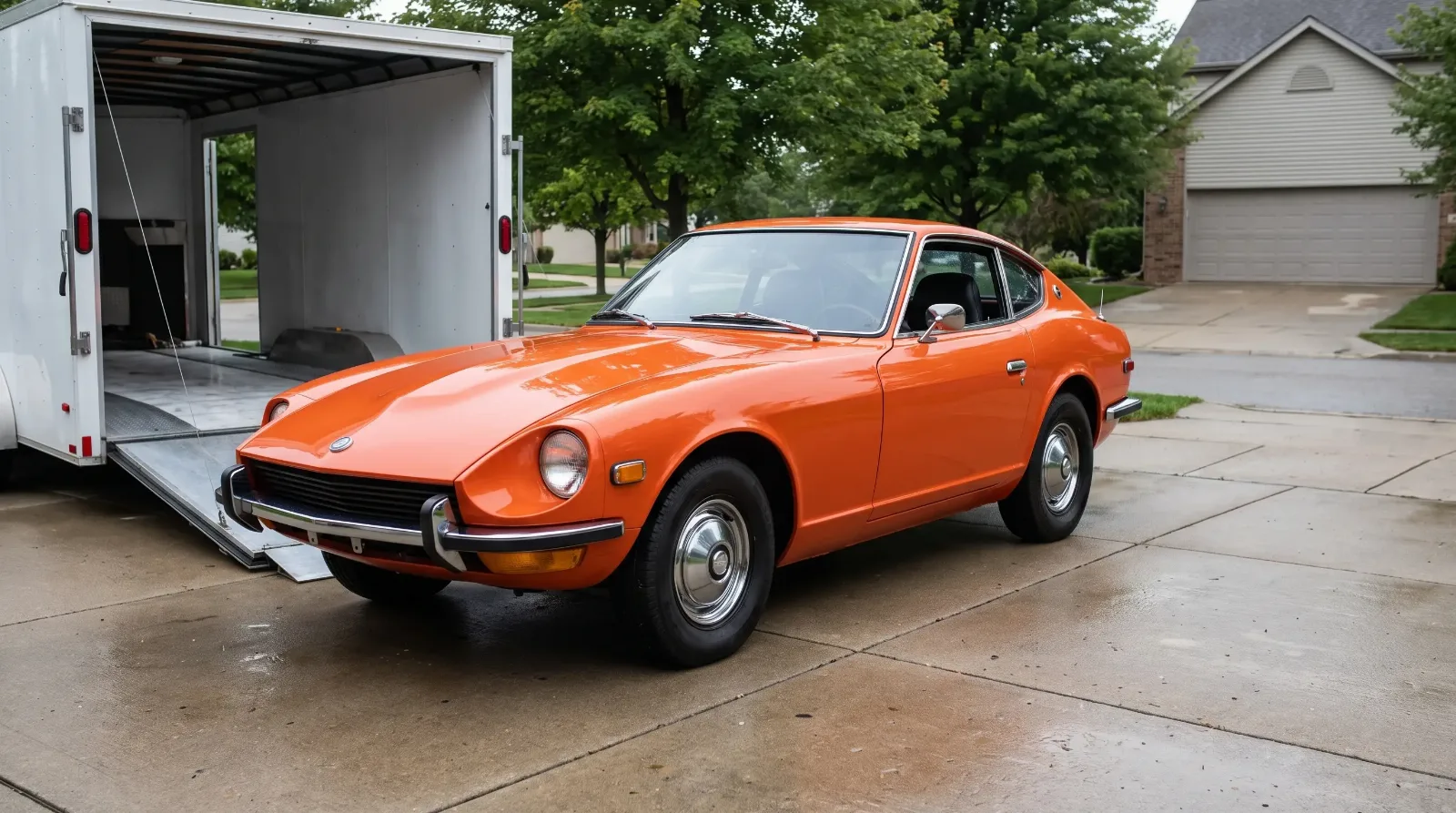
A 1972 Datsun 240Z rolls off an enclosed carrier in a suburban driveway, eleven hundred miles from the dealer that sold it. The price was agreed weeks ago. What decides the final cost now is a set of forms: who collected the tax, which state's plate is on the car, and what the local DMV wants before it will issue a title. Buying a classic car out of state is common and rarely complicated, but the money involved in the tax side alone is large enough to deserve a few hours of homework before the truck arrives.
Ownership & Lifestyle
7 min read
Buying a Classic Car Out of State: Title, Registration and Sales Tax
Who collects the tax, credit for tax paid elsewhere, temporary tags, VIN inspections, non-title states and smog rules for out-of-state classics.
This piece covers the registration and tax side only. Vetting the seller, inspection and payment are in our dealer buying guide. Everything below is general information. Rules vary by state and change, so confirm the details with your own DMV and revenue department before you buy.
Who collects the sales tax
The general rule is simple. Sales or use tax is owed in the state where the car is registered, not where it was bought. How that tax gets paid depends on the dealer, and there are three common outcomes.
Some dealers collect your home state's tax at the sale and send it to your state, which is easiest for you. Others collect their own state's tax regardless of where you live. Many collect nothing, or a reduced amount, from out-of-state buyers and document the sale with an affidavit stating the car will be registered elsewhere. Florida, for example, uses Form DR-123 and charges a nonresident the home state's rate, capped at Florida's own 6%, provided the car is registered at home within 45 days. When nothing is collected, you pay use tax when you register the car at home, usually at your state's rate on the purchase price. The tax is the same either way. What changes is the timing and the amount of paperwork you handle yourself.
Ask the dealer which of these it does, in writing, before you sign. Then read the buyer's order and make sure the tax line matches what you were told. If you are comparing the dealer route with a private purchase, our piece on sales tax in a private sale explains how it works when nobody collects anything at the table.
Credit for tax paid to another state
If you do pay tax to the selling state, most states credit it against what you owe at home, up to their own rate. You pay the difference if your rate is higher. You generally do not get a refund if it is lower. The arithmetic is easiest to see with numbers. The rates below are illustrative, not any specific state's.
| Scenario (on a $45,000 purchase) | Paid to the dealer's state | Owed at home | Total tax |
|---|---|---|---|
| Dealer collects nothing; home rate 6% | $0 | $2,700 | $2,700 |
| Dealer state rate 4%; home rate 6% | $1,800 | $900 (difference after credit) | $2,700 |
| Dealer state rate 7%; home rate 6% | $3,150 | $0 (no refund of the extra 1%) | $3,150 |
| Dealer collects home-state tax at 6% | $2,700 (remitted to your state) | $0 | $2,700 |
The third row is the one to avoid. Paying a higher rate to the selling state costs you money you will not recover, so if the dealer insists on collecting its own tax, check the rates first. Keep the bill of sale or buyer's order that shows the tax paid, because your DMV will ask for proof before it applies any credit. A few points complicate this. Some states treat certain dealer fees as taxable and others do not, so read the fee lines on the order carefully, and our breakdown of dealer fees covers which charges to question. Alaska, Delaware, Montana, New Hampshire and Oregon have no statewide sales tax (Alaska lets local governments levy their own), so a dealer there often collects nothing and the whole amount falls due at home.
Temporary tags and transit permits
How the car travels decides what plate it needs. A car shipped on a carrier needs no plate or permit for the trip. That is one reason most out-of-state classic purchases ship rather than drive, along with the obvious one of not putting eleven hundred unknown miles on an old car.
If you plan to drive home, you need legal plates for the trip. Many dealers can issue a temporary tag from their own state, and the validity period depends on the state: 30 days for a dealer tag in Florida, 60 days in Texas and 90 days in California, with conditions that vary as well. Some home states also issue trip or transit permits that let an unregistered car be driven from the point of purchase. Either way, have insurance in force before the car moves. An agreed-value collector policy can usually be bound on the VIN before you take delivery.
Title and VIN inspection after buying a classic car out of state
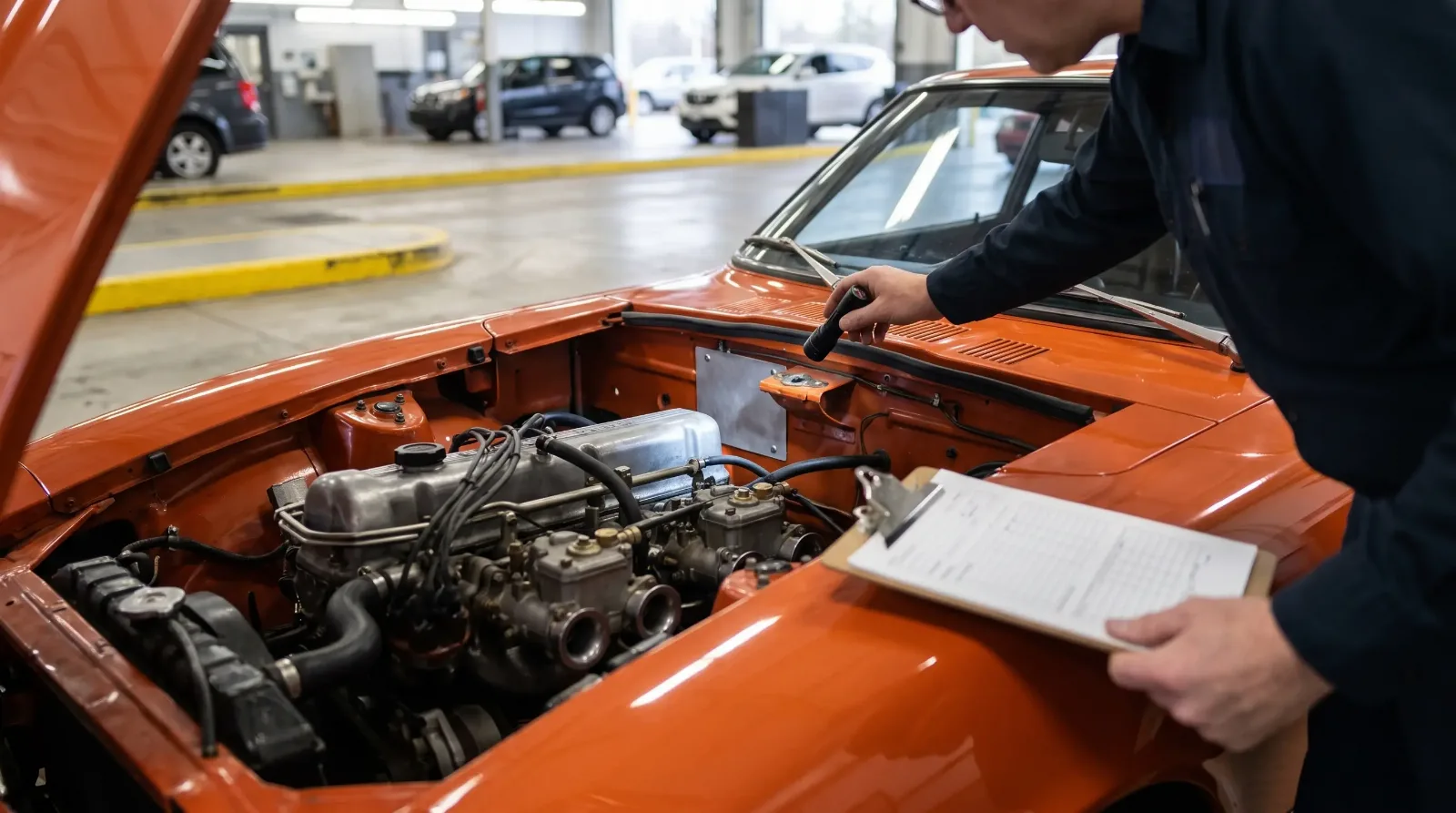
At your DMV you will typically need the title signed over to you, a bill of sale, proof of insurance, your ID and payment for tax and fees. Odometer disclosure is less of an issue than buyers expect: under federal rules, vehicles of model year 2010 and older are exempt, which covers nearly every classic, though your state may still ask for a mileage reading on its own forms.
Many states also require a VIN inspection on any vehicle titled elsewhere. Depending on the state, it is done at the DMV, by law enforcement, by a licensed dealer or by a notary on a state form. California uses a DMV employee, a law enforcement officer or a licensed vehicle verifier, while Florida's form can also be signed by a licensed dealer or a notary. Plan for it, because if the VIN plate on a fifty-year-old car is damaged, loose or does not match the title, this is where you find out.
Older cars from non-title states need extra care. New York does not title model year 1972 and older and uses a transferable registration instead, and Georgia does not require a title for 1962 and older. Your home state may accept the registration and bill of sale, or it may ask for more, such as a bonded title. In Texas, for example, a bonded title requires a surety bond of 1.5 times the vehicle's value, and the title carries a bonded brand for three years. Other states handle it differently. Ask your DMV what it accepts before you pay for a car without a title.
Emissions and smog rules
Emissions rules are the most state-specific part of the process, and they can stop a registration cold. California is the strictest example. Gasoline vehicles of model year 1975 and older are exempt from the smog check, but a gasoline car of model year 1976 or newer arriving from another state needs a smog certification before California will register it. That matters for buyers of late-1970s and 1980s cars, where a model built to federal rather than California specifications can be harder to pass.
Other states run emissions testing only in certain counties or metro areas, and many exempt cars beyond a certain age or cars registered on historic or antique plates. Georgia and Connecticut, for example, exempt vehicles 25 years and older. Those plates are worth asking about in any case. They often lower registration costs in exchange for limits on mileage or use, which suits a weekend car well and a daily driver poorly.
The practical step is one phone call before you commit. Ask your DMV what it needs for an out-of-state classic of that model year: title or alternative proof, VIN inspection, emissions, and how tax paid elsewhere is credited. Write the answers down with the date and the name of the person you spoke to.
"Buyers will argue for a week over a $1,500 discount and then lose the same amount on a tax line they never read. On an out-of-state purchase, the buyer's order deserves the same scrutiny as the car."
David Mercer
Sources and notes
Related Reading
Have a
Classic Car
for Sale?
Reach thousands of serious classic car collectors across the US.
Sell It Here →
Selling a classic? Here's how: the best sites to sell a classic car
Are You a Classic Car Dealer?
List your full inventory and connect with targeted classic car buyers.
Join as a Dealer →

About the author
David Mercer
Classic car market analyst with two decades of experience tracking collector car valuations, auction results, and investment trends.
More in Ownership & Lifestyle

Comments
Be the first to comment on this article.