
The cost of owning a classic car is usually smaller than people fear and larger than sellers admit. A $7,000 classic that you drive on weekends does not cost $7,000. It costs $7,000 once, then an annual sum for insurance, registration, storage, fuel and the repairs that old cars produce on their own schedule. That annual sum is what decides whether the car stays a pleasure or turns into a chore. This article puts a frame around it, line by line, with the caveats that matter.
Ownership & Lifestyle
7 min read
What a Cheap Classic Car Really Costs to Own Each Year
Insurance, plates, repairs, storage and the costs nobody lists: what a cheap classic car really costs to own each year, line by line.
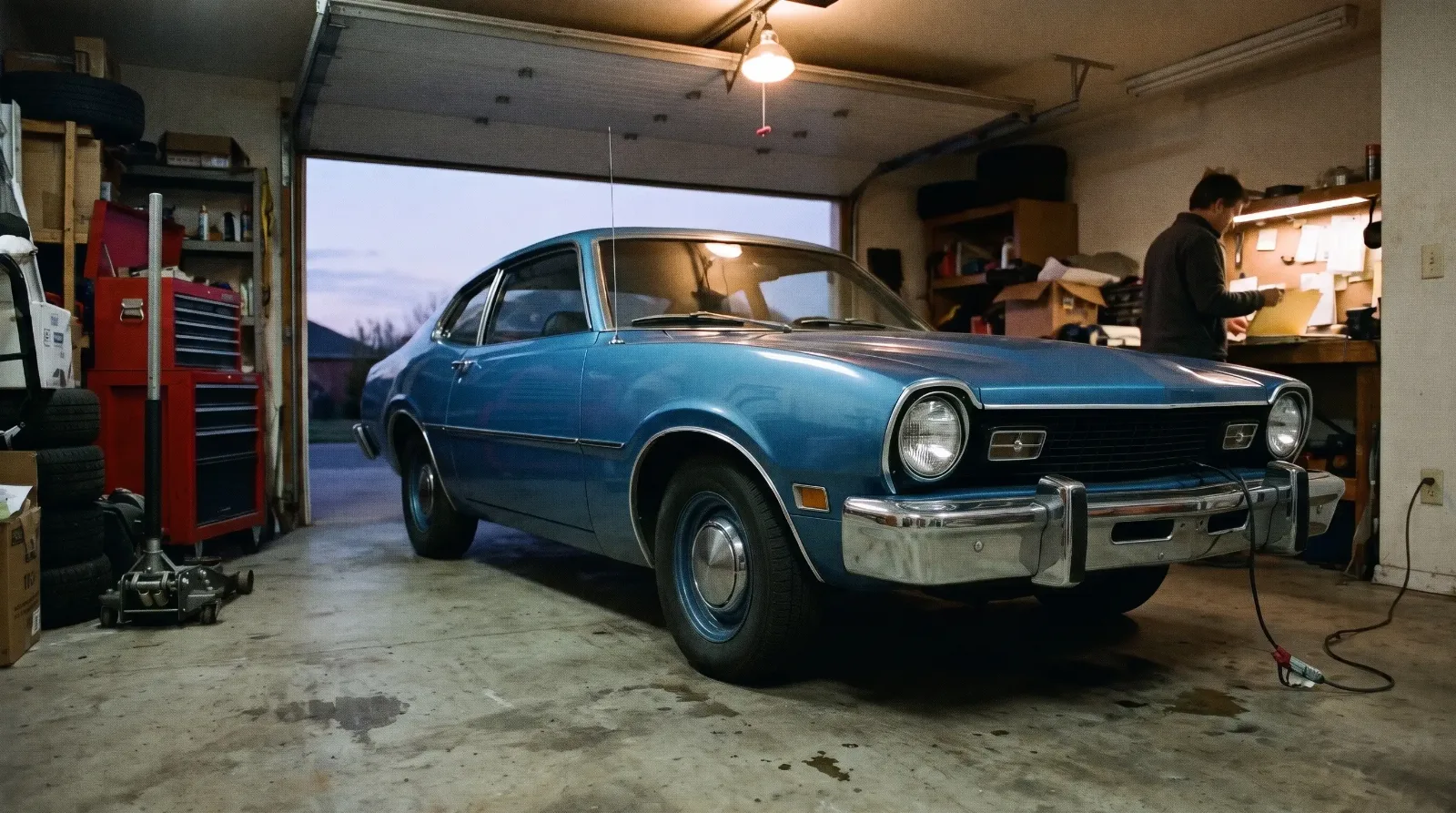
The numbers below assume a driver-quality car from the cheaper end of the market, the kind covered in our guide to good cheap classic cars. A concours car or a rare model is a different calculation.
The annual cost of owning a classic car, line by line
Every owner's total is different, but the categories are the same. The useful exercise is to fill each one in for your car, your state and your habits before you buy. The insurance and storage ranges come from published 2025 and 2026 figures; the maintenance and repair lines are planning allowances for a low value classic, not survey data and not quotes.
| Cost line | Typical annual range | What moves it |
|---|---|---|
| Collector car insurance | About $200 to $1,000 (as of 2025); a low agreed value sits toward the bottom | Agreed value, driving record, storage, mileage limit |
| Registration and plates | Usually small; many states charge a reduced or one-time fee for antique plates | State rules, antique versus regular plates |
| Routine maintenance | $300 to $800 | Oil, filters, plugs, points, tune-ups, fluids |
| Repairs and wear items | $500 to $1,500 as a planning allowance | Age of the car, how much was sorted at purchase |
| Storage | $0 at home; roughly $1,500 to $2,700 for a rented 10x20 unit (as of 2026) | Home garage versus rented space |
| Fuel | Depends on miles | Engine size, carburetor tune, how far you drive |
Add the lines up and a cheap classic kept in your own garage comes to a figure in the low thousands a year on these planning numbers. Rent an enclosed unit and storage alone can match everything else combined: suburban 10x20 units commonly run about $130 to $220 a month as of August 2026, more in big cities. The middle of the table, repairs and wear items, is the line most new owners underestimate, so it gets its own section below.
Insurance: the line that is cheaper than you expect
Collector car insurance is usually the pleasant surprise. Specialist insurers price these policies on the assumption that the car is driven occasionally, kept garaged and cared for, and the premiums reflect that. A daily driver policy, by contrast, may rate the old car as if it were used every day. Many policies use agreed value, which means you and the insurer settle the car's value up front and that is what a total loss pays.
The caveat is in the conditions. Collector policies commonly carry mileage limits (Hagerty describes 3,500 miles or fewer a year as typical, with up to 7,500 considered), require the car to be kept in a locked, enclosed space, and may expect you to have a regular daily driver on another policy. Commuting, school runs and routine errands are generally not covered use. Read those terms against how you actually plan to use the car. A cheap policy that does not cover the way you drive is not cheap; it is uninsured driving with paperwork.
Repairs and wear items: the real variable
Here is where the cost of owning a classic car is decided. A car that was bought sorted, meaning the brakes, cooling system, fuel system and wiring have been gone through, costs little to keep running. A car bought "running but needs a little work" will spend its first year telling you what the little work is.
Think about it in two parts. The first is catch-up: the deferred maintenance that comes with the car. Tires that are old, brake hoses that have never been changed, a radiator that is half blocked. This is a one-time bill, and it belongs with the purchase price, not the annual budget. The second is steady state: what the car costs each year once it is sorted. On a simple, common classic, steady state is modest. Parts are cheap and the work is within reach of a home mechanic.
That second point is why platform choice matters more than purchase price. A car with a deep parts catalog and simple mechanicals keeps the repair line low for years. If labor is your worry, pick from the easy classics to work on and do the routine jobs yourself. Every oil change and tune-up you do in the driveway is shop labor you did not buy.
"The cheapest classic to own is not the cheapest one to buy. It is the one somebody already sorted, with the receipts to prove it."
Marcus Feld
Storage, depreciation and the costs nobody lists
Storage is free if you have a garage and an understanding household. If you do not, it is likely the biggest single line in the table. Covered parking, a rented garage or a storage unit with power for a battery tender all cost real money every month. Outdoor storage costs nothing up front and a great deal later, because rust and sun damage are faster than any insurance premium.
Depreciation is the line people forget, and on a cheap classic it usually works the other way. A sound, common classic bought at a fair price tends to hold its value, give or take the market. That is not an investment case. Values can fall, and a car you neglect will lose value faster than any market move. But compared with a new car, which loses a large share of its value in the first years, a well bought classic is a car you can often sell for close to what you paid.
Then there are the small items that never appear in a listing: a battery tender, a car cover, a floor jack and stands, a set of tools, a trailer rental the day it will not start. Budget a few hundred dollars for those in year one and you will not resent them.
Setting a yearly budget you can keep
Here is a sensible approach. Take the annual estimate from your own table, add a reserve of roughly a quarter for surprises, and set that money aside monthly. If you do not use the reserve, it rolls into next year or into a planned improvement. If you do use it, you were ready. The owners who get frustrated are almost always the ones who treated the purchase price as the whole cost.
Value, in my line of work, is condition plus documentation plus liquidity. The annual budget protects all three. It keeps the car in condition, it builds the paper trail and it keeps the car sellable on short notice. If you are still comparing what a modest budget buys up front, start with the most affordable classic cars and run every candidate through the same table before you sign anything.
Sources and notes
- Experian: what is classic car insurance (January 2025)
- Hagerty: classic car insurance, guaranteed value and mileage
- 10 Federal Storage: cost of car storage (August 2026)
- RecNation: vehicle storage cost guide (May 2026)
- Historic and year of manufacture plates by state (2017 survey)
- Wikipedia: antique vehicle registration
Related Reading
Have a
Classic Car
for Sale?
Reach thousands of serious classic car collectors across the US.
Sell It Here →
Selling a classic? Here's how: compare the places to sell classic cars
Are You a Classic Car Dealer?
List your full inventory and connect with targeted classic car buyers.
Join as a Dealer →
#First Classic Car
#car storage
#classic car insurance
#affordable classic cars
#classic car maintenance
#cost of owning a classic car

About the author
Marcus Feld
Accredited collector-car appraiser who reads the market through hammer prices, condition tiers and risk.
More in Ownership & Lifestyle
Comments
Be the first to comment on this article.