
Here's the number nobody wants to hear. The total on your build spreadsheet is not the price of your car. It's what you paid. The market pays for the result, and only for the parts of the result a buyer can see, drive and prove. Anyone trying to sell restomod builds runs into this on day one, and the sellers who do well are the ones who accept it early and put their effort into proof instead of hope.
Market & Values
8 min read
Selling a Modified or Restomod Classic
How to sell a restomod or modified classic: document the build, prove the power, find the right buyer and price against modified comps.
The basic process, title, pricing, safe payment and handover, is in our guide on how to sell classic car deals start to finish. This piece covers what changes when the car isn't stock: a different buyer, different comps, and a lot more to document.
Your receipts are not your price
Builds cost what they cost. Labor at shop rates, parts that got bought twice, the wheels you swapped after a year. None of that transfers to the next owner at face value. A buyer looking at a swapped '69 Camaro compares it to the other swapped '69 Camaros for sale this month. He doesn't compare it to your invoices.
Two things eat into a modified car's value faster than anything else. Taste is the first. Every personal choice, wheel style, interior color, a loud exhaust, narrows the pool of buyers who want the car as it sits. The second is unknown quality. A buyer can't see how the wiring was done or whether the cooling system holds temperature in August traffic. If he can't verify it, he assumes he's paying to redo it.
So the job is simple to state. Show the quality. Keep taste from becoming a deal-breaker. Price against the right cars. Everything below is how.
Prove the power with paper
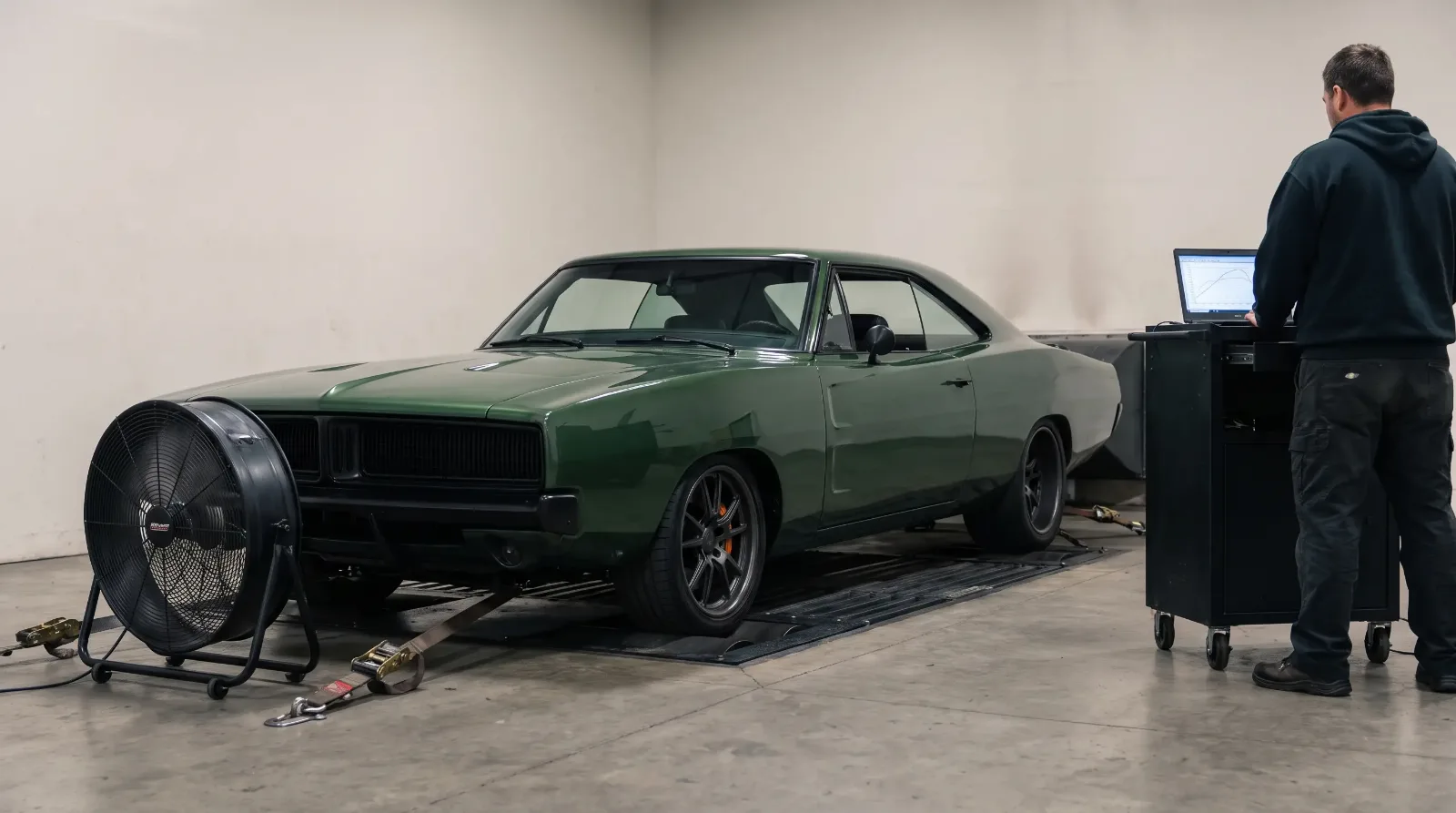
A restomod listing that says "about 500 horsepower" is a guess. A dyno sheet with a date, a shop name and a curve is a fact. Buyers pay for facts.
Say which number you're quoting. A crate engine's advertised rating is at the crank. A chassis dyno measures at the wheels, and the wheel number is always lower because the transmission, driveshaft and rear end take their share. A commonly cited rule of thumb puts drivetrain loss at roughly 15 percent with a manual and more with an automatic, though the real figure varies from car to car. If you post a crank rating, call it a crank rating. If you post a wheel number, say it's at the wheels. Mixing them up is the fastest way to lose a numbers-literate buyer.
| Document | What it proves | Without it, the buyer assumes |
|---|---|---|
| Dated chassis dyno sheet | Real power and a clean curve | The catalog number, minus a discount |
| Engine build sheet or crate engine invoice | What's inside and who built it | An unknown short block |
| Parts list with brands and part numbers | Quality of components, easy to source spares | Cheap parts somewhere in the car |
| Tune file and who did the tune | The engine runs right and can be serviced | A tune he'll have to pay to redo |
| Harness brand and wiring notes | Wiring done properly, not spliced | A fire risk and weeks of tracing |
| Alignment sheet, brake and suspension specs | The chassis was set up, not just bolted on | A car that drives worse than it looks |
| Original parts kept (engine, trans, trim) | The car can go back toward stock | No way back |
If the car lives in California or is going there, sort out the emissions side before you list. Gasoline cars from model year 1975 and older are exempt from California's Smog Check, so a swapped '69 usually won't need one, though the state's anti-tampering rules still apply. On a 1976 or newer car, an engine change has to pass an initial inspection at a state Referee station and carry a BAR Referee label, and the engine generally has to be the same year or newer than the chassis, with its emissions equipment in place. A buyer in that state will ask. Other states range from strict to nearly hands-off, and federal policy treats a swap that worsens emissions as tampering, so check the rules where the car is registered. Know where your car stands and put it in the ad.
"The dyno sheet sells the car. The parts receipt only tells the buyer what you paid."
Dan Reeves
Know which buyer you're selling to
There are two camps, and they don't overlap much.
The restomod buyer wants classic looks and modern behavior. Fuel injection, overdrive, real brakes, air conditioning that works, a car he can drive to dinner without carrying tools. He'll pay for a build that delivers that, and he'll pay more for a known builder with a paper trail than for a home build with none. He's comparing your car against a new performance car as much as against other classics.
The originality buyer wants the car the factory built. To him, most modifications are damage. He discounts them hard unless they're reversible and the original parts come with the car. Don't spend your time chasing him with a heavily modified car. You'll get lowball offers and lectures.
The bridge between the two is the original equipment. If you still have the numbers-matching engine on a stand, the original transmission or the factory trim in a box, it either goes with the car or gets sold separately, and you should decide which before you list. A matching engine can be worth real money to the right person on its own. Bundled, it tells the restomod buyer he has an exit.
Not every seller built the car. If you inherited a classic that somebody else modified, you may not even know what's in it. Get it identified before you price it. Pull the casting numbers, find the receipts, put it on a dyno. An afternoon of answers beats a listing full of "I think."
Price against modified comps, not stock ones
A restomod doesn't belong in the same comp set as a numbers-matching original. Different buyer, different number. Find completed sales of modified cars on the same platform at a similar level of build: same kind of engine, same class of brakes and suspension, similar finish quality.
Sort those comps hard. A car built by a known shop with full documentation sits in a different bracket from a driveway build with a shoebox of receipts. A car with a recent dyno and an alignment sheet sits above one with neither. When you find a comp that sold well, read the listing and figure out why. Usually it's the paperwork and the photos, not the parts.
Then be honest about the gap between your build cost and those comps. If every comparable car sold well under what you spent, your car will too. Price it where the comps say, and expect the buyer to pay for documented quality, not for your hours.
Listing, disclosure and the test drive
Lead with the drivetrain. First lines of the ad: engine, power with the dyno note, transmission, rear gear ratio, brakes, suspension. A restomod buyer reads specs first and paint color second. Then the build story, briefly: who built it, when, what it was before.
Disclose what isn't done. Headliner not installed. Wipers not wired. Runs hot in traffic over a certain temperature. Small items, stated up front, cost you little. Found during a test drive, they cost you a lot, because the buyer starts wondering what else you left out.
The test drive on a modified car is a different animal. The buyer will want to feel the power, and some will push it harder than you'd like. Drive it first with him in the passenger seat so he sees how it behaves. Check that your insurance covers another driver. Warm it up fully before he takes the wheel, and have the cooling system and brakes checked beforehand so nothing fails on the drive that a five-minute inspection would have caught.
Then close it like any other sale. Clean title, bill of sale that lists the modifications and says "sold as-is," payment cleared before the keys change hands. The build was the hard part. Selling it is mostly paperwork and patience.
Sources and notes
- California Bureau of Automotive Repair: engine changes and Referee inspection
- California DMV: smog inspections and exempt vehicles (1975 and older gasoline)
- iWire: what a California BAR Referee checks on an engine swap
- U.S. EPA: engine switching fact sheet (archived EPA snapshot)
- Street Muscle: what California's smog law means for 1975 and older cars and engine swaps
Related Reading
Have a
Classic Car
for Sale?
Reach thousands of serious classic car collectors across the US.
Sell It Here →
Selling a classic? Here's how: the best sites to sell a classic car
Are You a Classic Car Dealer?
List your full inventory and connect with targeted classic car buyers.
Join as a Dealer →
#engine swap
#restomod value
#sell classic car
#classic car pricing
#sell restomod
#modified classic car
#dyno sheet

About the author
Dan Reeves
Performance engine builder from North Carolina's motorsports corridor, focused on swaps, forced induction and making real, repeatable power.
Comments
Be the first to comment on this article.