
Upholstery is the part of a restoration that everyone sees and almost no one can judge. A seat cover that is off by a quarter inch at the seam looks fine to a casual eye and wrong to a trained one. The work is a trade of patterns, stitch counts and material, and the people who do it well are rare. That is why finding the right shop matters more here than for most jobs.
Restoration & Tech
6 min read
Choosing an Auto Upholstery Shop for a Classic
How to choose an auto upholstery shop for a classic car: what to ask, how to judge samples and stitching, what a quote should include and the red flags to avoid.
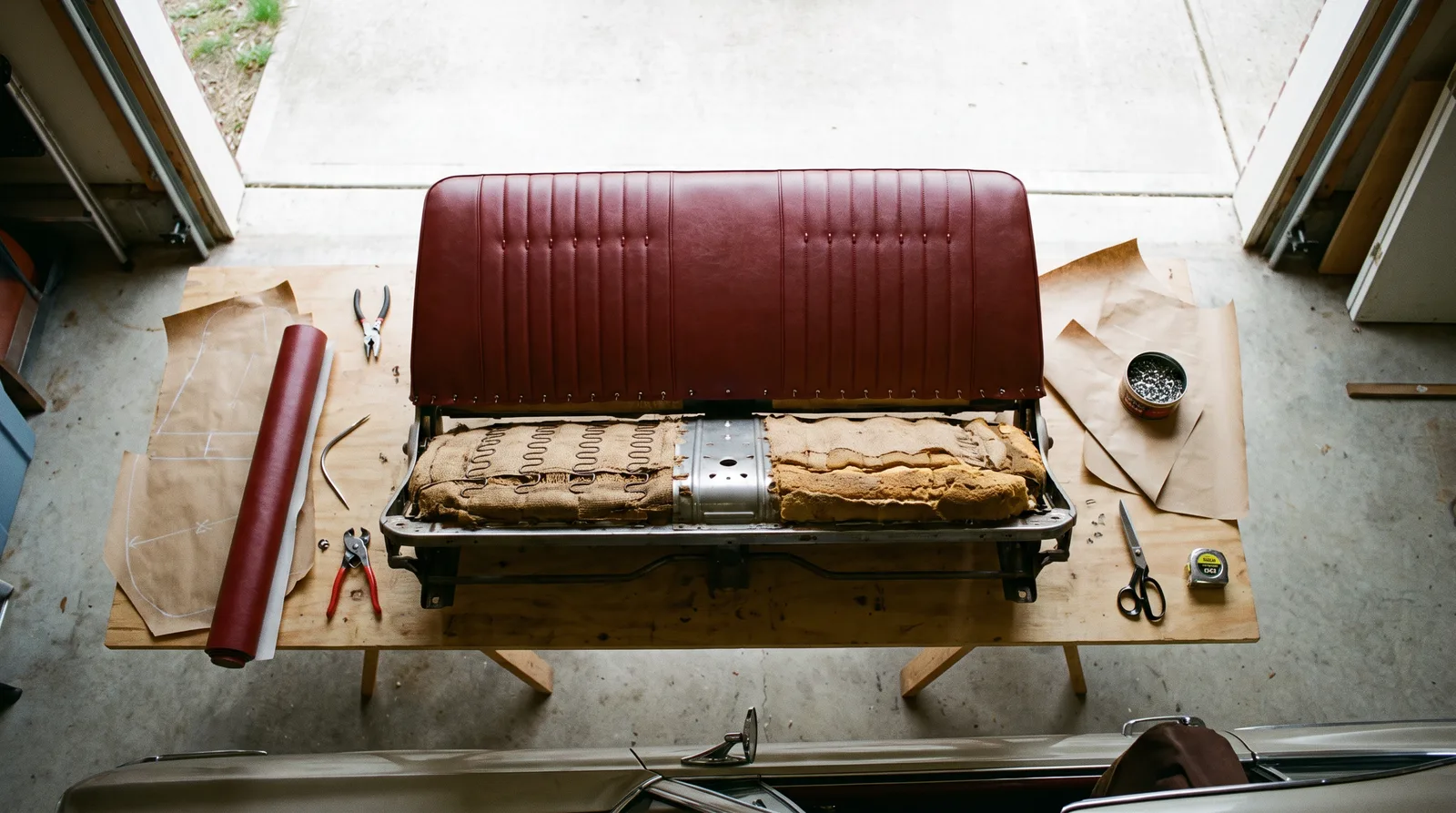
If you are searching for classic car upholstery shops near me, you will find many names and few ways to tell them apart. Here is how to sort them.
Know what kind of shop you need
There are three common types. A general auto trim shop handles seats, door panels and headliners on everything from daily drivers to boats. A restoration upholstery specialist focuses on period correct patterns, grains and stitching for older cars. A full restoration shop includes upholstery in house or through a partner. A shop that mostly does modern custom work is not necessarily wrong for a classic, but ask directly whether they have done correct restorations and how many.
If the car is going to a judged show, you want a specialist who knows the original pattern, stitch spacing and material for your make and year. If you are building a driver and want a good, durable, period appearance, a good general shop can be a fine choice. For a larger look at classic car restoration shops near you, start with the directory and filter by upholstery.
What to look at first
Ask for photos of finished cars similar to yours, and then ask to see one in person. Photos hide a lot. In person, look at these things:
- Seams lining up at the corners and across the seat bolsters.
- Even stitch length and straight rows, with no loose threads.
- Seat covers that fit tight with no wrinkles, but also no strain at the seams.
- Door panels that sit flat against the door with the clips seated and no gaps.
- Headliner without sagging, wrinkling at the bows, or glue bleeding through.
- Carpet that is cut and bound neatly around the transmission tunnel and seat mounts.
Sit in the car, too. A good seat should feel supportive, and the foam should be firm and even.
Questions that tell you who you are dealing with
- Have you restored a car like mine, and can I see it or talk to the owner?
- Where do you source materials, and can I see samples against the original?
- Do you reuse original frames and springs, and who repairs them?
- How long is the wait, and how many cars do you hold at a time?
- Do you sew in house, or send it out?
- What is your policy on rework if something does not fit?
A real craftsman will answer without bluster and will give you specifics. If they cannot say where the material comes from, treat that as a flag.
Reading a quote
Quotes vary widely, so do not take a single number as the standard. For a driver-quality classic, a complete interior (seats, door panels, carpet and headliner) typically runs about $5,000 to $12,000 installed, with parts alone often $1,800 to $5,000. Show and concours work starts around $15,000 and is often far more for rare, prewar or coachbuilt cars. Seat covers with new foam, front and rear, commonly land between $1,500 and $5,000 installed. Labor makes up much of the cost, and the main cost drivers are the car, the material, the extent of repairs to frames and foam, and the wait. Insist on a quote that is itemized, with each piece listed.
| Item on the quote | What to confirm |
|---|---|
| Seat covers | Material, grain, color match, listed by seat |
| Foam and padding | New or reused, and who pays for hidden repairs |
| Frames and springs | Inspection, repair and paint included |
| Carpet and headliner | Material type, molded or cut and sewn |
| Door panels | Reuse of originals or new boards |
| Timeline and deposit | Start date, completion, payment schedule |
Materials and originality
Ask which materials the shop will use and why. Real leather, vinyl and cloth each behave differently, and a good shop will tell you what was original and what is a reasonable alternative. Some owners choose modern vinyl that looks correct but lasts longer in the sun. If you are chasing a correct restoration, you need the right color and grain first, and for that you need the factory codes. Before you order a single yard of material, check the trim tag codes, which tell you what the car left the factory with.
Bring the codes, any original samples and photos to the first meeting. Those details show the shop that you take the project seriously, and it helps them quote accurately.
"A good upholsterer works from the artifact. Bring the original cover, the trim tag and your questions, and the right shop will be glad to see them."
Sarah Whitfield
Red flags
- No portfolio, or only stock photos from suppliers.
- A quote on a single line with no breakdown.
- Pressure to pay the full price up front.
- A refusal to show work in progress or to let you visit.
- Vague answers about materials and sources.
- A promise of an impossible schedule.
Ask for the deposit terms in writing. A modest deposit for materials is normal. Paying the whole job in advance is not.
Working with the shop
Once you have chosen, stay involved. Deliver the car or the seats cleaned, with all the hardware and any original trim pieces. Photograph everything before it goes in, and get a written scope. Visit during the job if the shop allows it. Many good shops welcome questions and will send photos at each stage.
The same habits that help with vetting upholstery work for the rest of the project too. If you want the full approach, see our guide to vetting any restoration shop, and keep the overall plan in view with the interior guide.
Sources and notes
- Best practices for classic auto interior restoration (Legendary Auto Interiors), cloth, vinyl and leather options, original parts versus cost, and the case for budgeting the interior properly
- Seat upholstery product information (Legendary Auto Interiors), factory-matched colors and grains, heat-sealed seams, foam construction and seat frame services
- SMS Auto Fabrics, range of cloth, vinyl, leather, door panels, headliners and carpets for American cars of the 1930s to 1990s
- Upholstery (Wikipedia), the trade, its traditional materials and automotive trimmers
- Polyurethane (Wikipedia), how seat foam breaks down with moisture and light
Related Reading
Have a
Classic Car
for Sale?
Reach thousands of serious classic car collectors across the US.
Sell It Here →
Selling a classic? Here's how: sell my classic car
Are You a Classic Car Dealer?
List your full inventory and connect with targeted classic car buyers.
Join as a Dealer →

About the author
Sarah Whitfield
Third-generation classic car collector specializing in pre-war American and European coachbuilt automobiles. Researcher and concours enthusiast.
More in Restoration & Tech
Comments (2)
C
carshow_cathy
5 days ago
Has anyone done this with a show car in mind: did your shop deliver the seats before or after the car went back together? Mine wanted the seat frames from my '55 six months before the body was finished, and I worried the covers would sit in a box and take a set. From my side, keep a scrap of the original vinyl like the piece says. Did anyone have a shop store finished seats well?
Red flags, well chosen. A one-line quote is not a quote. It is a guess.
Seconding the sew-in-house question. My RX-3 seats went to a shop that sent the covers out, and they came back with the insert seam a good quarter inch off the bolster line, exactly the kind of miss described up top. The shop was honest about it and redid them, but that cost six weeks. Ask before you sign, not after.