
A car under restoration is the least insured object in the hobby. It is high in sentimental value, increasing in actual value with every invoice, and often sitting in someone else's building with a policy written for a car that looked and ran very differently. When a fire, theft or flood hits a shop, the claim is where the gaps show up. Classic car restoration insurance is mostly a matter of closing those gaps before anything happens.
Restoration & Tech
6 min read
Insuring a Car While It's Being Restored
Insurance for a car in restoration: what covers a shell in a shop, how agreed value works mid-build, and the gaps that hurt owners when something goes wrong.
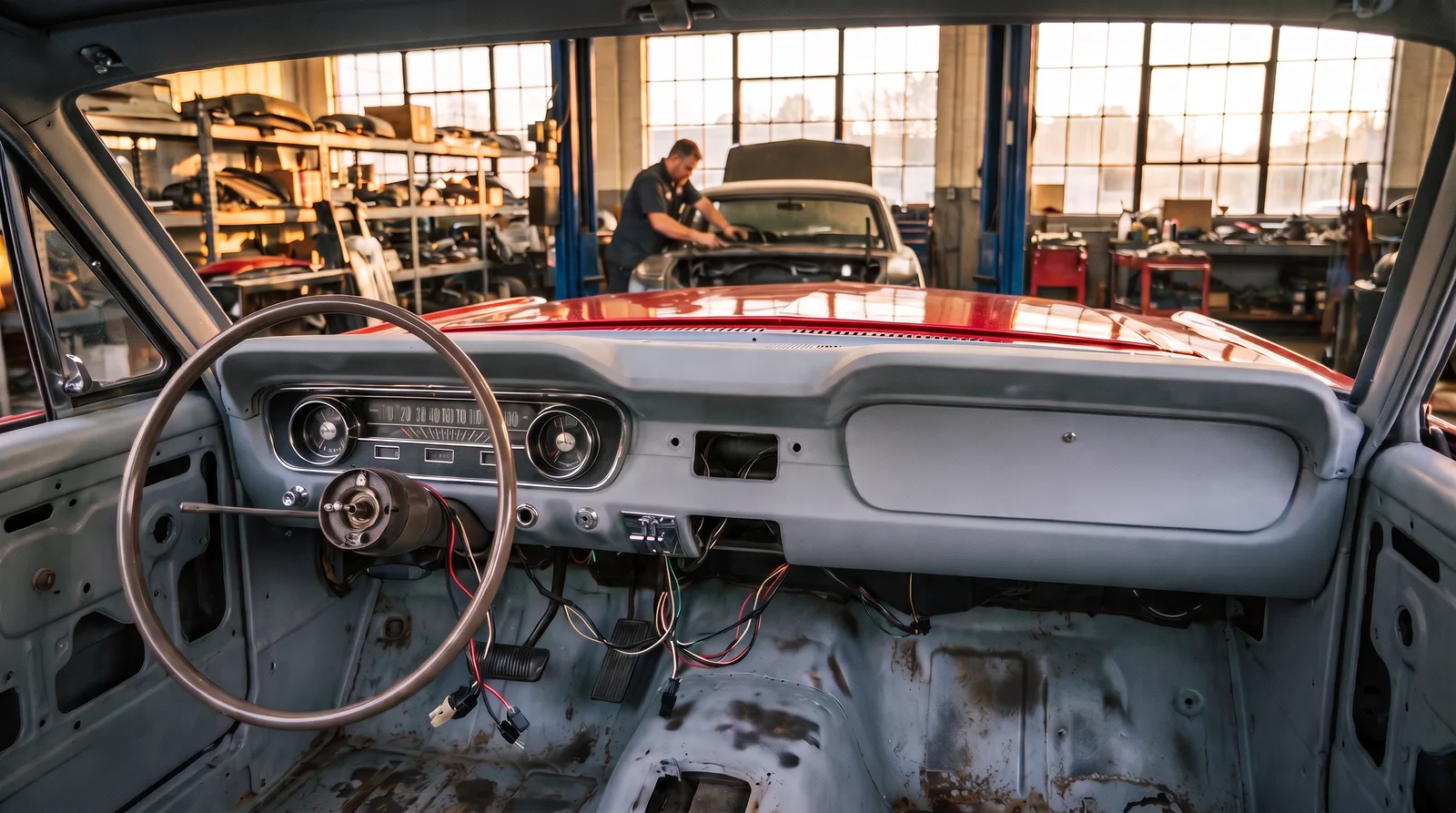
The core problem is simple. Insurance pays based on the policy terms and the documented value of the car at the time of loss. If the policy was written when the car was a rough runner and the car is now a nearly finished $90,000 build, the payout can be a fraction of what the owner has in it.
Who is covering the car in the shop?
Two policies matter, and owners often assume one covers everything. The shop should carry garagekeepers coverage, which is liability insurance for customer vehicles in its care. Check the limits, because garagekeepers coverage is often written at roughly $25,000 to $100,000 per vehicle, and a restoration in progress can be worth far more than that. Ask whether the shop's coverage pays first (direct primary) or only after your own policy. Then there is your own collector policy, which may or may not cover the car off premises or while disassembled. Some policies exclude cars that are not operable or are under restoration, and some require notice.
Ask the shop for a certificate of insurance and read it. Ask the insurer, not just the agent, whether a car in pieces is covered as a complete vehicle or only for the parts that are present. Disassembled parts stored in boxes, on shelves or at a plating or machine shop in another town are a gray area unless the policy spells it out.
Agreed value and why it must move
Collector policies are commonly written on an agreed value basis. You and the insurer settle on a number up front, and in a total loss that number is paid without depreciation arguments. Stated value policies sound similar but the insurer can pay the lesser of stated value or actual cash value, so read the fine print.
Agreed value on a restoration project is not static. A rough car might be agreed at $20,000. After a year of work and $70,000 of invoices, the right number is much higher, and the policy has to follow. Update it at defined points: after bodywork and paint, after mechanical completion, and at delivery. Send the insurer the invoices and photos each time, because documentation is what makes the number defensible.
| Stage | Typical exposure | What to confirm |
|---|---|---|
| Teardown and metalwork | Parts scattered, car not drivable | Policy covers disassembled car and parts off site |
| Paint and body | Fire and solvent risk, highest labor investment | Shop fire coverage, agreed value raised |
| Assembly | Car moves, test drives | Who covers road testing, who is the insured driver |
| Delivery | Transport, first drive home | Enclosed carrier coverage, policy in force from pickup |
Document everything, early and often
An appraiser looks for three things after a loss: what the car was, what was done to it, and what it was worth. Photograph the car before it goes to the shop, and again at each stage. Keep invoices, parts receipts, and a dated log. Mark irreplaceable items such as original trim, date coded glass and numbered components, and photograph them. Those parts are what turn a rebuilt car into an original one in an appraiser's eyes, and they are what is hardest to replace if lost.
The same paper trail supports your final value once the car is done, which is why it connects to appraisal after restoration. A well documented project is easier to appraise, easier to insure and easier to sell.
Transport and test drives
The riskiest moments are movement. Transit to and from the shop, trips to the paint booth, and the shakedown drives after assembly are when accidents happen. Confirm that the transporter carries cargo coverage for the actual value of the car, and that your own policy picks up where theirs stops. For test drives, ask who is insured to drive the car. A policy that names only the owner may not cover a shop employee at the wheel, and the shop's garagekeepers coverage may have its own limits for road use.
What to ask the insurer before the car moves
Put the questions in an email so the answers are on file. Does the policy cover the car while it is disassembled? Does it cover parts stored off site, including at plating, machine or upholstery shops? Is a car in a restoration shop treated as stored or as in use? What happens to the agreed value if a major component is replaced? Will the insurer send an adjuster to inspect the work at a milestone? A written yes is worth far more than a verbal one at claim time, and a written no tells you to buy a rider or a separate policy before the car leaves your garage.
"The policy that matters is the one that was in force and accurate on the day of the loss. Not the one you meant to update last month."
Marcus Feld
Fold insurance into the budget
Insurance costs on a classic are often modest compared with the car's value, often a few hundred dollars a year for a typical collector car, and more for high-value cars, depending on value, use and location. Raising agreed value raises the premium, but that cost belongs in the overall budget alongside storage and shipping. It is cheap protection against the most expensive kind of loss.
For a broader primer on how collector policies differ from standard auto coverage, including usage limits and valuation types, read our guide to how classic car insurance works. Before the shop takes the car, get the certificate of insurance, confirm your own coverage in writing, and set a calendar reminder to revisit agreed value at every major milestone.
Sources and notes
- Hagerty: agreed (guaranteed) value vs stated value, supports the difference in total loss payouts
- Alkeme Insurance: garage liability vs garagekeepers, supports garagekeepers scope, direct primary vs excess, and typical per-vehicle limits
- Grundy: restoration shop insurance, supports shop garagekeepers, test drive and vehicles under construction coverage
- Yahoo Finance: classic car insurance guide, supports typical premiums, mileage caps and storage expectations
- Hagerty: collector car insurance, supports collector policies being written for cars not driven daily
Related Reading
Have a
Classic Car
for Sale?
Reach thousands of serious classic car collectors across the US.
Sell It Here →
Selling a classic? Here's how: the best sites to sell a classic car
Are You a Classic Car Dealer?
List your full inventory and connect with targeted classic car buyers.
Join as a Dealer →

About the author
Marcus Feld
Accredited collector-car appraiser who reads the market through hammer prices, condition tiers and risk.
More in Restoration & Tech
Comments
Be the first to comment on this article.