
The 1994 Mustang GT gets judged by one number, and it is the wrong one. Everybody quotes 215 hp, compares it to the Camaro, and stops reading. I've had enough of these on a lift to tell you the horsepower was never the story. The story is that Ford took the same pushrod 5.0 out of a Fox body, dropped it into a stiffer, wider, heavier car, and changed what a GT felt like from the driver's seat. Some of that was a step forward. Some of it cost something.
Car Features
7 min read
The 1994 Mustang GT
The 1994 Mustang GT: a 215 hp 5.0 in a stiffer, heavier SN95 body. The ratings history, the chassis changes and the slalom number that matters.
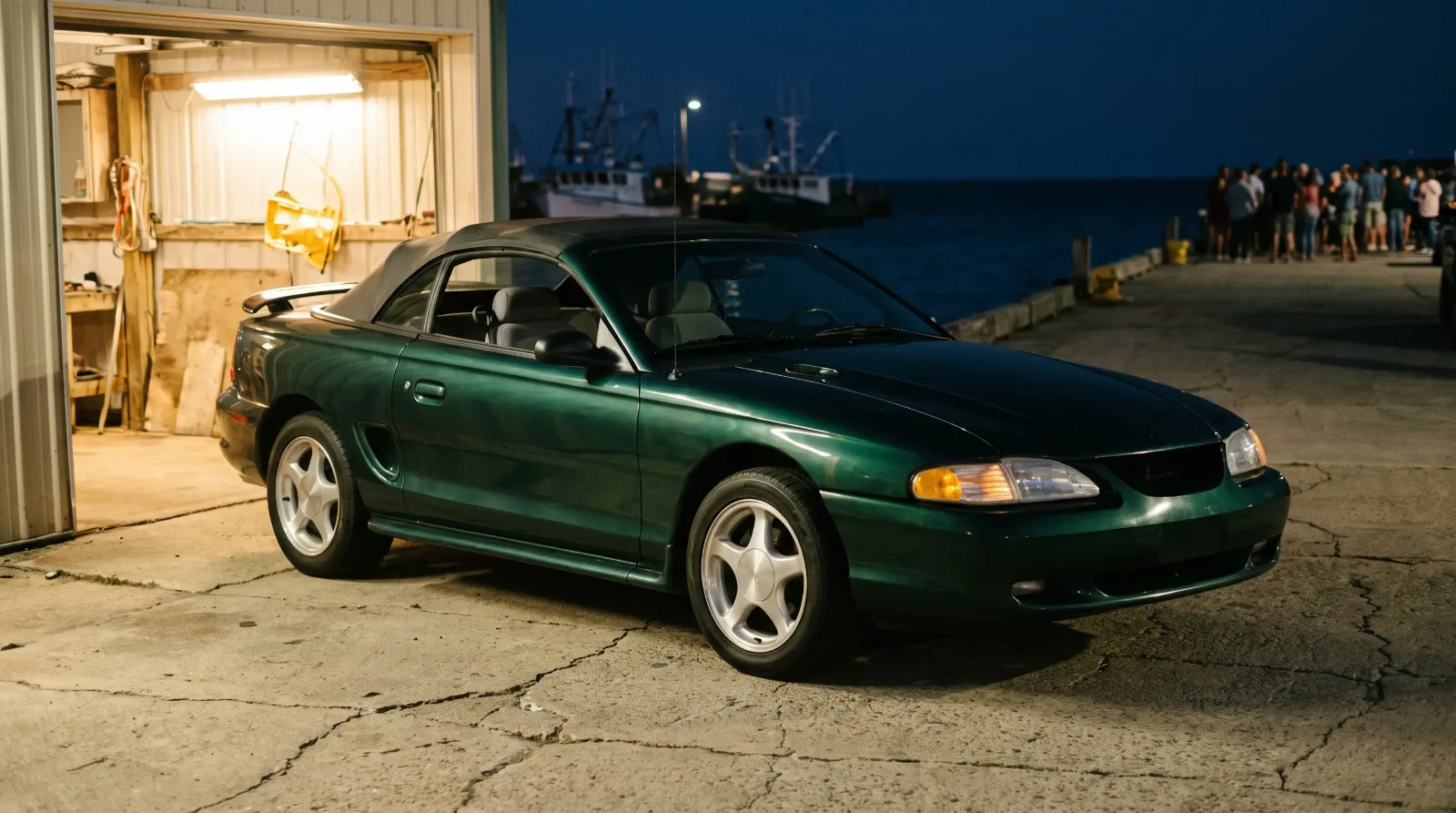
This piece sticks to the GT. The launch, the lineup and the pace car are covered in our look at the 1994 to 2000 Mustang, and the long view of where the car came from lives in the full history of the Ford Mustang. Here it's one car, one model year, and what was under it.
What the 1994 Mustang GT was
The new SN95 Mustang went on sale in December 1993 with the V6 car out front. The GT followed in January 1994. It came as a coupe at $17,280 or a convertible at $21,790, and Ford built 30,592 GT coupes and 25,381 GT convertibles for the model year. That is a lot of convertibles. Close to half of all 1994 GTs left the plant with a soft top, which says something about who Ford thought was buying a V8 Mustang that year.
Underneath, it was still a Fox. Ford called the platform Fox-4, and the company's own figure is that 1,330 of the car's 1,850 parts changed. So it was a new car in most of the places you can see and touch, sitting on an old idea. The 1994 Mustang was Motor Trend's Car of the Year, the second time a Mustang got it after 1974. The GT was the version of that car most people pictured when they heard the news.
The 5.0 under the new skin
The engine was the 5.0 HO, the 302 cubic inch pushrod V8 Ford had been building in Mustangs for years. In the 1994 GT it was rated at 215 hp at 4,200 rpm and 285 lb-ft at 3,400 rpm, SAE net. Some pages still print 300 lb-ft for the 1994 car. That is the old Fox rating carried over into the wrong paragraph, and it doesn't belong there.
The ratings history is where people get confused, so here it is in order. From 1987 through 1992 the Fox 5.0 was rated at 225 hp and 300 lb-ft. For 1993 Ford re-rated it to 205 hp and 275 lb-ft. Then the 1994 GT came in at 215 hp and 285 lb-ft. On paper, then, the new car gained 10 hp on the last Fox and still sat 10 hp under the 1987 to 1992 sticker. Anyone who tells you the SN95 GT "lost power" is comparing it to the older rating, not the 1993 one.
| Item | 1994 Mustang GT |
|---|---|
| Engine | 5.0 L (302) HO pushrod V8 |
| Output (SAE net) | 215 hp @ 4,200 rpm; 285 lb-ft @ 3,400 rpm |
| Transmissions | Borg-Warner T-5 five-speed manual or AOD-E four-speed automatic |
| Axle ratio | 3.08:1 at launch; 3.27 or 3.55 later, depending on transmission and year |
| Wheels | 16-inch (V6 cars on 15-inch) |
| Wheelbase | 101.3 in |
| Base price | Coupe $17,280; convertible $21,790 |
| Production | 30,592 coupes; 25,381 convertibles |
For perspective, the SVT Cobra that shared the showroom made 240 hp from the same displacement, thanks to GT-40 heads, a Cobra intake and its own cams and injectors. The GT got none of that. It was the volume V8 car, built to a price.
Heavier, wider and stiffer: the GT chassis
This is the part people skip, and it's the part that matters. Compared with the 1993 car, the SN95 put on about 300 lb and grew 3.7 inches in track width. More weight against roughly the same power is never good news at a drag strip. In a corner, though, the extra track and the stiffer body were exactly what the Fox had been missing.
Ford didn't just bolt the old suspension under a new shell. The GT got progressive-rate springs, longer control arms, new spindles, anti-roll bars and added chassis stiffening, and it rode on 16-inch wheels where the V6 car got 15s. Anyone who has driven a tired Fox convertible knows the shake through the cowl over a railroad crossing. That was the problem the 1994 car set out to fix, and you can feel that it did.
The numbers back it up. Motor Trend recorded 0.87 g on the skidpad and 66.3 mph through the slalom for the 1994 GT. The 1993 SVT Cobra, a car built specifically to handle, managed the same 0.87 g and a slower 64.8 mph slalom. A regular production GT out-running the previous year's Cobra through the cones is the best single fact anyone can give you about this car.
"Everybody reads the 215 and walks away. Read the slalom number instead. That was the first 5.0 Mustang that felt like it was built in one piece, and you notice it the first time you put a wheel over a bad patch of pavement mid-corner."
Mike Sullivan
Gearboxes, gearing and the stopwatch
Two transmissions were offered: the Borg-Warner T-5 five-speed manual and the AOD-E four-speed automatic. Neither was the headline. As far as you can tell from the car itself, the engineering money went into the body and the chassis rather than the driveline, and I think that was the right call.
The axle is where Ford played it safe, and you can argue it played too safe. Early cars left with a 3.08:1 ratio. Later cars got 3.27 or 3.55 gears depending on the transmission and the year. A 3.08 in a car that had just gained 300 lb takes some of the snap off the launch, and it shows up in the acceleration numbers.
Those numbers are softer than the period hype. Wikipedia puts the 1994 GT in the "high-six-second range" to 60 mph, with a quarter mile of about 15 seconds. Other pages quote a slightly quicker 0 to 60 time, but none of them names the magazine test behind its figure, so take any of them as a ballpark. Across town, the 1993 to 1995 Camaro Z28 had an LT1 rated at 275 hp and 325 lb-ft. That was 60 hp and 40 lb-ft the GT simply did not have, and no amount of chassis work closes that gap in a straight line.
How to tell a 1994 GT from its neighbors
The quickest tell is in the lower front fascia. The GT used rectangular fog lamps. The 1994 and 1995 Cobra used round ones. If a car is wearing the Cobra's round lamps and calling itself a GT, or the other way round, somebody has been shopping in a catalog. The 16-inch wheels separate it from a V6 car at a glance.
The 1995 GT is the hard one, because mechanically it is the same car, and 1995 was the final model year for the pushrod 5.0 in the Mustang. That year also brought the GTS, a stripped GT without fog lamps, rear spoiler or power sport seats. If you want the full story of that final year, it's told in our piece on the last 5.0. From 1996 on, the engine bay gives it away: the 4.6 Modular is a very different-looking engine from the 302.
What the 1994 car has that neither of those does is the first-year status. It was the first GT on the new body, the one Motor Trend gave its award to, and the one that answered whether the rear-drive V8 Mustang would survive the 1990s. Not every one has been treated kindly in the years since; these were cheap V8 cars for a long time, and a lot of them were driven like it. If you're looking through 1994 Mustangs for sale, that history is worth keeping in mind. The 215 hp sticker was never the interesting part. The way the car went around a corner was.
Sources and notes
- MustangSpecs: 1994 Ford Mustang GT, chassis changes and Motor Trend handling figures
- MustangSpecs: 1994 Ford Mustang specifications, prices and production
- The Roanoke Times, 15 October 1993: the new Mustang's launch and prices
- Wikipedia: Ford Mustang (fourth generation)
- Wikipedia: Ford Mustang (third generation), including the 1993 re-rating
- Wikipedia: Chevrolet Camaro (fourth generation)
Related Reading
Have a
Ford Mustang
for Sale?
Reach thousands of serious classic car collectors across the US.
Sell It Here →
Selling a classic? Here's how: compare the places to sell classic cars
Are You a Classic Car Dealer?
List your full inventory and connect with targeted classic car buyers.
Join as a Dealer →

About the author
Mike Sullivan
Detroit-area muscle car enthusiast and restoration specialist with three decades of hands-on experience working on American iron.
Related Listings - Ford Mustang
More in Car Features

Comments
Be the first to comment on this article.