
On paper the 1995 Mustang GT is a rerun. Same SN95 body as 1994, same 215 hp 5.0, same two transmissions. Park a 1994 and a 1995 GT side by side with the hoods up and you would need the paperwork to tell them apart. What earns 1995 its own page is everything around the car. It was the last model year of the pushrod 5.0 in the Mustang. It was the year Ford sold a stripped-down GT called the GTS. And it was the biggest Mustang production year since 1989. The whole generation is covered in the full story; this one sticks to the final year of the 302.
Car Features
7 min read
The Last 5.0: The 1995 GT and GTS
The 1995 Mustang GT was the last with the pushrod 5.0, and the year of the stripped GTS. What carried over, what the GTS deleted and how to spot one.
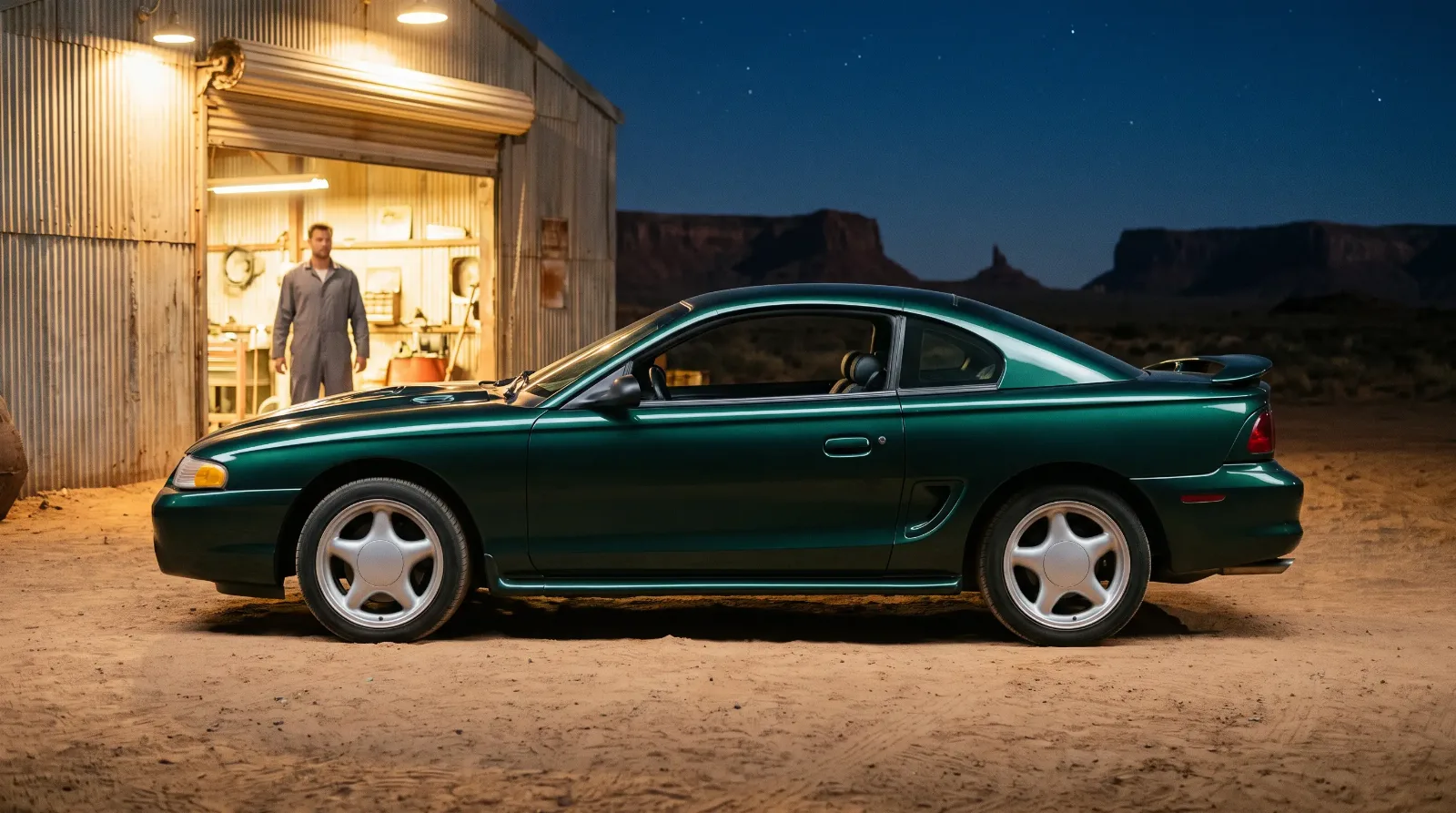
If you want to know how the 5.0 HO got its reputation in the first place, the Fox years are the background. By 1995 that engine had been the heart of the V8 Mustang for well over a decade, and 1995 turned out to be its last year in the car.
What carried over into the 1995 Mustang GT
Mechanically, nearly everything. The 5.0 HO was still rated at 215 hp at 4,200 rpm and 285 lb-ft at 3,400 rpm, SAE net. The gearbox choices were still the Borg-Warner T-5 five-speed and the AOD-E four-speed automatic. The GT kept its rectangular fog lamps, which is still the quickest way to separate it from a 1994 or 1995 Cobra, which used round ones.
The price moved. A 1994 GT coupe listed at $17,280. The 1995 GT stickered at $18,105, which is $825 more for a car that hadn't changed in any way you could measure with a stopwatch.
The mix of buyers moved too, and this is the part I find interesting. Ford built 40,718 GT coupes for 1995 against 30,592 the year before, up about a third. GT convertibles went the other way: 16,668, down from 25,381, a drop of about a third. In 1994 close to half of all GTs were convertibles. In 1995 it was closer to three in ten. The novelty of a new drop-top Mustang had worn off, and the V8 buyers were back in hardtops.
Total 1995 Mustang production was 185,986 by the commonly cited body-style tables, which add up to that figure line by line. That was up 51 percent on 1994 and the most Mustangs in a model year since 1989. It was also the only year Ford sold a removable hardtop for the convertible, a $1,825 option that went on 499 SVT Cobra convertibles and not on the GT.
The GTS: a GT with the extras taken out
The GTS is the reason a lot of people care about 1995 at all. Ford's idea was simple. Take the GT, keep everything that makes it go, and take out the parts that make it comfortable and expensive.
Out went the fog lamps and the rear spoiler. The power sport seats were replaced by manual cloth seats. Power windows and power locks were deleted, though the power mirrors stayed. What the GTS kept was the 5.0, the T-5 or AOD-E, the Traction-Lok rear axle, the dual exhaust and air conditioning. It was a coupe only, by the production tables.
| Item | 1995 GT coupe | 1995 GTS |
|---|---|---|
| Price | $18,105 | $16,910 |
| Engine | 5.0 HO pushrod V8, 215 hp, 285 lb-ft | Same |
| Transmissions | T-5 five-speed or AOD-E automatic | Same |
| Traction-Lok, dual exhaust, A/C | Yes | Yes |
| Fog lamps | Rectangular | Deleted |
| Rear spoiler | Yes | Deleted |
| Seats | Power sport seats | Manual cloth |
| Power windows and locks | Yes | Deleted (power mirrors kept) |
| Production | 40,718 | 6,370 (4,848 five-speed, 1,522 automatic) |
Now look at where that put the GTS on the price sheet. A 1995 V6 coupe was $14,530. The GTS was $16,910, so for $2,380 more than the V6 you got the 5.0 and 70 more horsepower than the 145 hp V6. Against the GT, you saved $1,195 and gave up some seat motors and a wing. Anybody who has spent time in a 1990s parts catalog knows which half of that trade mattered more for going fast.
The production count most people quote is 6,370. A figure of 7,154 credited to Kevin Marti also circulates, but the page it comes from could not be checked, so I'd treat it as unconfirmed until someone shows the Marti report itself.
Telling a real GTS from a GT with parts missing
Here is the problem with a car defined by what it doesn't have. Fog lamps unplug. A spoiler is a few bolts and some touch-up paint. Anyone with a free Saturday can make a GT look like a GTS from the outside, and a GTS can pick up a spoiler and fogs just as easily.
The interior is harder to fake. Manual window cranks and manual locks in a 1995 GT coupe are the giveaway, because swapping a car from power to manual windows is a lot of work for no obvious reward. Manual cloth seats help too, but seats are the first thing that gets replaced in a 30-year-old car. Power mirrors on a car with crank windows is the combination you're looking for.
The VIN won't settle it on its own. The engine letter in the 1994 GT's VIN is T for the 5.0 HO, and the 1995 cars use the same code. Since the GT and the GTS share the engine, they share the letter. Original paperwork, the window sticker above all, is the real proof. Without it you're reading clues, not facts.
"I like the GTS for the same reason I like a plain-cab work truck. Somebody at Ford sat down with a price sheet and asked what a V8 Mustang actually needs. The answer was the engine, the axle and the exhaust. Everything else was optional, and they were right."
Mike Sullivan
Why the pushrod 5.0 ended after 1995
For 1996 the GT got the modular 4.6, a single-overhead-cam two-valve V8 that had first gone into production in the 1991 Lincoln Town Car. It came rated at 215 hp at 4,400 rpm and 285 lb-ft at 3,500 rpm. The peak numbers were identical to the 5.0's. The way it made them was not: the new engine made its peaks 100 to 200 rpm higher, with its camshafts in the heads instead of the block.
The change took more than the engine with it. The 1996 GT also got the EEC-V engine computer, the T-45 five-speed in place of the T-5, and the 4R70W automatic in place of the AOD-E. So the 1995 car is the last GT with the whole familiar pushrod drivetrain, not just the last one with the 302.
The 5.0 bowed out of the SVT car the same year. The 1995 Cobra coupe and convertible ran a 240 hp version with GT-40 heads, its own intake, cams and injectors. The 1995 Cobra R is the exception that confuses people: its engine was the larger 5.8 (351) Windsor, rated at 300 hp, so it isn't a 5.0 at all.
The GTS idea didn't die with the 302. Ford carried the stripped-GT approach through 1998 as option package 248A, now with the 4.6 under the hood. It just never had a name on the fender again.
What the last 5.0 means now
The 1995 GT is easy to overlook because it changed so little. That's also its whole appeal. It is the final version of a recipe that started in the Fox years: a pushrod 302, a T-5 or an automatic, and a solid rear axle under a body that was finally stiff enough to use the power. The GTS is the same recipe with less on the plate, and at 6,370 cars it sits on the short list of the lowest-production SN95 variants, alongside the Cobra R and the pace-car replicas.
Not every one of them has been kept straight. These were affordable V8 cars for a long time, and a lot of them were modified, raced and repaired with whatever was on the shelf. If you go through 1995 Mustangs today, the GT and the GTS are worth a second look under the dash and in the paperwork, not just under the hood.
The 5.0 name did come back to the Mustang GT for 2011 on the all-new Coyote, a four-valve twin-cam engine. The pushrod 302, though, ended here, in a 1995 car most people still can't tell from a 1994.
Sources and notes
- 1995 Ford Mustang: production by body style and prices, MustangSpecs
- 1995 Ford Mustang GTS: deletions, price and production, MustangSpecs
- 1994 Ford Mustang: GT prices and production, MustangSpecs
- 1995 Mustang Cobra convertible with the removable hardtop, Martin Auto Museum
- VIN decode for a 1995 Mustang GT coupe, NHTSA vPIC
- Ford Modular engine: the 4.6 and the 2011 Coyote 5.0, Wikipedia
Related Reading
Have a
Ford Mustang
for Sale?
Reach thousands of serious classic car collectors across the US.
Sell It Here →
Selling a classic? Here's how: compare the places to sell classic cars
Are You a Classic Car Dealer?
List your full inventory and connect with targeted classic car buyers.
Join as a Dealer →

About the author
Mike Sullivan
Detroit-area muscle car enthusiast and restoration specialist with three decades of hands-on experience working on American iron.
Related Listings - Ford Mustang
More in Car Features
Comments
Be the first to comment on this article.