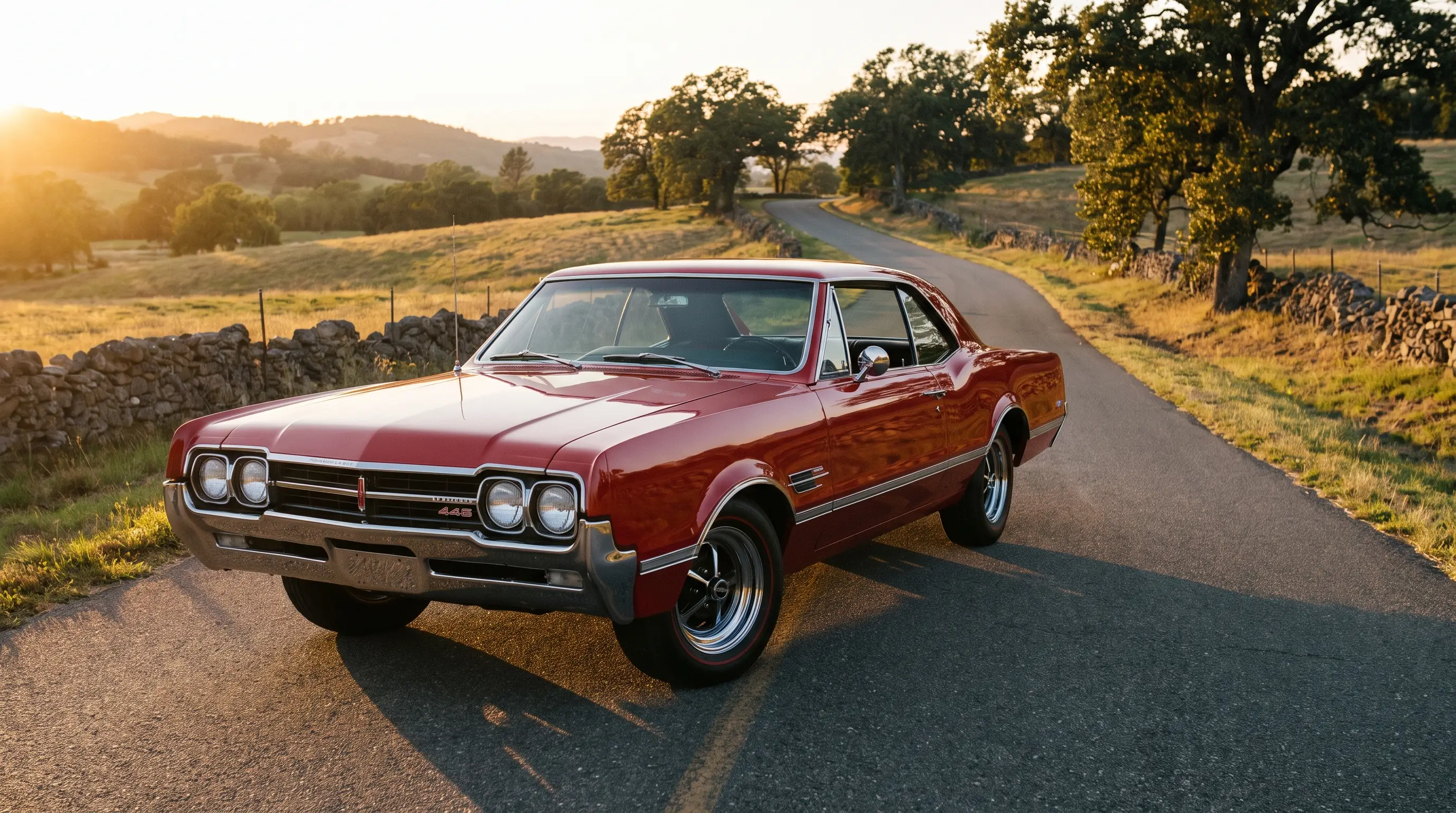
Three model years, one badge, and three genuinely different cars under the skin. That is the 1965 through 1967 Oldsmobile 442 in a sentence. This stretch is where the 442 stopped being a modest option package and started acting like a car that actually wanted to win at the strip, and it is also where the badge's own definition started coming apart at the seams. If you have only ever driven a 1968 or later 442, these three years will surprise you.
1965: the engine grows and the acronym breaks
Oldsmobile bumped the 442's engine from 330 cubic inches to 400 cubic inches for 1965, and that single change did more to the car's reputation than anything else that happened in this three-year window. The new 400, sometimes referred to in period literature as the Ultra High Compression V8, was rated at 345 horsepower and 440 lb-ft of torque, the kind of power-to-weight number that actually mattered on a Saturday night at the local strip. The B09 option package still existed on the order sheet, but nobody was thinking of it as a modest add-on anymore.
The problem was that "4-4-2" originally meant 4-barrel carburetor, 4-speed manual, dual exhaust, and that story stopped making sense once the headline feature was a 400 cubic inch engine. Oldsmobile's own marketing quietly shifted to explaining the badge as 400 cubic inches, 4-barrel carb, dual exhaust instead. Same three numbers, completely different explanation. Neither version is wrong exactly, they just belong to different model years, and mixing them up is one of the more common mistakes I hear from people who learned the acronym from a forum post instead of a factory brochure.
1966: Tri-Power arrives and complicates things further
For 1966, Oldsmobile introduced the L69 Tri-Power option, a triple two-barrel carburetor setup rated at 360 horsepower and 440 lb-ft, well past the standard four-barrel 400. This is also the year the W-30 forced-air package showed up, a separate RPO that routed cold air into the engine through functional hood scoops rather than relying purely on carburetion to make the power numbers work.
Here is the part that trips people up: a 1966 442 with the Tri-Power option technically does not have "a 4-barrel carburetor" at all. It has three 2-barrel carburetors. That breaks even the revised definition of the acronym, and Oldsmobile did not seem bothered by the contradiction one bit. The lesson for buyers today is simple. Do not assume every real 442 from this era matches whatever explanation of the name you have memorized. Check the actual engine code against the documentation for that specific car.
1967: back to a single four-barrel, and why that is not a downgrade
With Tri-Power banned by GM corporate policy, the 1967 442 went back to a single four-barrel carburetor on the 400 cubic inch engine. A lot of people read that as Oldsmobile stepping backward, and I do not see it that way. The single 4-barrel setups of this era, properly tuned, were reliable in a way the finicky triple-carb linkage never quite managed to be. Anybody who has actually had to synchronize three carburetors on an old Rochester setup knows exactly what I am talking about. Fewer parts to keep in tune is not automatically a worse car, it is a different set of tradeoffs.
1967 also refined some of the suspension and trim details that had been rougher around the edges in the first couple years of the 400 cubic inch cars. It is, in my opinion, the most buttoned-up version of the pre-1968 442, even without the Tri-Power party trick.
| Model year | Engine | Carburetion | Notable option |
|---|---|---|---|
| 1965 | 400 cubic inch V8, 345 hp | Single 4-barrel | First year of the 400 |
| 1966 | 400 cubic inch V8, up to 360 hp | Single 4-barrel or Tri-Power (L69) | W-30 forced-air introduced |
| 1967 | 400 cubic inch V8 | Single 4-barrel only | Tri-Power banned corporate-wide |
What this means for buyers today
If you are shopping this era, the 1966 Tri-Power cars command real attention because of their short production window, but they also come with the highest fake-out risk. A 4-barrel car with a bolted-on Tri-Power intake and three carburetors from the parts bin looks convincing to somebody who has not seen the real thing. Get the documentation before you get excited about the induction system. That goes for the W-30 package too, since the scoops and decals are trivial to reproduce compared to the actual factory paperwork trail.
For the background on the whole model line this era grew out of, the Oldsmobile 442 lays out the bigger picture, and our Cutlass retrospective is worth reading if you want to understand the car the 442 package was built on top of during these years.
"A real Tri-Power 442 from '66 is a great find. A four-barrel car with an aftermarket intake bolted on is a different animal wearing the same badge. Ask for paperwork before you ask about horsepower."
— Mike Sullivan
Where the story goes next
By the end of 1967, the 442 had already grown from a modest option package into a genuine performance car with its own reputation, even while it was still technically riding on the F-85/Cutlass platform as an add-on. That changed the following year, when Oldsmobile gave the 442 its own identity as a standalone series. If you are curious what happens after the single-carburetor era settles in, the next story in this set picks up right where 1967 leaves off. And if you are shopping rather than just reading, a classic Oldsmobile 442 for sale from this era is worth cross-checking against everything covered here before you write a check.
Sources and notes
- Oldsmobile 442 - Wikipedia
- 1965 Olds 442 - Muscle Car Facts
- 1966 Oldsmobile 442 - Muscle Car Facts
- Middle-of-the-Road Muscle: The Oldsmobile Cutlass and 442 - Ate Up With Motor
- Tri-carb induction wasn't always about the quarter mile - Hagerty Media
- Pick of the Day: 1966 Oldsmobile 4-4-2 W30 - ClassicCars.com Journal