
Stand a 1978 Ford Bronco next to a same-year F-100 pickup and the relationship is obvious before you even open a door. The ford bronco 1978 f series dna runs through nearly every visible panel, from the grille and front fenders to the windshield and cab structure. This was not a case of two trucks that happened to look similar. Ford built the 1978 Bronco directly off the F-Series parts bin, and understanding how deep that sharing went explains a great deal about how the truck drives, how it holds up today, and why parts for it are easier to find than parts for the compact Bronco it replaced.
Car Features
7 min read
How the 1978 Bronco Borrowed the F-Series Body
The 1978 Bronco shared doors, cab, frame, and front axle with the contemporary F-Series pickup, a parentage that still shapes parts availability today.
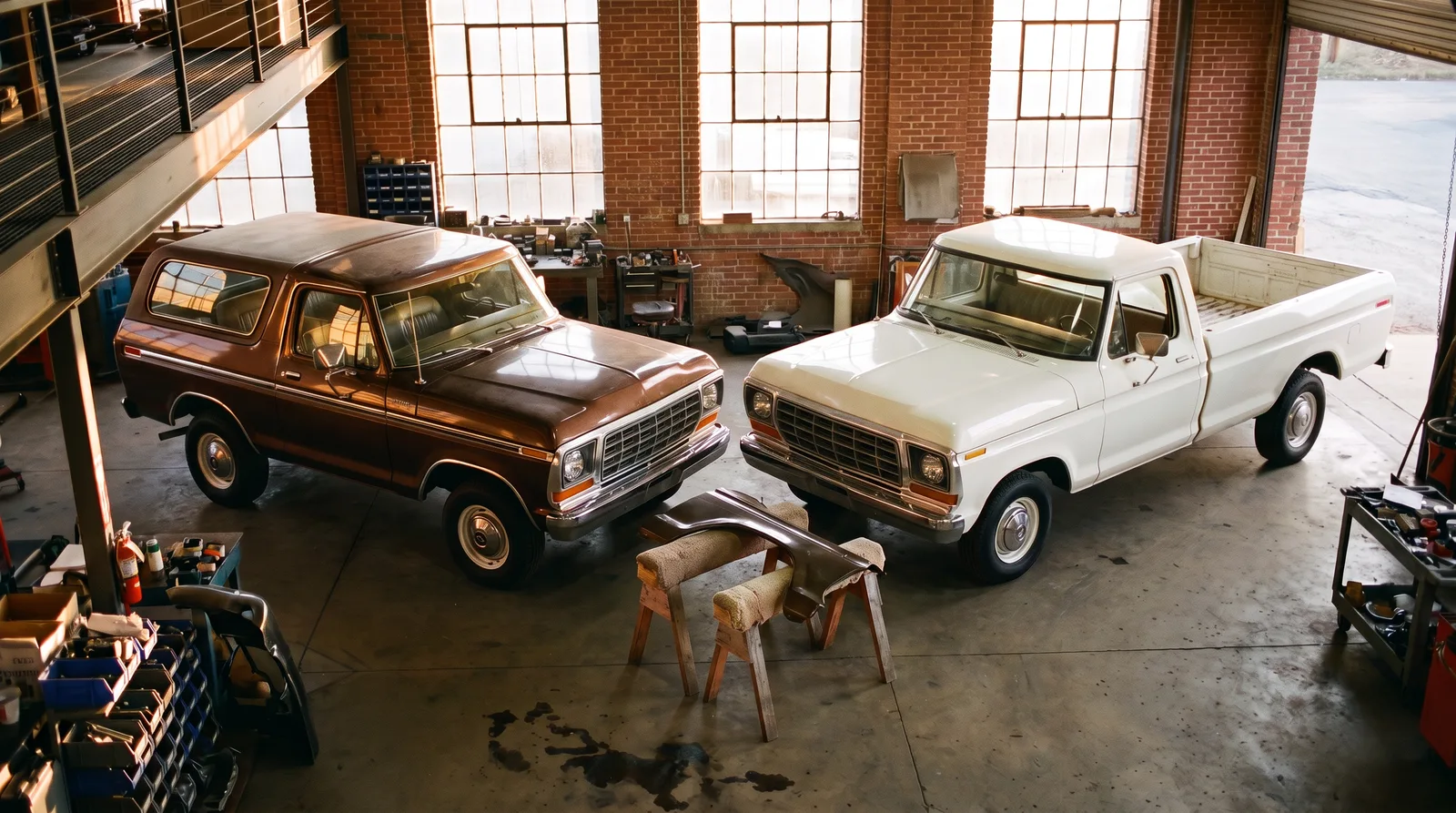
One cab, two badges
The 1978 Bronco used the F-100 cab structure essentially unaltered behind the doors, and the doors themselves, along with the front fenders, hood, and grille, came straight from the F-Series line. Ford shortened the wheelbase to 104 inches, well short of a standard short-bed F-100, and grafted a cargo area with a removable fiberglass top onto the back of that cab. But sit in the driver's seat and the dashboard, steering column, and gauge cluster are pulled directly from the contemporary pickup. A Ford salesman in 1978 could point to nearly identical switchgear whether he was showing a customer an F-150 or a Bronco parked next to it.
This kind of sharing was standard practice across Detroit by the late 1970s, and Chevrolet had already proven the formula worked with the Blazer riding on C/K pickup bones. What made the Bronco's version notable is how little Ford disguised it. Where some manufacturers reworked shared sheet metal enough to blur the family resemblance, the 1978 Bronco wore its F-Series parentage plainly.
Chassis and running gear underneath
Below the sheet metal, the sharing continued. The Bronco rode on a shortened version of the F-100 ladder frame, with the same basic suspension geometry, and four-wheel-drive models used the Dana 44 front axle also found under contemporary F-Series trucks. Engine choices tracked the pickup lineup closely too, with the 351M V8 standard and the larger 400 cubic inch V8 optional, both pulled from the same M-series engine family Ford offered across its truck range that year. A buyer cross-shopping an F-150 and a Bronco in 1978 was, mechanically, looking at close cousins wearing different bodies.
more on the 1978 ford bronco covers the full production story of how that platform sharing translated into the finished truck buyers actually drove off the lot, including trim levels and the two model years the full-size Bronco was built before Ford revised it again for 1980.
| Component | Shared with F-Series |
|---|---|
| Doors, fenders, hood, grille | Yes, same stampings |
| Cab and dashboard | Yes, F-100 structure |
| Front axle (4x4) | Dana 44, shared |
| Ladder frame | Shortened F-100 frame |
| Rear body and top | Bronco specific, removable fiberglass top |
Where the Bronco departed from the F-Series
None of this means the 1978 Bronco was simply a shortened pickup with a fiberglass cap bolted on. Ford's engineers made real changes to differentiate the two vehicles even while sharing so much hardware. The rear body structure, the removable top and its mounting points, and the shortened frame rails behind the cab were all Bronco-specific, engineered to give the truck its own cargo area and roofline rather than simply lopping the bed off an F-100. The fuel tank location and capacity also differed from the pickup, positioned to work with the shorter wheelbase and the enclosed rear body.
Interior trim levels diverged as well. While the basic dashboard and switchgear carried over from the F-Series, Ford offered Bronco-specific upholstery packages and trim badging that distinguished the truck inside the cab, even for buyers who never looked underneath to compare frames. Ranger and Custom trim designations, familiar from the F-Series lineup, carried over to the Bronco, but the specific color and material combinations offered on the Bronco did not always match what was available on the contemporary pickup exactly.
These distinctions mattered to Ford's marketing even if they did not change the fundamental engineering relationship. A buyer walking into a Ford dealership in 1978 was meant to see a Bronco as its own vehicle with its own identity, not simply a two-door F-100 with a roof welded on, even though a mechanic working underneath the truck would have recognized the shared architecture immediately.
Why this matters more than badge engineering usually does
Plenty of vehicles across automotive history share a platform with a more common sibling without anyone caring much. The Bronco's F-Series connection matters because it marks such a sharp break from what came before. The original 1966 Bronco had its own dedicated 92-inch chassis, built specifically for the model with no direct pickup equivalent. Its replacement abandoned that independence entirely, choosing instead to be a Bronco-bodied variant of the truck Ford already knew how to build efficiently and profitably. where this started traces that earlier, standalone chassis back to the Bronco's 1966 origins, before the F-Series relationship existed at all.
For collectors and restorers, the practical upside of this parentage is real. Interior trim, door hardware, front suspension components, and many drivetrain parts overlap with F-Series trucks of the same era, which were built in far higher volumes. That overlap keeps parts availability healthier for the 1978-79 Bronco than for the compact model, where Bronco-specific pieces can be harder to source.
The tradeoff nobody talks about enough
Sharing so much with the F-Series gave the 1978 Bronco genuine capability, but it also meant the truck lost some of what made the original Bronco distinctive. The compact Bronco's tight turning radius and light, nimble feel came directly from its purpose-built chassis. Once the Bronco became a shortened pickup, it inherited a pickup's road manners, for better and for worse. Buyers got more room, more power, and easier towing. They gave up the go-anywhere agility that had defined the nameplate through its first dozen years.
"Once you have documented enough 1978 Broncos and F-100s side by side, you stop seeing two different trucks. You see one platform wearing two bodies, and Ford was not shy about it."
- Sarah Whitfield
The parts overlap also shapes restoration decisions in ways many buyers do not anticipate until they are already deep into ownership. A cracked windshield gasket, a worn door hinge, or a tired suspension bushing on a 1978-79 Bronco can often be sourced from the same supplier catalogs that serve F-Series pickup owners, since the two vehicles used identical or near-identical part numbers for many mechanical and body components. That is a meaningful practical advantage over the compact Bronco, where some trim and body pieces exist only in the smaller pool of parts made specifically for that model, and where reproduction suppliers have had to fill gaps that never existed for the F-Series-based truck.
If you want to see how that shared architecture holds up on the used market today, you can browse classic Broncos on the market and compare condition and originality across surviving examples from the 1978-79 run.
Sources and notes
Related Reading
Have a
Ford Bronco
for Sale?
Reach thousands of serious classic car collectors across the US.
Sell It Here →
Selling a classic? Here's how: the best sites to sell a classic car
Are You a Classic Car Dealer?
List your full inventory and connect with targeted classic car buyers.
Join as a Dealer →

About the author
Sarah Whitfield
Third-generation classic car collector specializing in pre-war American and European coachbuilt automobiles. Researcher and concours enthusiast.
Related Listings - Ford Bronco

Comments
Be the first to comment on this article.