
The archival record of American off roading through the late 1960s and 1970s is written almost entirely in the voices of men, in trade magazines, in dealer brochures, in the roster lists of desert races. Look closely at the photographs, though, and a different picture starts to come into focus. The ford bronco first gen women drivers story has been sitting in plain sight for decades, undercatalogued and rarely asked about, and it deserves a more careful accounting than it has generally received.
Car Features
7 min read
Women and the Early Bronco, an Overlooked History
Period advertising, competition entry lists, and family ownership records point to a fuller history of women and the early Ford Bronco than the standard telling allows.
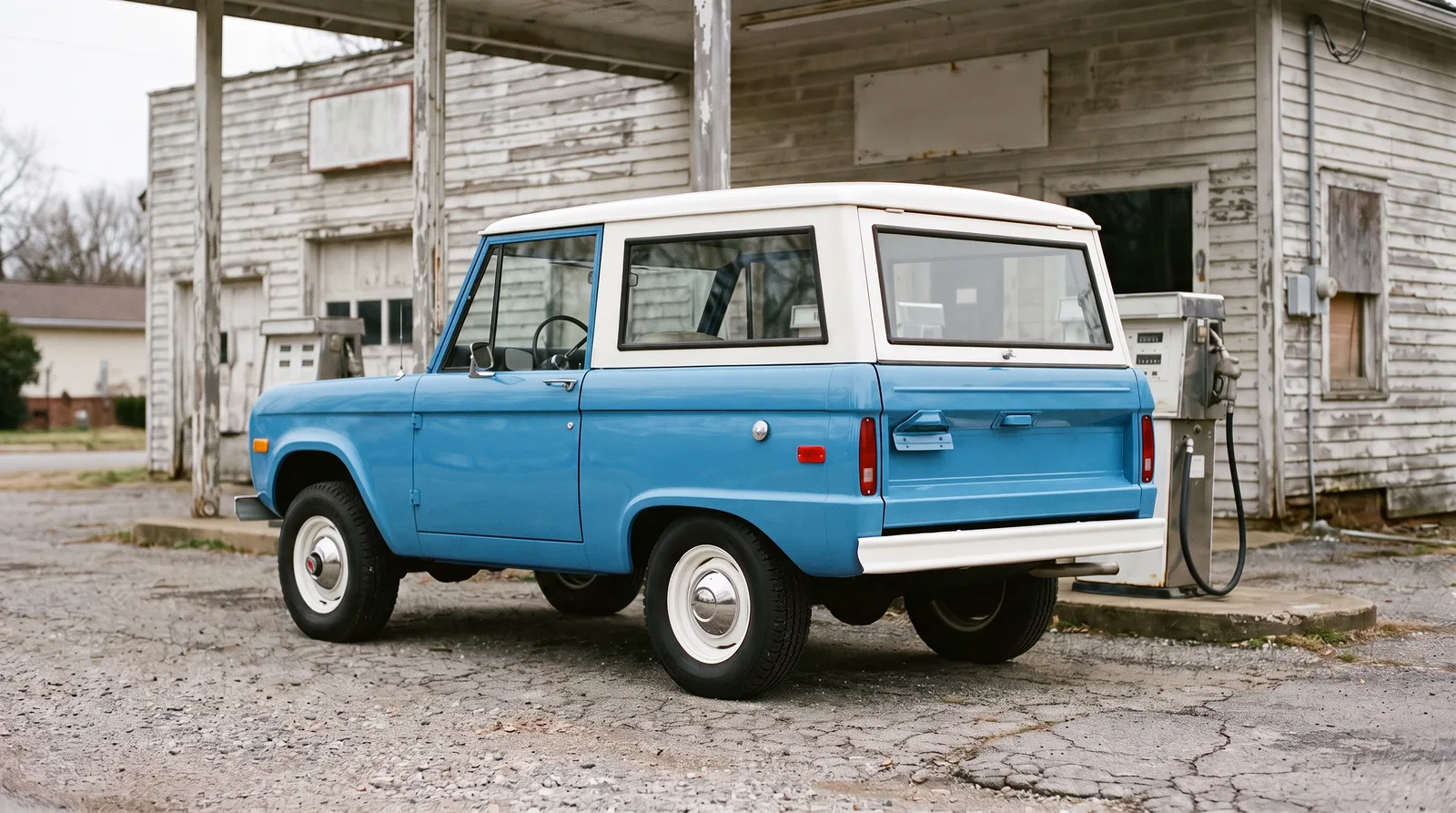
What the sales literature actually shows
Ford's own marketing for the early Bronco was not exclusively aimed at men, even if later retellings of the truck's history tend to assume it was. Period brochures from the late 1960s feature women behind the wheel with some regularity, often shown driving rather than simply posed beside the vehicle, which was a meaningfully different choice than most competing truck advertising of the era made. Whether that reflected genuine market research or simply an art director's instinct is hard to say with certainty from the surviving documents, but the visual pattern is consistent enough across several years of Bronco print advertising that it was not incidental.
Dealer records from the period are thinner on this point, and no reliable published figure exists for the specific share of early Bronco sales that went to women buyers in the 1960s and 1970s, so any precise percentage should be treated with real skepticism. Anecdotal dealer accounts describe the Bronco as an unusually common first vehicle purchase for young women in rural and suburban markets alike, in part because its short wheelbase and light controls made it more approachable than a full size pickup.
Competition, not just commuting
Off road competition in the late 1960s and 1970s was overwhelmingly male, but not exclusively so, and the Bronco was present at both ends of that story. Women competed in desert races including events tied to the Baja circuit during this period, occasionally as co-drivers and navigators, sometimes as the driver of record, running Broncos alongside prepared trucks and buggies. These entries rarely made the headline coverage that the leading male competitors received, and the names of many of these women have to be pieced together from entry lists and regional newspaper coverage rather than any single comprehensive source. That gap in the record is itself part of the story. The truck was there. The full accounting of who drove it competitively is still being assembled by historians and enthusiast researchers today, often working from faded entry lists, sponsor decals visible in old photographs, and interviews with surviving family members rather than any single organized database. A few names have resurfaced clearly enough to be confirmed in more than one source, but for every documented entry there appear to be several more that exist only as a blurry photograph captioned with a first name and a hometown, which is not enough for a historian to work with confidently but is more than enough to prove the pattern was real and not incidental.
A pattern that repeats across the rural West
The most consistent thread running through surviving dealer accounts and family histories is not any single dramatic story but a quiet, repeated pattern across ranching communities from Montana down through Texas. A daughter learning to drive on a Bronco because it was the vehicle small enough for her to handle safely. A rancher's wife using it as her own working truck for feed runs and fence checks rather than riding along in her husband's larger pickup. A widow keeping the family Bronco running for decades after a spouse passed, because it was the vehicle she already knew how to maintain and trusted. None of these stories individually rewrites the historical record, but taken together they describe an ownership pattern that period marketing materials only partially captured and that later retrospectives have mostly ignored in favor of a simpler, more male coded narrative about ranch trucks and off road racing.
Regional Bronco clubs in states with strong ranching and rodeo traditions have started actively soliciting these family stories as part of broader documentation projects, recognizing that the generation who bought these trucks new is aging out and the firsthand accounts will not be recoverable much longer. That urgency has pushed some of this research further in the past decade than in the previous four combined, though the work is still far from complete and relies heavily on volunteer effort rather than any institutional archive.
Everyday ownership, quietly documented
Beyond racing and advertising, the more common story is the one that never made it into any magazine at all, women who simply bought and drove Broncos as ranch trucks, ski trip vehicles, and daily transportation across the rural West and beyond. Concours and club circles today are slowly recovering some of this history through oral interviews with original owners and their families, and a recurring theme in those accounts is that the Bronco's size made it feel manageable in a way full size trucks of the same period did not. A woman who might have found a three quarter ton pickup intimidating to park or maneuver often found the Bronco's compact dimensions genuinely usable, which is a practical explanation that gets less attention than it deserves in a history that tends to focus on horsepower and trim levels instead.
"The ownership records survive better than the stories do, and that is the gap researchers are still working to close."
- Sarah Whitfield
Why this history matters to collectors now
Provenance research has become a serious part of how the collector market evaluates any early Bronco, and original ownership documentation, including cases where a truck's first or long term owner was a woman, is increasingly treated as a point of interest rather than a footnote. A well documented ownership chain adds real value regardless of who held the title, but it also means these overlooked stories are finally being written down rather than lost when a family sells the truck. Anyone researching a specific vehicle's history should treat surviving registration paperwork, insurance records, and family photographs as primary sources worth preserving alongside the truck itself.
For readers who want the fuller mechanical and market context behind these trucks, more on the first generation bronco covers the platform in depth, while our complete history traces the model across all four decades of production. Those researching or shopping for a truck with documented history of any kind can review classic Broncos on the market to see what is currently available and how sellers are presenting provenance today.
The early Bronco was never marketed, driven, or owned by only one kind of person, and the more the ownership record gets pulled out of family attics and into public archives, the clearer that becomes.
Sources and notes
Related Reading
Have a
Ford Bronco
for Sale?
Reach thousands of serious classic car collectors across the US.
Sell It Here →
Selling a classic? Here's how: where to sell your classic car online
Are You a Classic Car Dealer?
List your full inventory and connect with targeted classic car buyers.
Join as a Dealer →
#automotive history
#Ford Bronco
#classic truck ownership
#first generation bronco
#women in motorsport

About the author
Sarah Whitfield
Third-generation classic car collector specializing in pre-war American and European coachbuilt automobiles. Researcher and concours enthusiast.
Related Listings - Ford Bronco
Comments (1)
T
Tony Marchetti
3 days ago
Those brochure photos, reprinted anywhere, anybody??
Some have been reprinted in club literature, but originals from literature dealers are the better record because the print date and dealer imprint survive. Look for the regional dealer versions too, which vary more than the national ones.