
Every population of rare cars has an edge case that sits alone at the extreme end of the distribution, the one combination so improbable that the rest of the market treats it almost as a different category entirely. For the Barracuda, that edge case is the 1971 hemi cuda convertible, a car built in numbers so small that describing it as rare almost undersells the point. This is not a rare Barracuda. This is one of the rarest production cars General Motors, Ford, or Chrysler built in the entire muscle car era, full stop.
Car Features
7 min read
The 1971 Hemi Cuda Convertible: The Holy Grail
Three independent scarcity factors stack into one car, making the 1971 Hemi Cuda convertible one of the rarest production cars of the entire muscle car era.
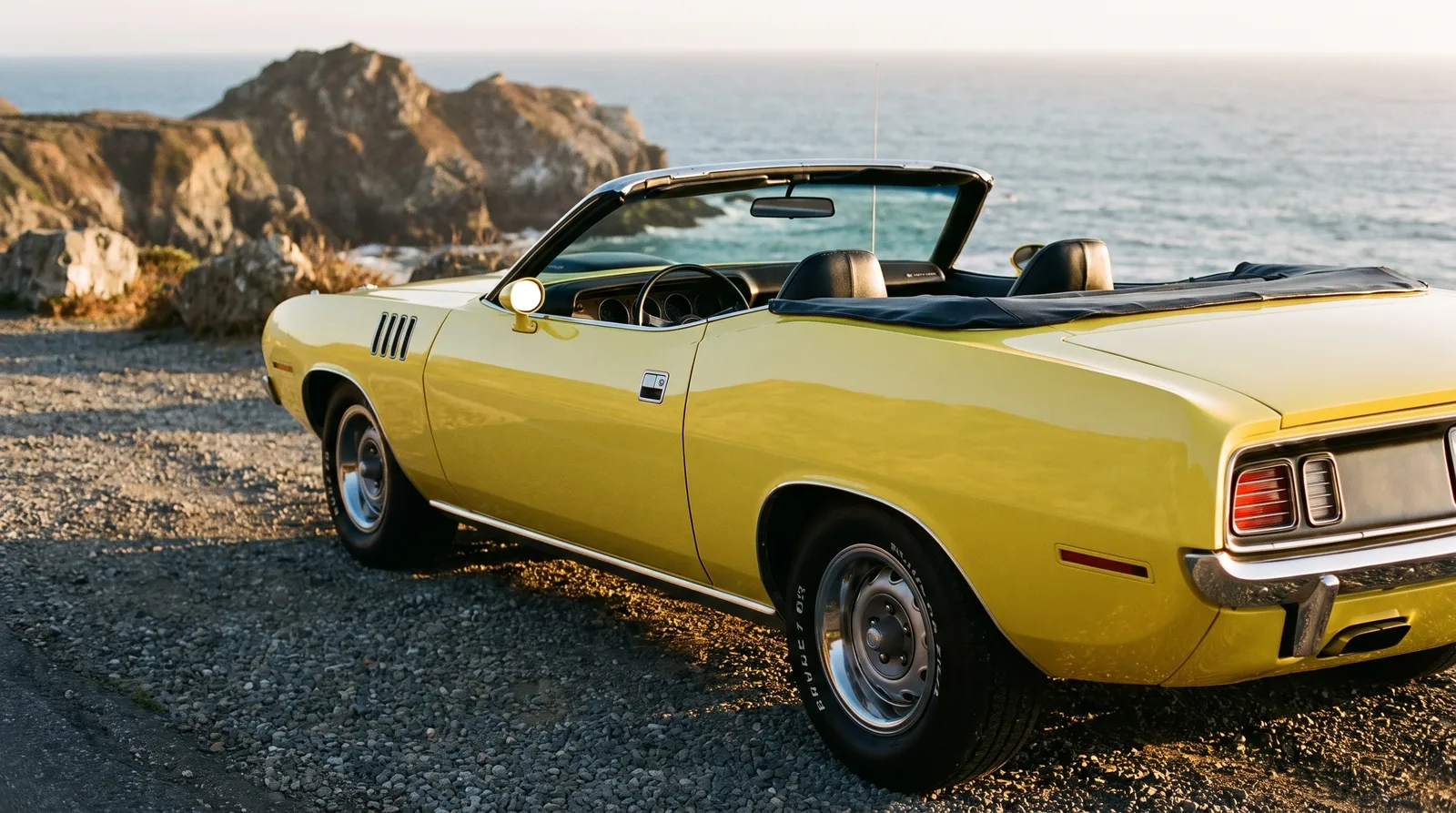
Stacking scarcity on scarcity
Start with the 426 Hemi option itself, offered in the Cuda for only two model years, 1970 and 1971, before insurance and emissions pressure ended it. Layer on convertible body style, which had already fallen sharply out of favor with buyers by 1971 across the entire American industry, well before this specific combination even enters the picture. Then layer on the fact that 1971 was the final year the Hemi was offered at all in the Cuda. Each of those three factors independently reduces the pool of possible cars. Multiplied together, they produce a build count low enough that this is not really a market segment, it is a specific, countable list of individual cars that serious collectors can name.
This is the kind of compounding rarity problem that rewards a systematic approach rather than an emotional one. When three independent scarcity factors stack, the resulting population does not shrink additively, it shrinks multiplicatively, and that is exactly the mechanism that makes the 1971 hemi cuda convertible sit in a category by itself even within an already rare model lineup.
How few, exactly
Documented production of 1971 Hemi Cuda convertibles is most commonly cited at twelve cars total, with roughly five built with automatic transmissions and the remainder four-speed manual, though the exact automatic-to-manual split still varies slightly between sources and remains a point of ongoing documentation work among Mopar historians. Whatever the precise final figure turns out to be once every surviving broadcast sheet is cross-checked, the order of magnitude is not in dispute. This is a single-digit-to-low-double-digit production run, the kind of number more commonly associated with a coachbuilt exotic than a mass-market American manufacturer's mid-size performance car.
That production reality means every claimed example needs to be treated as an individual research problem rather than a market category. Fender tag decode, broadcast sheet cross-reference, and a documented ownership chain matter more here than on almost any other Barracuda variant, because the financial gap between a genuine, documented example and an undocumented claim is enormous, and the incentive to misrepresent a car in this bracket is correspondingly high.
Why the color and options data matters just as much as the count
Total production count is only the first variable in this analysis, and treating it as the only one leads to systematic underestimation of just how granular this rarity actually gets. Cross the transmission split against the original exterior color, against interior trim choice, against any additional performance or convenience options ordered on top of the base Hemi package, and the resulting matrix of unique combinations shrinks the true population of any single, fully-specified configuration to numbers that may well be one or two cars, not a dozen. A specific color and transmission pairing within this already tiny production run can be functionally unique, a population of one, and that changes the entire analytical frame a buyer or researcher should use.
This is the same logic that applies to any extreme-tail distribution analysis: as you add independent conditioning variables, the surviving sample size for any fully specified combination collapses fast, often faster than intuition expects. A researcher looking at twelve total cars and then asking how many of those were a specific color with a specific transmission is not asking a market question anymore, they are asking a genealogy question, and the answer requires primary-source documentation rather than statistical inference from a larger comparable set, because there simply is no larger comparable set once the conditioning gets this specific.
Treat every claim about a specific 1971 Hemi Cuda convertible's exact specification with that granularity in mind. A seller citing "one of twelve" without specifying which of the underlying variables that count actually covers is giving you a partial answer to a question that has a much more precise, and usually much smaller, true answer once every documented variable is accounted for.
Reading the documentation correctly
A methodical buyer treats the fender tag as a starting hypothesis, not a conclusion. The tag's codes should cross-reference cleanly against a broadcast sheet where one survives, against the VIN's own coded information, and against any factory invoice or dealer paperwork that has stayed with the car. Where those sources agree, confidence rises. Where they conflict, or where key documents are simply missing, the honest conclusion is that the car's status is unresolved, not that it should be assumed genuine because the seller says so.
This approach applies to every Hemi Cuda claim, but it matters most here, at the top of the rarity pyramid, where the financial stakes of getting the verification wrong are highest. Read our complete history of the Hemi Cuda lineup for the documentation framework that applies across every model year, not just 1971.
"Three independent scarcity factors compounding into one car is not a marketing claim, it is arithmetic. The documentation standard has to match the stakes that arithmetic creates."
- Emily Chen
What comparable sales even mean at this scale
Standard valuation methodology leans on a pool of comparable sales, enough completed transactions in a similar configuration to establish a defensible price range. That methodology simply breaks down at a population this small. With a total build count in the single digits to low double digits worldwide, there may be only two or three genuinely comparable sales in existence for a given specific configuration, and each of those sales carries its own idiosyncrasies, a different buyer pool, a different auction house, a different economic moment, that make treating them as a clean statistical sample misleading.
The honest approach here is closer to appraising a unique piece of art than pricing a production car. Each transaction has to be read individually, understood in its own context, rather than averaged into a smooth market curve the way a more common car's pricing can be. That is not a failure of the market, it is simply what happens once a population shrinks small enough that the law of large numbers no longer applies, and any appraiser or buyer who quotes a confident price range for this specific car without acknowledging that limitation is overstating the precision the underlying data actually supports.
Why this combination still gets discovered
Because Hemi Cuda convertibles were built in such small numbers and often ordered by individual buyers rather than fleet accounts, some genuine examples spent decades in private hands, undocumented in any public registry, before resurfacing at estate sales or through family transfers. That pattern is part of why this specific segment of the market still produces the occasional verified new discovery even now, five decades after production ended. Every one of those discoveries goes through the same documentation gauntlet described above before the wider collector community accepts it, and that skepticism is appropriate given what a wrongly attributed claim would be worth if it went unchallenged.
For collectors and researchers who want to see the broader universe of cars this combination sits at the top of, find a classic Barracuda is a reasonable starting point for comparing documented listings against the standard this article lays out.
The 1971 Hemi Cuda convertible is not a car you shop for casually. It is a small, specific, heavily researched population, and treating it with anything less than full documentation rigor is the fastest way to get an expensive answer wrong.
Sources and notes
- DodgeGarage: Multi-Million-Dollar Mopar Sells at Mecum
- SlashGear: All About the 1971 Plymouth Hemi 'Cuda Convertible
- Classic Industries: The Unicorns of Auburn Hills, 1970 and 1971 Hemi 'Cuda Convertibles
- DodgeGarage: Sno-White 1971 Hemi 'Cuda Convertible
- Motorious: The Rarest of a Dying Breed, 1971 Hemi 'Cuda Convertible
Related Reading
Have a
Plymouth Barracuda
for Sale?
Reach thousands of serious classic car collectors across the US.
Sell It Here →
Selling a classic? Here's how: the best sites to sell a classic car
Are You a Classic Car Dealer?
List your full inventory and connect with targeted classic car buyers.
Join as a Dealer →

About the author
Emily Chen
Bay Area engineer with a deep focus on vintage Japanese and European performance cars. Approaches classic car research and restoration with an analytical eye.
Related Listings - Plymouth Barracuda

Comments
Be the first to comment on this article.