
One car sits above every other Mopar on the auction circuit, and it is not the one with the biggest engine or the flashiest paint. It is a 1971 Hemi Cuda convertible, and among collectors who track these things closely it has earned the nickname the hemi cuda holy grail because so few were built and so few survive with original drivetrains intact. When one comes up for sale, and it happens rarely, the number attached to it reorders what everyone thought they knew about muscle car ceilings.
Car Features
7 min read
The Holy Grail of Mopar Collecting
The 1971 Hemi Cuda convertible sits above every other muscle car on the auction circuit, and the numbers behind that reputation actually hold up.
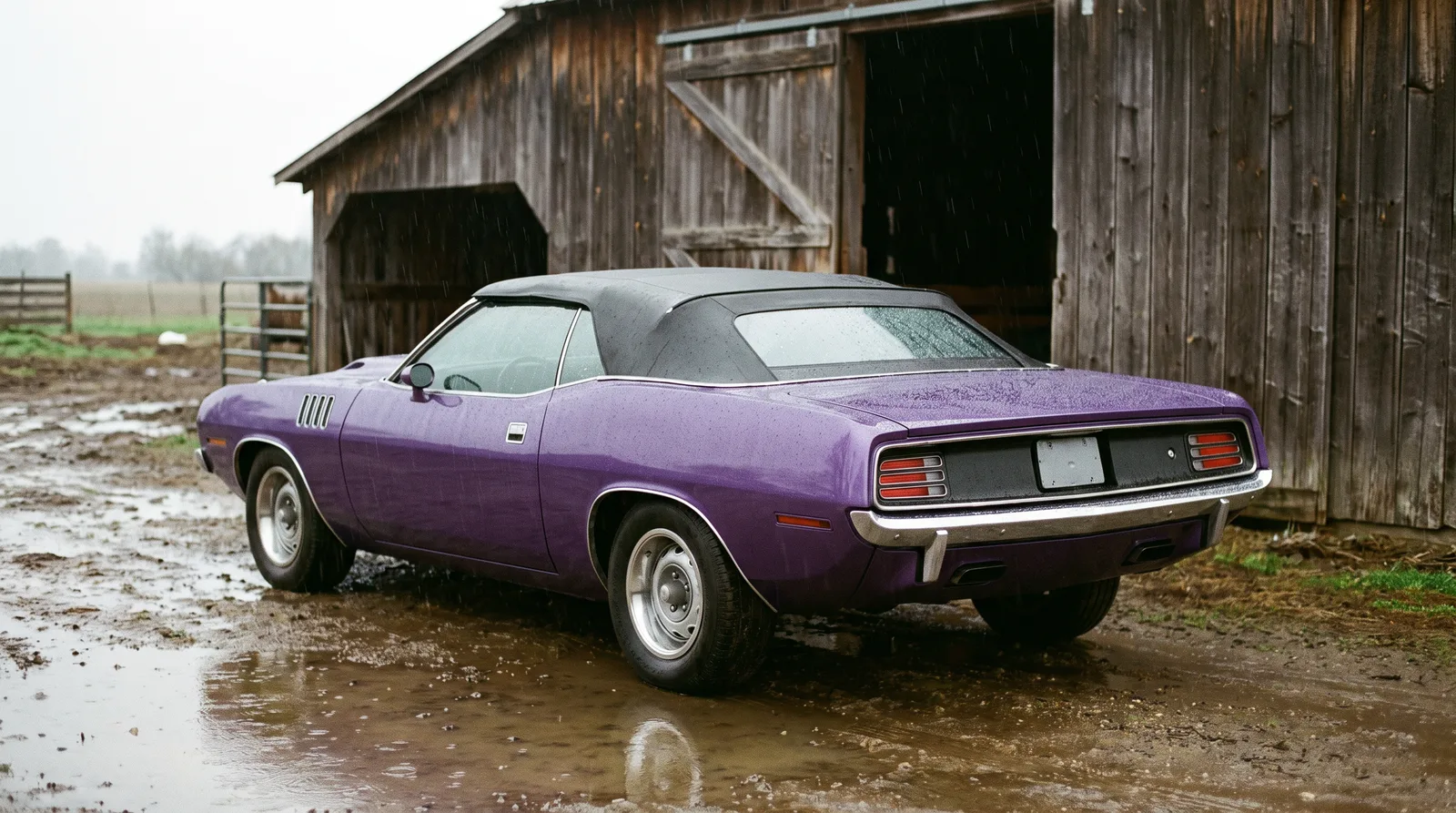
Why the 1971 Hemi Cuda convertible sits above everything else
Plymouth built the Hemi Cuda for two years, 1970 and 1971, and the convertible body style was always the minority choice within an already small production run. Add the 426 Hemi option to a convertible in 1971 specifically, the final year the engine was offered in the Barracuda, and the number of surviving cars drops into territory where auction houses can often account for every known example by chassis number. That level of scarcity does not exist anywhere else in the muscle car era at a comparable price point, which is exactly why this car commands auction results that dwarf its hardtop siblings.
Several sales of these convertibles have crossed the multi-million dollar threshold at major auction houses over the past two decades, with the trajectory generally upward as fewer examples remain in private hands willing to sell. Mecum sold one for a record $3.5 million at its 2014 Seattle debut auction, and a 1971 Hemi Cuda convertible sold again at Mecum's Kissimmee auction for $3.3 million in January 2026, the second-highest price ever paid for a Plymouth at auction.
What the auction record actually shows
Track the sales of 1971 Hemi Cuda convertibles going back to the early 2000s and a pattern emerges. Early sales in that period were already remarkable for a muscle car, well into seven figures. By the 2010s, documented examples with verified numbers-matching drivetrains were routinely clearing higher thresholds, and by the most recent sales this class of car has been discussed in the same breath as pre-war classics and postwar European exotics, an unusual comparison for anything built in Detroit.
The pattern is consistent with basic scarcity economics. As fewer examples change hands and as documentation standards for verifying numbers-matching cars have improved, buyers with serious capital have been willing to pay a premium for certainty on top of rarity. A car with a full, unbroken ownership chain and a verified fender tag now commands more than a comparable car with gaps in its paper trail, and that gap has widened over time rather than narrowed.
| Factor | Effect on value |
|---|---|
| 1971 model year, final Hemi option year | Adds scarcity premium over 1970 hardtops |
| Convertible body style | Significant premium over hardtop of same spec |
| Numbers-matching engine and drivetrain | Largest single driver of top-tier sales |
| Documented ownership chain | Reduces risk discount, raises achievable price |
Is it actually worth the price, or is the market pricing in mythology
My honest read as an analyst, not a fan, is that this is one of the few muscle car segments where the price is defensible on fundamentals rather than pure hype. The production numbers are real, the documentation standards have genuinely tightened over the past twenty years, and the pool of buyers capable of writing a check at this level has grown, not shrunk, as classic car ownership has become a recognized asset class for high net worth collectors. That combination of hard scarcity and expanding buyer pool is what supports a price trajectory that keeps climbing rather than one that is due for a correction.
Where I would tell a buyer to be careful is provenance risk. At this price level, a car with any ambiguity in its build sheet, fender tag, or ownership history should be treated as a different, lower tier asset entirely, regardless of what the seller claims about its history. The gap between a fully verified example and a disputed one is not a discount, it is a different market.
"This is the rare case where I tell a client the price is not the risk. The paperwork is the risk. Get the paperwork right and the price takes care of itself."
- David Mercer
How the hardtop and convertible markets diverge
It is worth separating the hardtop story from the convertible story here, because they have not moved together. A 1971 Hemi Cuda hardtop, still rare by any normal measure, trades at a fraction of what its convertible sibling commands, and that gap has widened rather than narrowed over the past two decades. Some of that is simple body style preference among collectors generally, convertibles across most muscle car nameplates carry a premium over hardtops. But the gap on the 1971 Hemi Cuda specifically is larger than the typical convertible premium seen elsewhere in the muscle car market, which tells me the scarcity of the drop-top variant is doing more work than body style preference alone would predict.
Buyers who cannot stretch to convertible pricing should not read that as the hardtop being a lesser car. A well documented 1971 Hemi Cuda hardtop remains one of the strongest values in the entire muscle car market relative to its rarity, simply because the convertible has absorbed so much of the attention and the capital.
What this means for anyone shopping below the top tier
Very few readers are in the market for the single rarest Hemi Cuda convertible, and that is fine, because the same principle applies at every price point below it. Documentation quality, not just rarity or engine size, is what separates a strong buy from an overpriced gamble across the entire Hemi Cuda market. A hardtop with verified numbers and a clean paper trail will always outperform a flashier car with question marks, and buyers who understand that the holy grail's value is built on documentation as much as scarcity are better equipped to evaluate every other Hemi Cuda on the market too. For the whole picture on how these cars were built and optioned, the full history fills in what the auction results only hint at.
The bottom line
The 1971 Hemi Cuda convertible earns its holy grail reputation on numbers that hold up under scrutiny, low production, a hard cutoff on Hemi availability, and a buyer pool willing to pay for verified rarity. It is one of the rare instances in the collector car world where I would call the pricing rational rather than speculative. For buyers working at any budget level who want to see what is actually available right now, the smartest first step is to find a classic Barracuda and start evaluating documentation before falling for the badge alone.
Sources and notes
- Supercars.net: Record $3.5 Million for 1971 Hemi Cuda Convertible
- Autoevolution: Holy-Grail 1971 Hemi Cuda Convertible Sells for $3.3 Million
- Classic Industries: The Unicorns of Auburn Hills, 1970 and 1971 Hemi Cuda Convertibles
- Dodge Garage: Multi-Million-Dollar Mopar Sells at Mecum
- Hagerty: Ultra-Rare Four-Speed Hemi Cuda Convertible
- Wikipedia: Plymouth Barracuda
Related Reading
Have a
Plymouth Barracuda
for Sale?
Reach thousands of serious classic car collectors across the US.
Sell It Here →
Selling a classic? Here's how: sell my classic car
Are You a Classic Car Dealer?
List your full inventory and connect with targeted classic car buyers.
Join as a Dealer →
#Plymouth Barracuda
#provenance
#Hemi Cuda
#muscle car auctions
#Mopar collecting
#classic car investing

About the author
David Mercer
Classic car market analyst with two decades of experience tracking collector car valuations, auction results, and investment trends.
Related Listings - Plymouth Barracuda




Comments
Be the first to comment on this article.