
Trim badges are small pieces of evidence, easy to overlook and easy to lose, and they tell a researcher more about how a truck was actually sold than almost anything else on the vehicle. The k5 blazer 1973 cheyenne trim is one of the more telling pieces of that evidence from the squarebody redesign year, a package that reveals exactly how Chevrolet wanted to position its newly reworked truck against a market that was growing more comfortable spending real money on a four-wheel-drive vehicle.
Car Features
9 min read
The 1973 K5 Blazer Cheyenne Trim
The Cheyenne trim package on the redesigned 1973 K5 Blazer extended Chevrolet's pickup trim hierarchy into the sport-utility line, and it still carries real weight for collectors evaluating originality.
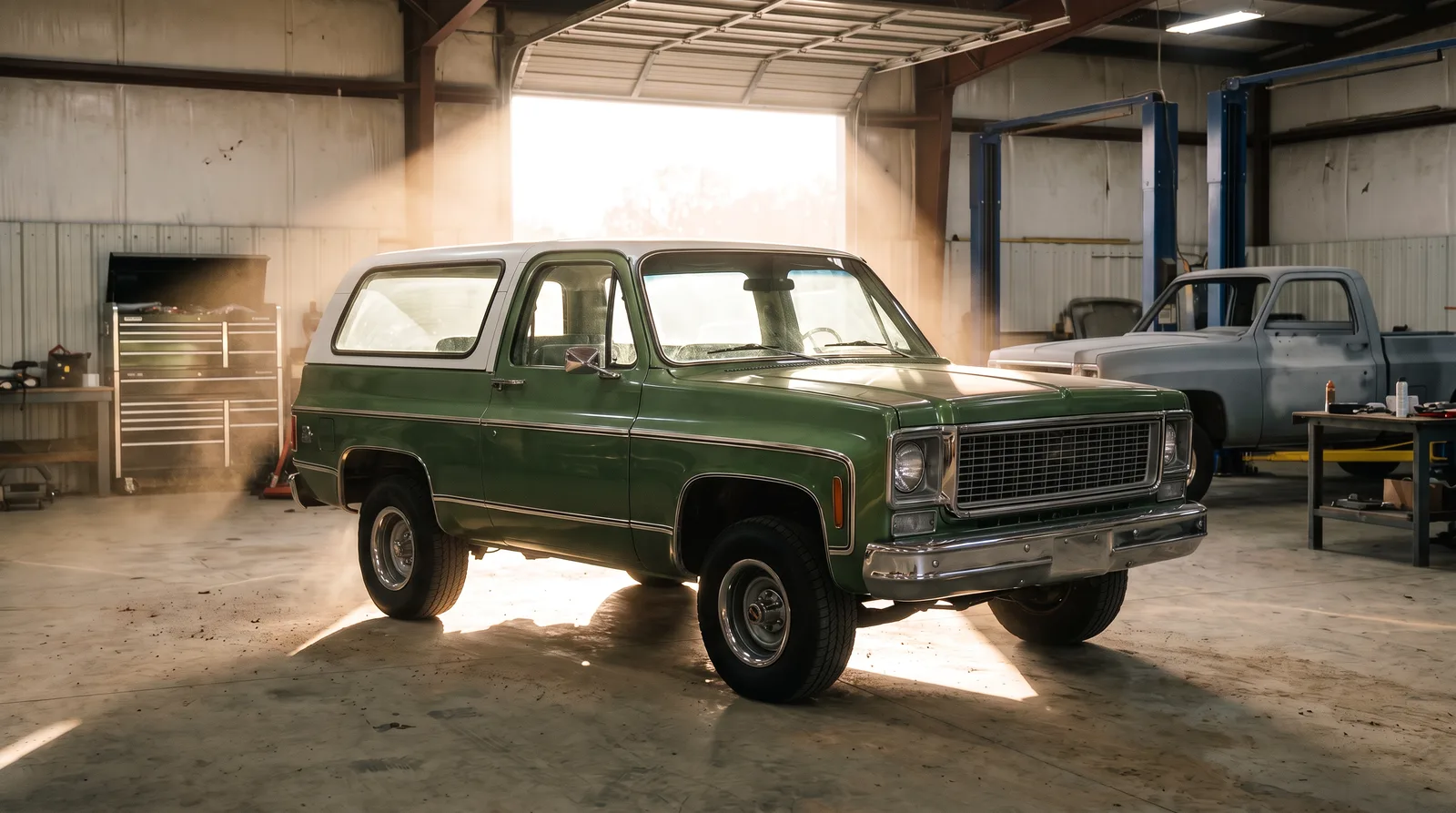
Positioning a trim package for a changing buyer
By 1973, Chevrolet's truck lineup had already learned an important lesson from its car division: buyers would pay for interior comfort and exterior trim even on a vehicle built primarily for capability. The Cheyenne name had been used on Chevrolet's C/K pickup line as an upscale trim designation, and its arrival on the redesigned K5 Blazer that year was a deliberate extension of that strategy into the sport-utility side of the business. This was not a case of a name being reused casually. It reflected a considered decision to treat the Blazer as a vehicle that deserved the same trim hierarchy as the full-size pickups it now shared a chassis with.
The Cheyenne package on the 1973 K5 Blazer typically brought a step up in interior appointments over the base truck, along with brightwork and trim details on the exterior that distinguished it at a glance from a standard work-spec Blazer, though the exact option list and pricing varied by year and are best confirmed against original dealer literature or factory build documentation for a specific truck rather than general reference. What matters historically is less the precise list of included items and more what the package represented: Chevrolet was actively marketing the redesigned Blazer to buyers who wanted their four-wheel-drive vehicle to look and feel like a considered purchase, not a stripped utility rig.
"A trim badge like Cheyenne is a small artifact, but it documents a real marketing decision. Chevrolet was telling a specific buyer that this truck was built with them in mind."
- Sarah Whitfield
What the Cheyenne package typically included
Researching any period trim level means resisting the urge to treat it as a single fixed parts list, because Chevrolet's option sheets shifted from one production run to the next and dealers sometimes ordered variations that do not match later reference summaries exactly. That caveat aside, the general pattern documented for the Cheyenne package across Chevrolet's 1973 C/K based lineup, the Blazer included, points toward an emphasis on cabin refinement over exterior flash. Interior work tended to focus on upgraded seat trim, added sound insulation, and dash treatments meant to read as a step above the vinyl-and-rubber base cabin. Exterior distinction leaned on brightwork rather than bold graphics, a quieter way of signaling status that suited a truck still expected to do real work on weekdays and look presentable on weekends.
That restraint is worth noting on its own terms. Chevrolet was not yet selling the Blazer the way later decades would sell trucks, with loud badging and aggressive two-tone paint schemes competing for attention in a dealer lot. The Cheyenne name did its work quietly, through material choices and comfort details that a buyer noticed once they were inside the truck rather than from across the lot. That approach reflects an early and still-cautious step toward the leisure-truck marketing that would fully arrive later in the decade, and it is part of why researchers treat the 1973 Cheyenne Blazer as a transitional artifact rather than the finished expression of Chevrolet's upscale truck strategy.
Reading the badge as a historical record
For anyone researching or authenticating a period truck, the Cheyenne badge and its accompanying interior appointments function as a kind of documentation in their own right, evidence of how the vehicle was originally specified and sold. That matters because trim levels get altered over decades of ownership. A base truck can gain aftermarket brightwork that makes it look upscale, and an original Cheyenne-trimmed Blazer can lose its distinguishing interior pieces through wear, repair, or a previous owner's taste. Treating the trim package as historical evidence rather than a cosmetic detail is part of how a serious researcher approaches any period vehicle, and the 1973 K5 Blazer rewards that kind of careful attention.
Cross-referencing badge placement, interior material choices, and factory literature from the period is the only reliable way to confirm whether a given truck's Cheyenne trim is original or added later, and that verification work is exactly the kind of detail that separates a documented example from one relying on an owner's memory alone.
What the cabin actually revealed
Walk up to a period-correct Cheyenne Blazer and the story is told before you even open the door. The badge itself sits low on the front fender, small enough that a casual observer might miss it, deliberate enough that a period buyer would have known exactly what it signaled. Inside, the differences from a base truck were not subtle once you knew what you were looking at. Cloth and vinyl upholstery combinations replaced the plainer bench seating of a work-spec Blazer, door panels carried additional trim pieces, and the dash and console area picked up brightwork that a stripped truck simply did not get. None of this changed how the Blazer performed off pavement. That was the point. Chevrolet was selling two different experiences of the same chassis, and the Cheyenne package existed entirely to make the interior feel like a considered purchase rather than an afterthought bolted onto a work truck.
For a researcher cataloging an original example, these interior specifics matter more than the exterior badge does, since exterior trim is the easiest thing for a later owner to add or remove. A dash pad, a seat pattern, or a door panel insert that matches period Cheyenne documentation carries more evidentiary weight than brightwork alone, and it is exactly the kind of detail that gets lost first when a truck passes through several owners without careful records.
The badge-engineered twin and what it tells us
Chevrolet did not sell the redesigned K5 Blazer in isolation. GMC offered its own version under the Jimmy name, built on the same platform and assembled alongside its Chevrolet counterpart, with GMC's own trim naming applied to a comparable upscale package. Comparing the two lines is useful precisely because it isolates what belonged to the Cheyenne name specifically and what was simply General Motors corporate strategy applied across both divisions. A trim hierarchy that appears on both the Chevrolet and GMC versions of the same truck was not a one-off marketing experiment. It was a deliberate, company-wide decision to sell the same reworked chassis to two overlapping but distinct dealer networks, each with its own badge language for the same underlying idea.
That corporate context is worth keeping in mind whenever a seller emphasizes how special a particular trim badge supposedly was. The Cheyenne name was distinctive to Chevrolet, but the strategy behind it was not unique to the Blazer, or even to Chevrolet alone within General Motors. Understanding that wider pattern is part of reading any single truck's history accurately rather than in isolation.
Cheyenne's place in the C/K trim ladder
Chevrolet's truck trim hierarchy in this era generally ran from a base work-grade specification, through a Custom Deluxe level aimed at buyers who wanted a modest step up without paying for full luxury trim, and on to Cheyenne as the more upscale designation, with a further Cheyenne Super tier appearing above it in some model years. Placing the Blazer's Cheyenne package within that ladder matters for research purposes because it clarifies what the badge was actually claiming. A Cheyenne-trimmed Blazer was not the top of Chevrolet's truck lineup and was never marketed as a luxury flagship the way later high-trim trucks would be. It occupied a middle position, aimed at buyers who wanted meaningfully better comfort than a stripped work truck without paying for whatever the top-tier package of a given year offered.
That middle position is precisely what makes the trim significant to a researcher rather than incidental. A base Blazer and a Cheyenne Blazer represent two different answers to the same question Chevrolet was asking its dealers to pose to customers in 1973: how much comfort does a four-wheel-drive buyer actually want to pay for. Understanding where Cheyenne sat in that ladder, rather than treating it as a vague synonym for upscale, is part of reading the badge correctly and avoiding the kind of loose generalization that creeps into casual descriptions of period trucks.
Why the trim question still matters to collectors
Decades later, the presence or absence of period-correct Cheyenne trim measurably affects how a 1973 K5 Blazer is evaluated by serious buyers and researchers. It is not simply a cosmetic preference. It speaks directly to how original a given truck's specification remains, and originality carries real weight in how these vehicles are documented, described, and ultimately valued. A Blazer wearing its factory Cheyenne trim with matching interior materials tells a more complete and verifiable story than one where trim history has to be reconstructed from partial evidence.
Readers looking for the fuller context of the model year that introduced this trim package can find more on the 1973 k5 blazer covering the redesign in depth, and for the complete arc of the truck's history from the very beginning, where this started traces the full production run. For those ready to evaluate an actual example, there are classic K5 Blazers on the market worth comparing, trim level by trim level, before making a decision.
Small details like a trim badge rarely get the attention they deserve in casual conversation about classic trucks, but they carry real historical weight. The Cheyenne package on the 1973 K5 Blazer is a documented piece of how Chevrolet chose to sell its newly redesigned truck, and understanding it properly means treating it as evidence rather than decoration.
Sources and notes
Related Reading
Have a
Chevrolet Blazer
for Sale?
Reach thousands of serious classic car collectors across the US.
Sell It Here →
Selling a classic? Here's how: compare the places to sell classic cars
Are You a Classic Car Dealer?
List your full inventory and connect with targeted classic car buyers.
Join as a Dealer →

About the author
Sarah Whitfield
Third-generation classic car collector specializing in pre-war American and European coachbuilt automobiles. Researcher and concours enthusiast.
Related Listings - Chevrolet Blazer

Comments
Be the first to comment on this article.