
Stand a 1930 Fordor beside a late 1931 one and look at the windshield. On the earlier car the glass stands upright under a projecting visor, the way Model A sedans had looked since 1928. On the later car the visor is gone and the glass leans back. It is a small change measured in degrees, and it is the most visible thing Ford did to the four-door Model A in its final season. The Model A slant windshield arrived on the Fordor in March 1931, and with it came a new family of body style numbers, a shared design between two rival body builders, and the car Ford chose for its 20 millionth vehicle.
Car Features
7 min read
The 1931 Slant Windshield Fordor
The 1931 Model A slant windshield Fordors: the 160-A, 160-B and 160-C, built to one design by Briggs and Murray, and how to identify them.
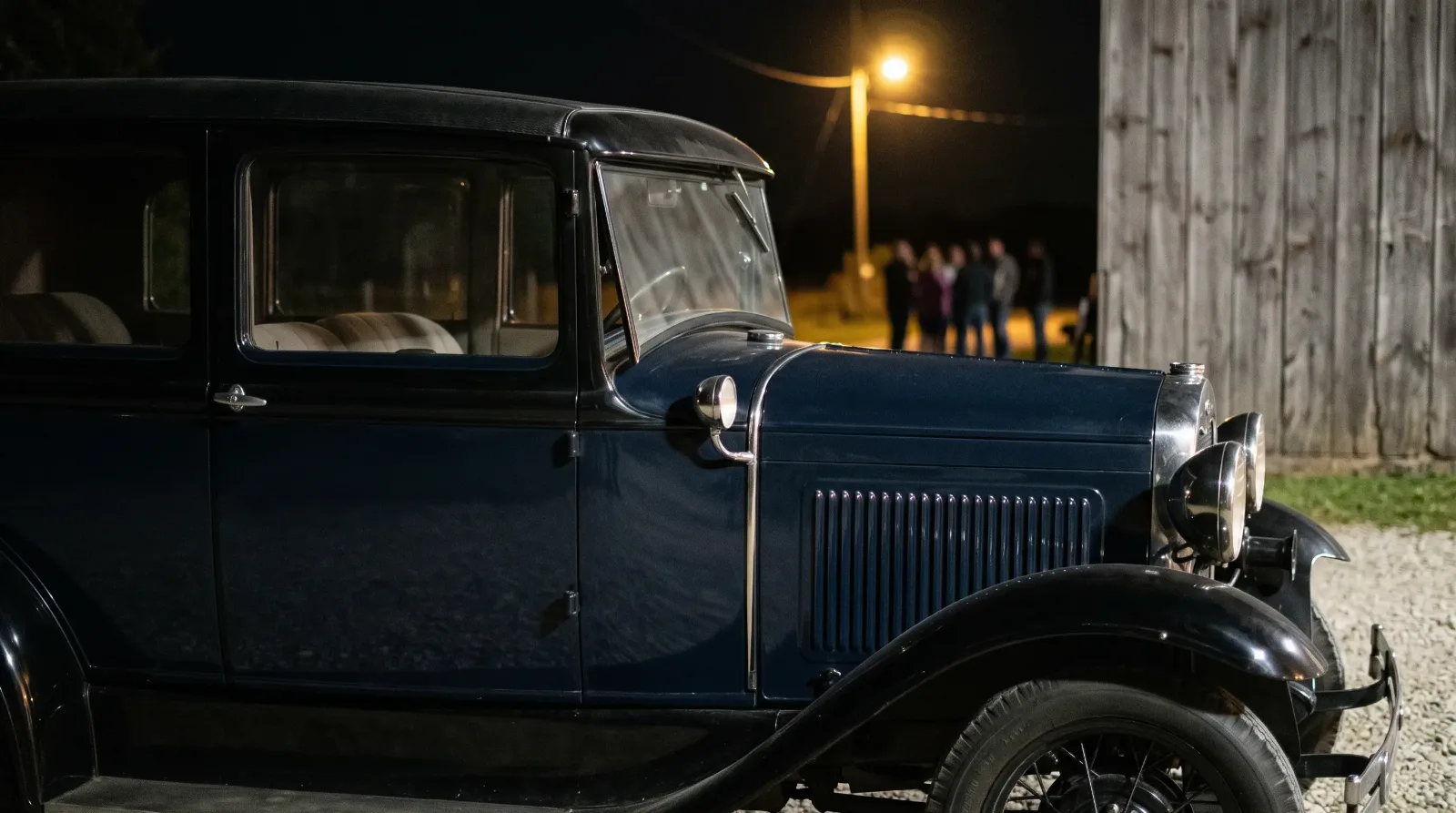
This is a narrow subject, one body family in one model year. For the wider catalog of Tudors, Fordors, roadsters and the rest, start with our body styles story. Here the concern is the 160 series: what it is, how to identify it, and why it matters to anyone judging or restoring one.
The 160 series: three style numbers
Ford identified its bodies by style numbers, and the slant-windshield Fordors carry the 160 prefix. There are three of them.
| Ford style | Body | Briggs tag | Murray tag | 1931 list price |
|---|---|---|---|---|
| 160-A | Standard Fordor | 140- | 160A | $590 |
| 160-B | Town Sedan | 141- | 160B | $630 |
| 160-C | DeLuxe Fordor | 139- or 153- | 160-C | $630 |
The 160-A and 160-B were introduced in March 1931. The prices are the 1931 factory list figures, f.o.b. Detroit. For context, the Standard Tudor listed at $490 that year and the Convertible Sedan, the most expensive standard Model A of 1931, at $640. A slant-windshield Town Sedan or DeLuxe Fordor sat just below the top of the range.
The builders' tag prefixes in the table are not Ford's numbers. Briggs and Murray each stamped their own codes on a tag fixed to the firewall, and many of those tags are now missing. Ford stamped its own body numbers on the interior floor sills, and the 160 bodies Ford built itself carried no builder's tag at all, only that sill stamping. When the tag is gone, the sill stamping and the construction details have to carry the identification. One more detail separates the three: the 160-A and 160-B are three-window bodies, while the 160-C DeLuxe is a two-window blind back with no rear quarter window.
These codes were new for 1931 and existed only in that year, alongside the 68-C slant-windshield Cabriolet, the 400-A Convertible Sedan and a handful of others. Before them, the Fordor had passed through the 60-A, 60-B and 60-C two-window bodies of 1928 and 1929, the 170-A from July 1929, and the 165 and 155 three-window and Town Sedan families. The 160 series did not simply replace all of those at once: the upright-windshield 170-B DeLuxe Fordor stayed in production until April 1931.
One design, two builders

The most interesting fact about the slant-windshield Fordor is not visible from the curb. Through most of the Model A run, Briggs and Murray built Fordor bodies to their own patterns. Collectors learn to tell them apart by small things: Murray door windows have a slight arch along the top edge, while Ford and Briggs windows run straight across. On the door window channel retainer, Briggs used machined D-nuts; Murray used sheet-metal square cage nuts stamped "8-32."
For the 1931 slant-windshield Fordors, Ford had Murray and Briggs build identical bodies with interchangeable parts. The windows follow the Murray arched design on all of them, regardless of who built the body. This is the exception that catches people out. On almost any other Model A sedan an arched door window says Murray. On a 160 series car it says nothing about the builder at all.
The two firms had a long history with Ford, and the split of work between them shaped a lot of what restorers find today. The fuller account of that arrangement is in Briggs and Murray. Ford built some 160 bodies itself, to the same design.
"The arched window is the first thing people reach for when they want to name a builder, and on these cars it is the one detail you cannot use. Look at the tag, the sills and the hardware. The glass will only tell you the year."
Sarah Whitfield
Shared parts and the family resemblance
The slanted, visorless windshield was not invented for the Fordor. It had already appeared on the Victoria, the 190-A, introduced in November 1930 with a bustle back, a lower roofline and folding front seats. The Fordor borrowed the windshield idea a few months later, and the parts tell the same story. The same door window channel retainer was used on the 160-series Fordors, the Victoria and the 400-A Convertible Sedan.
That kinship matters for restoration. A part that is scarce for one of these bodies may be catalogued under another. It also explains the look. Without the visor, the roofline reads lower and cleaner, and the whole front of the car feels less upright. The 1931 slant-windshield cars were Ford's last word on the Model A before the 1932 cars replaced it, and the family resemblance between the Victoria, the Convertible Sedan and the new Fordors is deliberate.
Open cars took a different path. The phaeton and roadster had their own windshield story, with fold-down frames from 1930, and the phaeton has the full story in its own article. The slant windshield was a closed-car feature, and a late one.
Judging and identifying a 160 series car
Production figures for the 160-A, 160-B and 160-C are not reliably documented, and the totals that circulate for 1931 Fordors do not separate the slant-windshield cars from the upright ones. Treat any single number with care. What is certain is that 1931 was a hard year: the Depression halved Ford's annual output to 541,000 cars, and 1931 was the last Model A model year.
For a buyer or a judge, the checks are practical:
- Confirm the windshield and cowl are original to the body, not grafted from a Victoria or a later restoration.
- Look for the builder's tag on the firewall and record its prefix: 139, 140, 141 or 153 for Briggs, 160 for Murray. A Ford-built body has no tag.
- Read Ford's own numbers stamped on the floor sills, especially if the tag is missing.
- Expect arched door windows. A straight-topped window on a 160 series car is a question, not a feature.
- Check the nuts on the door window channel retainer. Machined D-nuts point to Briggs, square cage nuts stamped "8-32" point to Murray.
The trim level follows the style number. A 160-A is the Standard Fordor, the 160-C the DeLuxe, and the 160-B the Town Sedan, a body type Ford had offered since 1929. The 20 millionth Ford, stamped "A20000000" on its engine and frame on April 1, 1931 and sent on a goodwill tour across America, makes the 160-B the best known of the three.
The slant-windshield Fordor sits at the very end of the Model A era. It was built for barely a year, by two companies working to a single design, in a year when sales were falling. That combination makes it a precise document of where Ford's closed-car styling had arrived by 1931, and a useful reminder that the most telling detail on a body is sometimes a few degrees of glass.
Sources and notes
- Ford Garage: US Model A body styles and builder tag codes, 1928 to 1931
- Ford Garage: Murray and Briggs slant-windshield Fordor bodies compared
- MAFCA: identifying 1931 slant-windshield Fordors
- MAFCA: Model A new car prices by year
- Ford Garage: the 20 millionth Ford
- The Henry Ford: 1931 Ford Model A collection record
Related Reading
Have a
Ford Model A
for Sale?
Reach thousands of serious classic car collectors across the US.
Sell It Here →
Selling a classic? Here's how: the best sites to sell a classic car
Are You a Classic Car Dealer?
List your full inventory and connect with targeted classic car buyers.
Join as a Dealer →

About the author
Sarah Whitfield
Third-generation classic car collector specializing in pre-war American and European coachbuilt automobiles. Researcher and concours enthusiast.
Related Listings - Ford Model A




Comments
Be the first to comment on this article.