
Ford sold the Model T for nineteen years on one 100 inch wheelbase chassis, and yet the Model T body styles changed more than most people expect. The touring car and the runabout carried the volume from start to finish. The coupe came, went and came back. The sedan arrived as an expensive oddity in 1915 and left as the family car of the 1920s. For anyone looking at a surviving car, the body is the first piece of evidence, and it is usually more honest about the car's age than the paperwork.
Car Features
7 min read
Ford Model T Body Styles: Touring, Runabout, Coupe and Sedan
Touring, runabout, coupe, coupelet, town car and sedans: every Model T body style, when Ford built it and how to tell the years apart.
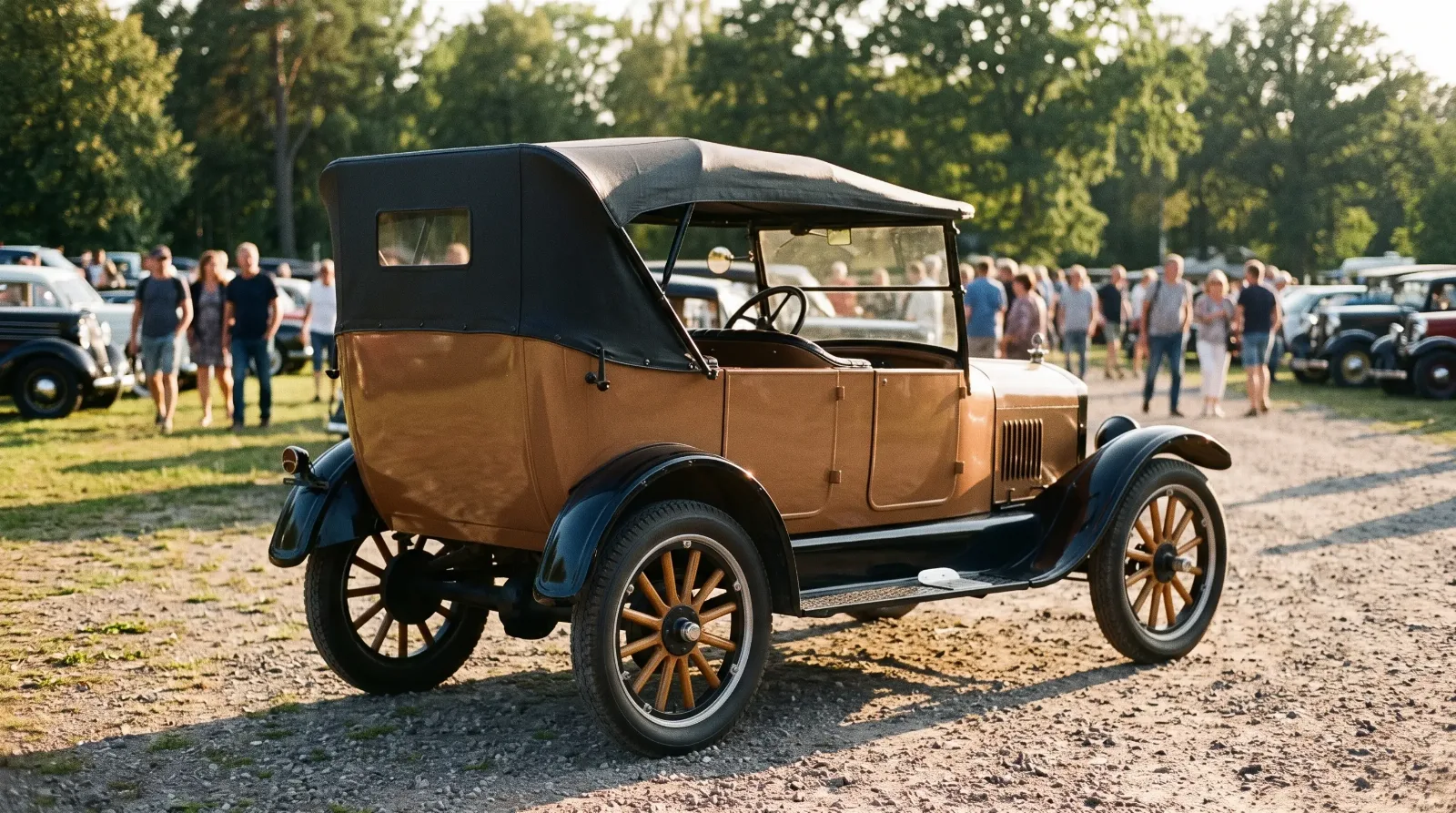
This piece sorts the styles by what Ford actually catalogued and when. It stays on the T; the later car has its own Model A body story, and the wider arc of the car from 1908 onward lives in our Model T history story.
The five bodies of 1909
The first model year listed five bodies: Touring, Runabout, Coupe, Town Car and Landaulet. That is a broader range than the "one car for everyone" legend suggests. Ford was still building for a customer who might want a chauffeur up front and a closed compartment behind, which is exactly what the Town Car and the Landaulet offered.
Colour told the bodies apart in that first season. Runabouts were mostly gray, touring cars mostly red, and the town cars and landaulets green. Red was dropped after June 1909. A 1909 car in the "wrong" colour is not automatically a fake, since those are tendencies rather than rules, but it is a question a careful buyer should ask.
The Town Car lasted longest of the formal bodies, through 1918. The coupe of this first period ran from 1909 to 1912 and then disappeared for several years. The Landaulet, a seven-passenger car listed at $950 in 1909, does not appear in the later lists at all. The counts quoted for it in club discussions disagree with one another, so I will not give a production figure.
Touring and runabout: the open cars that carried the volume
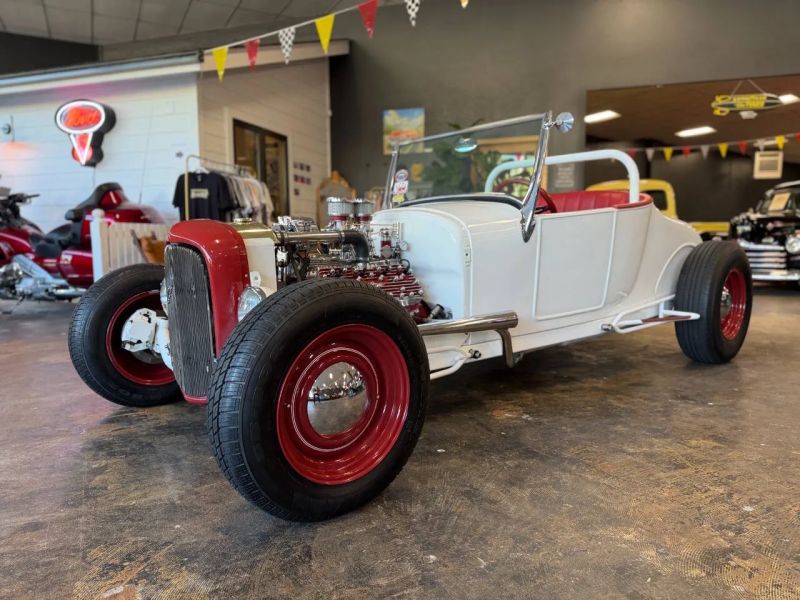
The touring car was the family car under a folding top; the runabout was the two-seat roadster with a deck behind. Between them they were the Model T for most buyers, and the door count is the quickest way to date one.
The touring began as a two-door body from 1909 to 1911. From 1912 to 1925 it was a "three-door" car: doors for the rear passengers on both sides and for the front passenger on the right, with only a dummy door stamped into the left side where the driver sat behind the levers. The 1926 and 1927 Improved cars finally gave the driver a real door and made the touring a four-door. The runabout followed the same logic. It had no doors from 1909 to 1911, one door from 1912 to 1925, and two doors in 1926 and 1927.
Price is the other half of the story. The runabout fell from $825 in 1909 to $260 in 1925, the lowest price the Model T ever reached, while the touring stood at $290 that year. Both rose again with the Improved car, the runabout to $360. In 1923 the gap between the cheapest open car and the closed cars was wide: Runabout $269, Touring $298, against $530 for a coupe. The electric starter added $65 on an open car and came standard on the closed ones. Shoppers in 2026 looking at Model T tourings and runabouts for sale will find the same open bodies dominate, for the simple reason that Ford built so many of them.
Coupe, coupelet and the closed two-seaters

The second coupe era started with the Coupelet, which Ford built from 1915 to 1917. It was a coupe with a folding top, door windows and a large turtle deck, priced at $750 in 1915. Production was small by Ford standards: 2,417 in 1915 and 3,532 in 1916. A useful detail for judging a top: 1916 Coupelet tops have a porthole window on each side, and 1915 tops do not.
From 1917 a fixed-roof coupe took over, and it stayed in the range to 1927. Some later sources keep calling it a Coupelet, which confuses the record; the folding-top car is the 1915 to 1917 Coupelet, and the hardtop is simply the coupe. By the 1923 model year the coupe was a mass product, with 313,273 built. A new coupe body arrived with the August 1923 restyle, at the same moment the Tudor appeared.
"Count the doors and look at the top before you read the title. A Model T body tells you its year range in about ten seconds, and it rarely lies about it."
Sarah Whitfield
Sedans: from the center door to Tudor and Fordor
The first Model T sedan was the most expensive car Ford sold in 1915: $975, against a range that began at $440, with 989 built. Its doors sat in the middle of each side, and it stayed in the catalogue until 1923. The design deserves its own treatment, and you can read more about the center door and how it was laid out. Club historians describe the early 1915 bodies as largely aluminum-paneled, with steel following, though I have not seen a factory record that dates the change.
The four-door Fordor came first, in the 1923 model year, so 1923 is the one year with both a two-door and a four-door sedan in the range (the center-door car and the Fordor). Its lower body panels changed from aluminum to steel in the June 1923 restyling. The Tudor followed in August 1923, sold as a 1924 model, with its two doors at the front. It replaced the center-door sedan. Ford used the name Fordor for the 1923 model (a Fordor was photographed in September 1922) and Tudor from August 1923, and they carried straight over to the Model A. Prices in 1923 were $595 for the Tudor and $725 for the Fordor.
| Body style | Years built (US) | Identifying detail |
|---|---|---|
| Touring | 1909 to 1927 | 2 doors 1909 to 1911, 3 doors 1912 to 1925 (dummy driver's door), 4 doors 1926 to 1927 |
| Runabout | 1909 to 1927 | No doors 1909 to 1911, 1 door 1912 to 1925, 2 doors 1926 to 1927 |
| Coupe | 1909 to 1912, 1917 to 1927 | Fixed roof from 1917; new body with the August 1923 restyle |
| Coupelet | 1915 to 1917 | Folding top, door windows, turtle deck; portholes on 1916 tops |
| Town Car | 1909 to 1918 | Open driver's seat, closed rear compartment |
| Center-door sedan | 1915 to 1923 | Doors in the middle of each side; $975 in 1915 |
| Fordor sedan | 1923 to 1927 | Lower panels aluminum, then steel from June 1923 |
| Tudor sedan | 1924 to 1927 | Two doors at the front; introduced August 1923 |
Reading a Model T body today
Bodies on these cars were swapped, rebuilt and converted for a century, so the body and the chassis do not always agree. A closed-cab "pickup" may have started as a 1924 to 1927 Tudor. A touring car with a working driver's door belongs to 1926 or 1927, whatever the engine number says. A Coupelet with portholes should be a 1916 car. These checks cost nothing and catch most of the mismatches.
The other check is proportion. The Improved cars of 1926 and 1927 sit lower and look heavier than the earlier black cars, and a body from one period will not sit naturally on the other. Taken together with the door count and the top, that is usually enough to place a car within a couple of years before any serial number is read. For how these body changes fit Ford's whole run from the T to the Model A, see the bigger picture.
Sources and notes
- Ford Model T: body styles and years (Wikipedia)
- Car of the Week: 1909 Ford Model T (Old Cars Weekly)
- 1909 Ford Model T Town Car, catalogue body styles and prices (RM Sotheby's)
- 1923: the Model T Ford's biggest year (Mac's Motor City Garage)
- 1915 Ford T Coupelet (The Motor Museum in Miniature)
- Ford Model T sedan (Old Rhinebeck Aerodrome)
Related Reading

Have a
Ford Model T
for Sale?
Reach thousands of serious classic car collectors across the US.
Sell It Here →
Selling a classic? Here's how: compare the places to sell classic cars
Are You a Classic Car Dealer?
List your full inventory and connect with targeted classic car buyers.
Join as a Dealer →
#ford model t
#Model T body styles
#Model T touring
#Model T runabout
#Model T coupe
#Tudor
#Fordor
#Coupelet

About the author
Sarah Whitfield
Third-generation classic car collector specializing in pre-war American and European coachbuilt automobiles. Researcher and concours enthusiast.
Related Listings - Ford Model T



Comments
Be the first to comment on this article.