
Most histories describe the Model T to Model A changeover as a single dramatic act: Henry Ford stopped the world's biggest car line one day in 1927 and started a new one months later. The records tell a more interesting story. The decision came in stages, the shutdown lasted somewhere between three and six months depending on who was counting, and the new car was built in a different factory from the old one. What follows is the changeover by the dates, with the numbers that can be trusted and the ones that cannot.
Car Features
7 min read
The Great Changeover: How Ford Stopped the Line to Build the Model A
The 1927 Model T to Model A changeover by the dates: the last T, the shutdown, the move to the Rouge, the cost and what Ford got back.
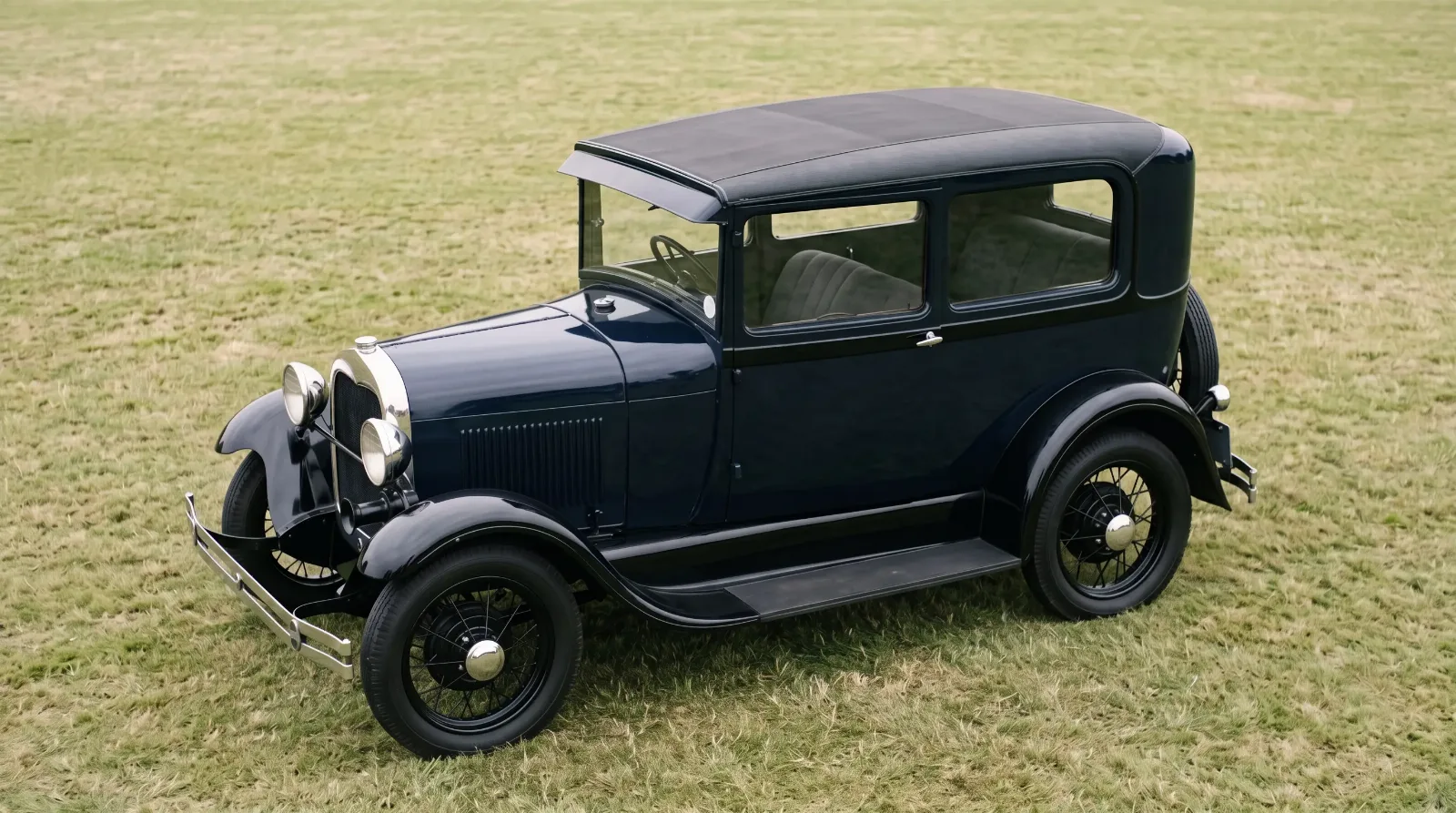
The decision came before the shutdown
The new car did not appear out of a panic in the spring of 1927. A Ford order to start work on a "new Ford" is dated July 20, 1926, before anyone had settled on the name Model A. By then the sales numbers were already moving the wrong way. Chevrolet's Capitol Series AA, with an overhead-valve four and a three-speed sliding gearbox, sold for $525 to $745 across seven body styles, and its $695 two-door Coach was the best seller of the line. General Motors president Alfred P. Sloan was betting that Model T owners would trade up for comfort and style, and he was right.
Ford announced the end of the Model T on May 25, 1927. The next day, May 26, Henry and Edsel Ford drove the 15 millionth Model T off the line at Highland Park. That car, a 1927 Touring, survives at The Henry Ford. The factories shut in early June. If you want the earlier history of how that line was built and run, the details are in the assembly line story; this piece starts where that line stopped.
| Date | Event |
|---|---|
| July 20, 1926 | Order to begin work on a "new Ford" |
| May 25, 1927 | End of the Model T announced |
| May 26, 1927 | 15 millionth Model T leaves Highland Park |
| Early June 1927 | Ford factories shut |
| October 20, 1927 | Henry Ford stamps engine "A-1" |
| October 27, 1927 | Model A production starts at the Rouge |
| December 2, 1927 | Model A introduced to the public |
| December 1927 | Last Model T built, at Cork, Ireland |
How long the Model T to Model A changeover really took
You will see "six months" in most accounts, and it is a fair round number for the gap between the last American Model T in May and the public launch in December. Ford's own release described a "three-month" retooling shutdown before Model A production began at the River Rouge on October 27, 1927. Count from the Highland Park line stopping on May 26 to that production start and you get five months. All three figures appear in print. None of them is exactly wrong, because they measure different things: the factory floor, the dealer showroom, or the advertising calendar.
What is not in dispute is how deep the hole was. Cram's Automotive Reports for the week of November 19, 1927, counted 550 Fords built. In the same week of 1926, Ford had built about 20,000. Chevrolet built 6,682 that week in 1927. For a full year Ford sold fewer than 500,000 cars, less than half of Chevrolet's total, and Chevrolet took first place in the American market.
A new car in a new factory
The detail most people miss is that Ford did not simply clear the Highland Park floor and refit it. Model A assembly moved to the River Rouge complex in Dearborn. Ford had bought the land in 1915 and had been building there since 1917; the site turned out Eagle-class patrol boats in 1918 and 1919 and Fordson tractors from 1921. By the time of the changeover it had its own docks, power plant, steel mill and, from 1925, a glass plant. Ford later described the Model A as the first car assembled at the Rouge.
Highland Park did not go dark. Fordson tractor work and trim stayed there, and the plant later became Ford's main American tractor plant. But the center of gravity had moved. The Model T had been built in a plant designed around a single car. The Model A was built in a complex designed to make almost everything that went into it, from steel to glass.
That is also why the changeover cost so much. The Model A shared no parts with the Model T, according to Ford, so nearly every die, jig and fixture had to be new. TIME later reported that the model change cost "something more than $72,000,000," measured as Ford's accounted loss for 1928. A club history puts the figure at $100 million spent on design and retooling, but it gives that only as what was "said." The $72 million figure is the better documented of the two, and it measures a loss, not a bill.
"Ford's own paperwork says three months, the calendar says five, and the history books say six. When the numbers disagree like that, write down what each one is counting before you pick a favorite."
Tom Ramirez
The people on the wrong side of the shutdown
The workforce paid first. Two accounts give about 60,000 Ford workers out of jobs during the 1927 shutdown. The figure deserves care, because the same number turns up for August 1931, when Ford is said to have closed the Rouge late in the Model A run. It is possible the two events have been blended in later retellings. The safest reading is that tens of thousands of Ford workers in Detroit lost their pay for months in the second half of 1927.
Dealers had almost nothing new to sell for most of the year. Ford kept up interest with a five-day advertising campaign from November 28, 1927, that put about $2 million into 2,000 newspapers, and roughly 2,000 sets of a 26-page dealer portfolio titled "Introduction of the New Ford Car" went out in late November. When the car appeared on December 2, more than 9 million Americans reportedly visited Ford dealers that week. What the new car changed, from engine to brakes, is the full story of its own.
Henry Ford's attention was not only on Dearborn that year. In 1928, while the Rouge was ramping up, Ford also founded a rubber plantation town on the Tapajos River in Brazil, a project known as Fordlandia. It is a reminder that the company in 1927 and 1928 was trying to control every input to its cars, the same instinct that shaped the Rouge.
What the gamble bought
The shutdown was expensive, and the record shows it worked. Henry Ford stamped engine A-1 on October 20, 1927, and the millionth Model A was built on February 4, 1929. By mid-1929 the line was running at full capacity, about 9,000 units a day. In calendar 1929 Ford took back first place in American sales, with 1,507,132 cars against Chevrolet's 1,328,605. Chevrolet regained the lead in 1931, the last Model A model year.
So the changeover was neither a clean overnight switch nor a long period of drift. It was a planned, costly, sometimes chaotic move from one car in one factory to a new car in another, and the records let us measure most of it. For a wider view of how the two cars fit into Ford's history, the overview covers the whole period from 1908 to 1931.
Sources and notes
- Heritage: Model A production begins at the Rouge (Ford press release, archived)
- Last day of Model T production at Ford (HISTORY)
- Business: Ford Loss, April 22, 1929 (TIME)
- Ward's flashback: Cram's figures for November 1927 (WardsAuto)
- History of the Model A (MAFCA)
- The Chevrolet that defeated Henry Ford: 1927 Capitol Series AA (Mac's Motor City Garage)
Related Reading

Have a
Ford Model T
for Sale?
Reach thousands of serious classic car collectors across the US.
Sell It Here →
Selling a classic? Here's how: compare the places to sell classic cars
Are You a Classic Car Dealer?
List your full inventory and connect with targeted classic car buyers.
Join as a Dealer →

About the author
Tom Ramirez
Corvette researcher and historian based in Bowling Green, Kentucky. Two decades documenting Corvette production history from original factory records.
Related Listings - Ford Model T



Comments
Be the first to comment on this article.