
Ask ten builders to name the one car that defines lowriding and nine of them say Impala. Not because it is rare, not because it was fast, but because the full-size Chevrolet built between 1958 and 1964 wears low better than anything else Detroit ever shipped. Long doors, a wide greenhouse, sculpted flanks that catch candy paint like water catches light. The Impala is the shape the whole culture drew itself around, and half a century later it still sits at the top of the food chain.
Car Features
7 min read
The Impala Lowrider
The full-size 1958-64 Impala is the shape the whole lowrider culture drew itself around. The best years, the drop-top premium, and why it still rules.
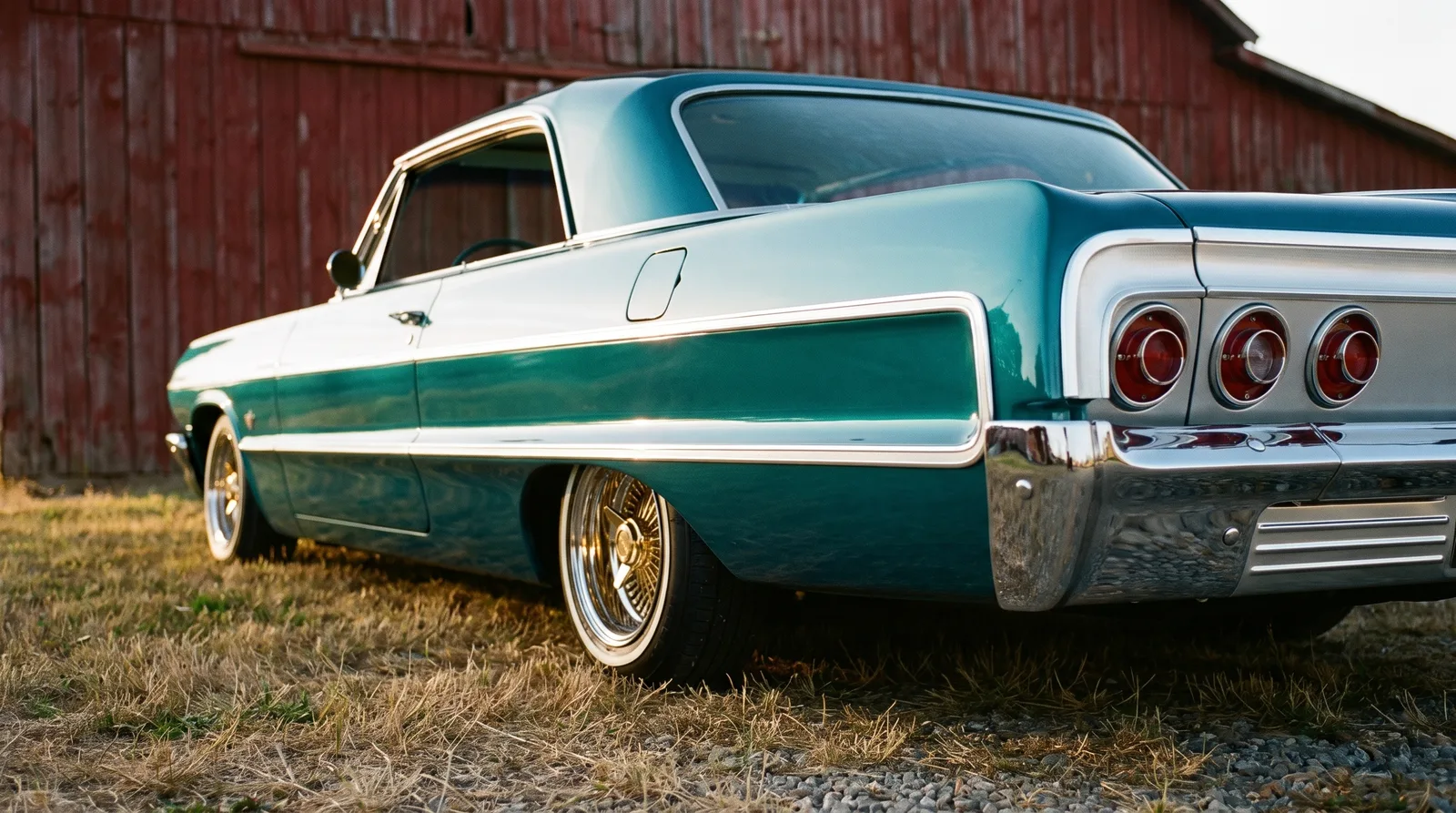
I have built plenty of platforms. G-bodies, Town Cars, a couple of trucks. When a customer walks into the shop and says they want the real thing, no compromise, they are talking about a '59 or a '63. Everything else is a substitute for that car, and everybody in the room knows it.
Why the Impala became the icon
Timing and geometry. The Impala arrived as a distinct model in 1958 and became its own line in 1959, right as the Chicano car clubs of East Los Angeles were figuring out what a lowered cruiser should look like. These cars were cheap on the used lot through the sixties and seventies, they were everywhere, and the body was made to lay down. That combination is why the Impala got adopted instead of admired from a distance.
The proportions do most of the work. A full-size Chevy from this era has a long hood and deck, a low beltline, and door skins big enough to become a canvas. Drop it over the frame, tuck a set of wires under the fenders, and the car looks intentional from thirty feet away. You are not fighting the shape to make it read low. It already wants to be there. That is not true of most cars, and it is the whole reason the platform holds its crown alongside the older lowrider bombs that came before it.
The best years, and what separates them
People argue this in shop parking lots for hours. There is no single right answer, but there is a real hierarchy, and it comes down to the sheet metal.
| Year | What builders prize | Reality on the ground |
|---|---|---|
| 1958 | The debut year, distinct one-year styling | Rare, expensive, harder to find good sheet metal and trim |
| 1959 | The "batwing" rear deck and cat-eye taillights | Polarizing, dramatic, a favorite for wild custom builds |
| 1960 | Softer version of the '59 wing, triple round taillights return | Underrated, often cheaper than its neighbors |
| 1961 | Cleaner bubble-top and first SS package | Bubble-top hardtops command strong money |
| 1962 | Squared-up roofline, sharp trim | Popular, clean lines, easy to make look right |
| 1963 | The classic year, balanced proportions | The default "dream" Impala for a huge share of builders |
| 1964 | Last of the body style, refined details | Arguably the most sought-after single year on the market |
If I had to plant a flag, the 1963 and 1964 cars are the ones customers ask for by name. They read as the "correct" Impala to most eyes, the trim is clean, and parts support is deep because so many survived. The 1959 is the show-stopper, the car you build when you want people to stop walking. The 1960 is the value play nobody talks about, and I have put together beautiful cars on 1960 bodies for real money less than a comparable '63.
Why the drop-top is the one everybody wants
A convertible Impala is the top of the mountain, and the market knows it. Take the roof off one of these cars and the whole silhouette opens up. The candy paint has more surface to move across, the interior becomes part of the show, and when the car lays out at a cruise the profile is unbroken from the windshield to the rear deck. It is the cleanest way to present everything the platform does well.
There is a supply story too. Chevrolet built far fewer convertibles than hardtops and sedans, so the drop-tops were scarcer to begin with, and decades of hard use thinned the survivors further. Fewer cars, higher demand, and a body style that photographs like nothing else. That is why a genuine convertible commands a serious premium over a hardtop of the same year, and why a lot of the cars you see badged as convertibles at shows started life with a steel roof.
"A convertible '64 done right is the car that makes a grown man go quiet. I have watched it happen at the curb. Everybody has a favorite year, but nobody argues with a clean drop-top Impala."
Jim Vasquez
What these cars are worth now
Values have climbed hard over the last fifteen years, and the Impala led the way. I will not pin exact auction figures to a specific hammer here because the range is wide and it moves, but the shape of the market is clear enough to plan around.
- A solid driver-quality hardtop, running and presentable, sits in the mid five figures for a good year.
- A show-level, frame-off hardtop with a proper hydraulic setup and quality candy work runs well into six figures.
- Genuine, documented convertibles carry a large premium over the equivalent hardtop, often a substantial multiple for the best 1963 and 1964 cars.
- The 1960 and some early cars still offer the most car for the money if you can find honest sheet metal.
The reason values hold is simple. Rust-free bodies are finite, the culture that reveres these cars is not going anywhere, and a properly built Impala is a decades-long project that people do not part with lightly. When one does come up, it moves. If you are shopping, look through the used lowriders for sale and price the difference between a hardtop and a convertible before you fall in love with one you cannot afford.
Why it stays cherished
The Impala is not the fastest classic, not the rarest, and on paper not the most valuable car you can buy. It stays on top because it carries the culture. These cars were built in home driveways and small shops by people who had more skill than money, and every clean one that survives is a piece of that. When you build an Impala you are joining a line that runs back to East LA in the sixties, which is the story of the lowrider told in steel and candy paint.
It is also just a beautiful object. The proportions were right the day it left the factory, and lowering it only sharpened what was already there. That is rare. Most cars need a lot of help to look this good laid out. The Impala needed almost none, and that is why it earned the crown and has never given it back. If you want to understand where it sits in the wider family, read up on Lowrider Bombs: The Pre-War Classics and you will see the Impala is the bridge between the old bombs and everything modern.
Sources and notes
- Period Chevrolet model and trim references for the 1958 to 1964 full-size line.
- Club and cruising histories from the East Los Angeles lowrider community.
- Collector-car auction and market records for full-size Impala values and hardtop-versus-convertible premiums.
- Builder and shop interviews on platform selection, body condition, and value.
Related Reading
Have a
Classic Car
for Sale?
Reach thousands of serious classic car collectors across the US.
Sell It Here →
Are You a Classic Car Dealer?
List your full inventory and connect with targeted classic car buyers.
Join as a Dealer →
#classic chevrolet
#impala lowrider
#1963 impala
#1964 impala
#lowrider convertible
#lowrider values

About the author
Jim Vasquez
Southern California hot rod and custom car builder with roots in the traditional kustom kulture scene.
Comments
Be the first to comment on this article.