
Every famous muscle coupe had a plain sister parked next to it on the dealer lot. Same front clip, same frame family, same engine bay, two extra doors and a price tag that still makes sense. The 4 door muscle cars, or more honestly the four-door sedans built on muscle car platforms, are where a working guy on a modest budget can still get into a Chevelle, a Coronet or a Torino without fighting collectors for it. They are not the cars on the posters. That is the point.
Ownership & Lifestyle
8 min read
Four-Door Muscle Cars: The Cheaper Sedans Behind the Famous Coupes
Chevelle, Coronet and Torino sedans share the coupe hardware for a lot less money. Here is what the extra doors save you and what they cost.
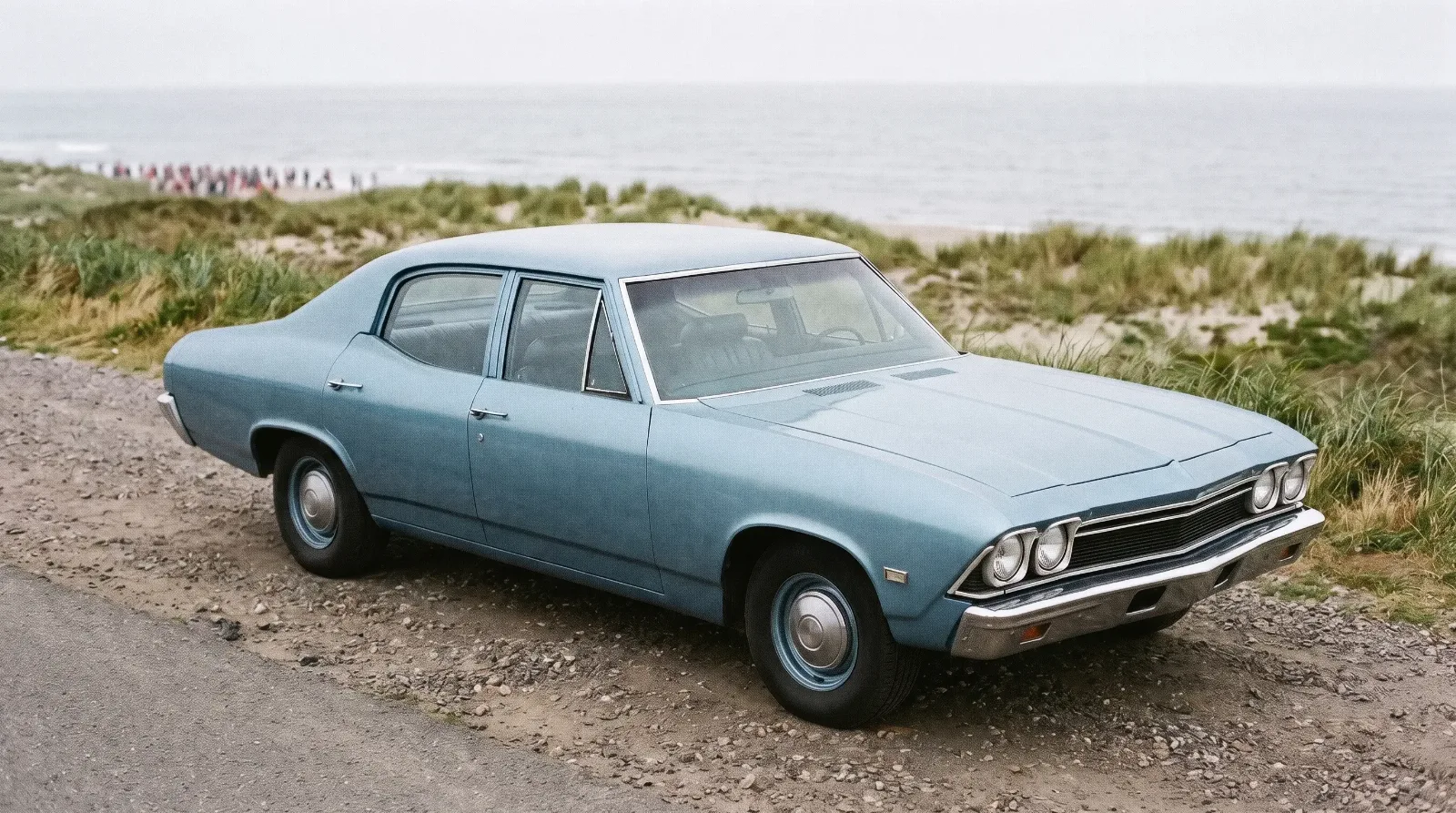
If you have already read our rundown of the cheapest muscle cars, you know the two-door prices. This piece is about the cars that share the hardware and skip the markup.
Why the sedan costs less than the coupe
It is not mechanical. It is buyers. The people writing big checks in 2026 want the fastback roofline, the hardtop with the windows down, the car they had in high school. Almost nobody had a four-door in high school. Their dad did.
So the sedans sat. They got used as family cars, then as beaters, then as parts donors when somebody needed a rear end or a column for their coupe. The ones left are often honest, low-option cars with a small V8 or a six, bench seats and an automatic. That makes them cheaper to buy, and in most cases, cheaper to fix, because the drivetrain parts are the same parts everybody else is buying.
The catch is sheet metal. More on that below, because it decides whether a cheap sedan stays cheap.
The 4 door muscle cars that share a platform with the famous coupes
These are the sedans worth hunting. The wheelbases come from period specs. Prices swing too much with condition and region to pin to one number, so the last column tells you where the sedan sits against its coupe, not what a seller will ask.
| Sedan | Famous sibling | Platform | Sedan wheelbase | Price picture |
|---|---|---|---|---|
| Chevrolet Chevelle / Malibu four-door, 1968 to 1972 | Chevelle SS 396 / 454 | GM A-body | 116 in (two-doors 112 in) | Under a base Malibu hardtop, nowhere near SS money |
| Pontiac Tempest / LeMans four-door, 1968 to 1972 | GTO | GM A-body | 116 in (two-doors 112 in) | Under the LeMans two-door, GTO money never applies |
| Dodge Coronet four-door, 1968 to 1970 | Charger, Super Bee, Coronet R/T | Chrysler B-body | 117 in, same as the two-doors | Under the Coronet two-door, Charger and R/T money never applies |
| Plymouth Belvedere / Satellite four-door, 1968 to 1970 | Road Runner, GTX | Chrysler B-body | 116 in, same as the two-doors | Under the two-door, Road Runner money never applies |
| Ford Fairlane / Torino four-door, 1968 to 1969 | Torino GT, Cobra | Ford intermediate | 116 in, same as the two-doors | Under the hardtop and fastback |
| Chevrolet Nova four-door, 1968 to 1974 | Nova SS | GM X-body | 111 in, same as the two-door | Under the two-door, which gets the attention |
Notice the GM intermediates. The A-body sedans rode a 116 in wheelbase against 112 in for the two-doors, so the frame is not a bolt-for-bolt match to a coupe frame. The engine mounts, front suspension and rear axle family carry over. The Mopar B-body, the Ford intermediates and the Nova used one wheelbase for both body styles, which makes swapping parts across body styles a little less of a guessing game.
Full-size cars belong on this list too. A four-door Impala, Biscayne, Polara or Fury from the late 1960s could be ordered with a big-block, and police-package sedans were built to run hard all shift. Those cars are long, heavy and cheap, and a lot of buyers walk right past them.
What the extra doors cost you in the shop
Here is where a sedan either saves you money or quietly takes it back.
Everything from the cowl forward is generally shared with the coupe: fenders, hood, grille, core support, and the whole engine bay. That stuff is reproduced by the truckload for popular platforms. Drivetrain, brakes, steering and suspension parts are shared too. You will find them on any parts counter.
Behind the front doors, you are on your own. Rear doors, the B-pillar, sedan roof skins, rear quarter panels and sedan-specific trim are rarely reproduced. If the rear quarters on your Coronet sedan are rotted through, nobody is stamping new ones. You patch them, you find a donor sedan, or you walk away.
So buy the solid body. A sedan with a tired engine and clean quarters is the right car. A sedan with a fresh engine and Swiss-cheese rockers is somebody else's problem, and the price difference between those two is usually smaller than the welding bill.
Turning a family sedan into something that moves
Most of these cars left the factory with a small V8 or a six and a two-speed or three-speed automatic. That is not a problem. That is a blank page. The engine bay was designed to hold the big engines too, so the usual upgrades fit without cutting.
The sane order goes like this. Brakes first, because front discs were an extra-cost option on these cars when new (Chevrolet only made them standard on the Chevelle for 1973), so most low-option sedans rolled out on four drums, and you are about to add power. Then suspension: springs, shocks and a rear sway bar wake up a soft sedan more than people expect. Then the drivetrain. A rebuilt small-block with a mild cam, a better intake and a four-barrel will make a sedan feel quick, and it costs a fraction of a numbers-matching big-block.
If you want to go further, read our guide to building from a base-model body. The same rules apply to a sedan. The only difference is that nobody will accuse you of cloning anything, because there was no four-door SS to clone.
"I have never had a guy at a gas station ask how many doors my car has. They ask what is under the hood. Put the money where they are looking."
Mike Sullivan
Where the deal ends, and how to shop for one in 2026
A few honest limits.
Resale is lower. A built sedan will not climb in value the way a coupe does. If you are buying to flip, buy something else. If you are buying to drive, it does not matter.
Rare body parts can sink a rusty car, as above. And some sedans are not cheap at all. A documented big-block police car with its paperwork is a collector item in its own right, priced like one. Do not expect a four-door with a factory big-block and a build sheet to sell for family-car money.
Then there is the roofline. Some people will never warm to a four-door. Fine. They are the reason it is cheap.
Before you look at a single listing, decide what you can spend all in. Purchase price is only part of it. If you have not done that math yet, start with the budget, then come back to the cars.
Search wider than the model name. Sellers list these as Malibu, Belvedere, Fairlane 500, Coronet 440 or just "old Chevy four-door." Search the body style and the year range, not the badge. Look at estate sales and small local classifieds, where these cars turn up with one owner and a shoebox of receipts.
When you find one, crawl under it. Bring a flashlight and a magnet. Check the floors, the frame rails at the rear axle, the trunk drop-offs and the bottom of every door. Start it cold. Listen for the timing chain and look for blue smoke on startup. Then make an offer that reflects what you found, not what the ad said.
If you want to see what is out there right now, browse old muscle cars under $10,000 and filter for four-doors. You will be surprised how much car that money still buys when you let go of the roofline.
Sources and notes
- Chevrolet Chevelle: wheelbases, SS 396 and SS 454 body styles, 1973 standard disc brakes (Wikipedia)
- 1968 Chevelle facts, figures and specifications (Over-Drive Magazine)
- 1970 Dodge Coronet sedan specifications, 117 in wheelbase (Conceptcarz)
- Plymouth Belvedere: 1968 to 1970 wheelbase (Wikipedia)
- Ford Torino: 1968 to 1969 wheelbases by body style (Wikipedia)
- 1968 Chevrolet Nova facts, figures and specifications (Over-Drive Magazine)
Related Reading
Have a
Classic Car
for Sale?
Reach thousands of serious classic car collectors across the US.
Sell It Here →
Selling a classic? Here's how: compare the places to sell classic cars
Are You a Classic Car Dealer?
List your full inventory and connect with targeted classic car buyers.
Join as a Dealer →
#affordable classic cars
#budget muscle cars
#4 door muscle cars
#muscle car sedans
#Chevelle four-door
#Dodge Coronet

About the author
Mike Sullivan
Detroit-area muscle car enthusiast and restoration specialist with three decades of hands-on experience working on American iron.
More in Ownership & Lifestyle
Comments
Be the first to comment on this article.