
A coupe is a box with a lid welded on. A convertible is a box that has to hold its shape without one. That single fact explains why convertible restoration costs more than the matching hardtop, and why the extra steps come early, before anyone has sanded a fender. If you have read about body-off restorations on a coupe, everything there applies here. This article covers what gets added.
Restoration & Tech
7 min read
Restoring a Convertible: The Extra Steps in a Body-Off Job
A convertible has no roof to hold its shape. Here are the extra measuring, bracing, structural and top steps a body-off convertible restoration adds, with 2026 cost ranges.
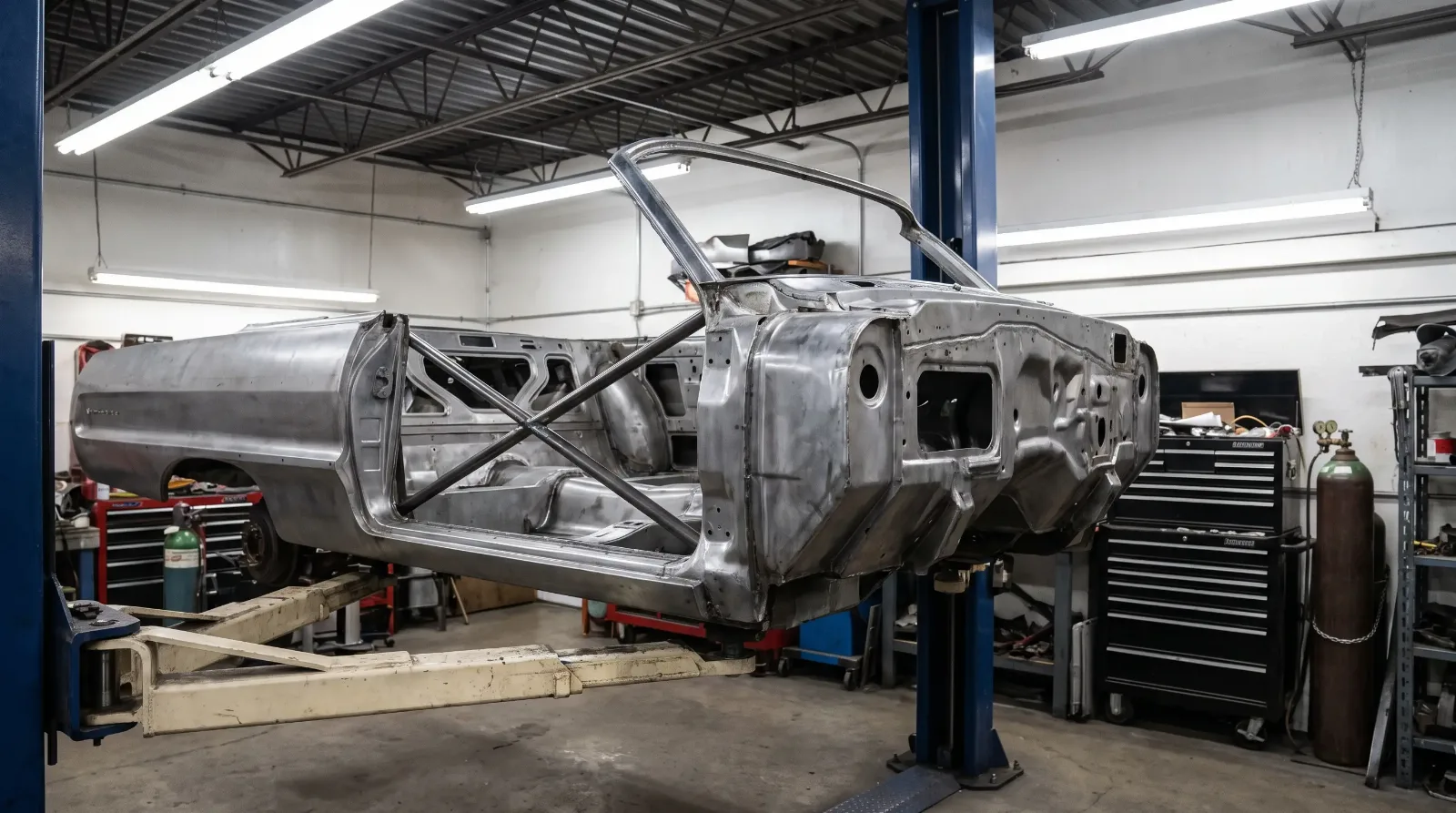
Why the open body is a different problem
Closed cars borrow stiffness from the roof, the pillars and the rear window opening. Remove the roof from the design and the engineers had to put that stiffness back somewhere else, usually in heavier rockers, a reinforced cowl and sometimes extra crossmembers under the floor. Many American convertibles carried reinforced rocker boxes, torque boxes or heavy plates inside the rockers for this reason, and some unibody cars added boxed sections or extra bracing under the floor. The result is a body that flexes in specific places, and those places are where fatigue cracks and tired metal show up decades later.
That is why a convertible should be judged on how it sits, not only how it looks. Doors that drop at the latch edge, a windshield frame that has twisted a few millimeters, and gaps that change when the car is jacked at one corner all point to a shell that has lost its geometry. Paint will hide none of it for long.
Measure before you disassemble
The first extra step is documentation of the shell while it is still assembled. Before the doors come off, set the car on level stands at the factory jacking points and record door gaps, cowl height and the fit of the windshield header to the top frame. Photograph the gaps with a ruler held in frame. When the body comes off the chassis, those numbers are the only reference you have for where the car sat when it was sound.
Many restorers also fit temporary bracing before the body leaves the frame: diagonal tubes or flat bar across the door openings, welded or clamped to the sills. A convertible body lifted from its chassis without bracing can sag, and a sagged shell is nearly impossible to bring back square once the doors and quarter panels have been fitted around it.
The cowl, the rockers and the floor
On any open car, the cowl and the lower body structure carry the load. Water also collects in them. A leaking top, a clogged cowl drain or a weeping rear window seal sends moisture straight into the footwells and rear seat floor, where it sits under carpet and sound deadener. Inspection of a stripped convertible should begin at the cowl corners, the bottoms of the A-pillars, the rocker ends and the rear quarter lower sections behind the seat.
Expect more floor and rocker work than on a coupe of the same age, and plan the budget around it. Fabricated repair sections need to be fitted with the body supported at its measured ride height, not hanging free on a rotisserie with the doors open and the shell relaxed. Do the structural welds first, then check the door gaps again against your numbers.
The top, the frame and the well
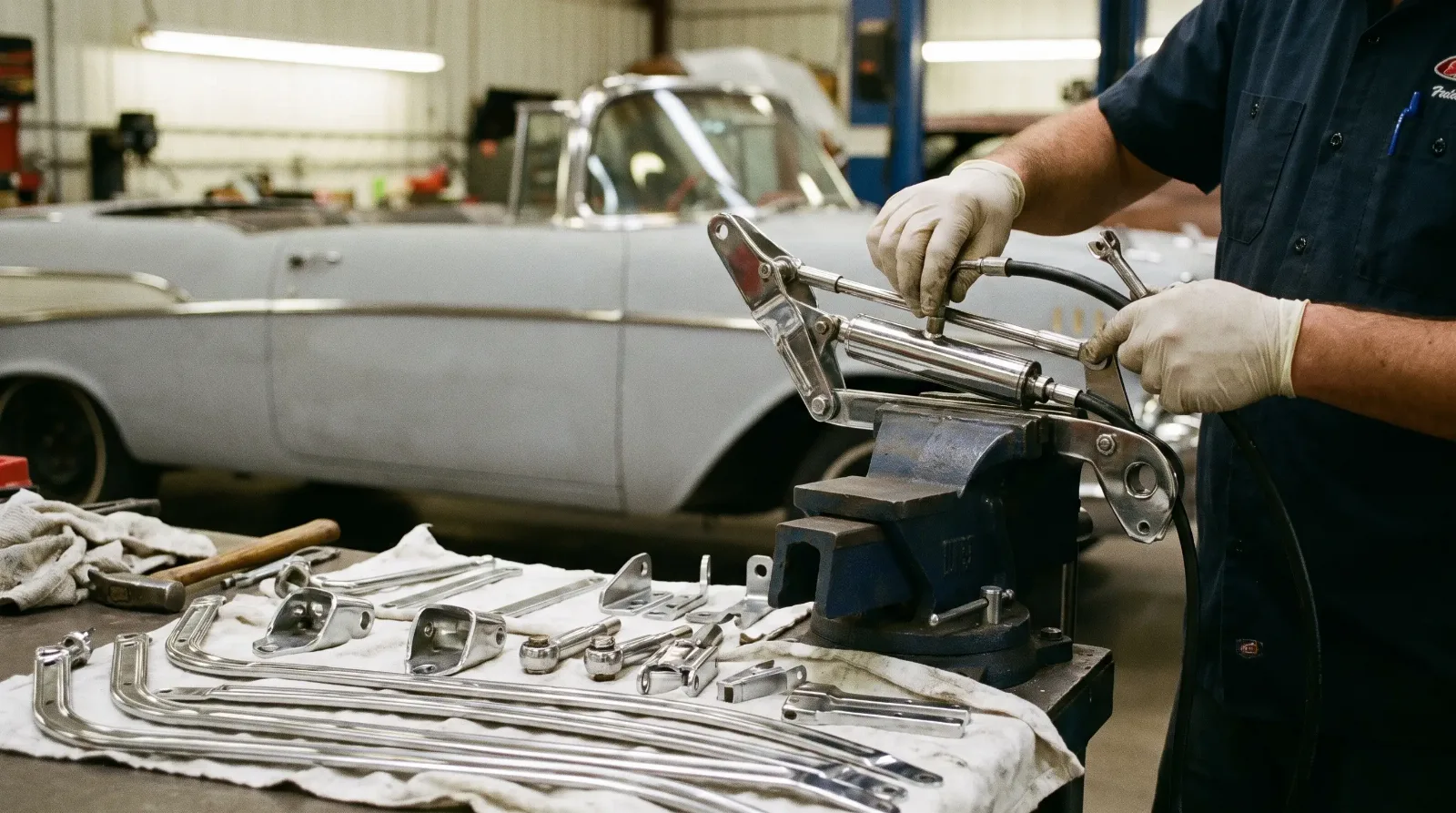
The folding mechanism is the part most owners underestimate. A top frame is a set of linkages, pivots and bows that has to open and close in sequence, and a slightly bent or worn pivot makes the whole assembly bind. Strip it, clean it, check each pin and bushing, and rebuild or replace what is worn before any new top material is ordered. Bench-test the frame on the car before the top is sewn and fitted.
Power tops add hydraulic or electric components. Pumps, cylinders and hoses age, seals dry out, and original fluid specifications matter. A rebuild kit for a hydraulic cylinder is cheap, a leak onto new carpet is not. On manual cars, check the latches and the windshield header weatherstrip, since they decide whether the finished top seals in the rain.
Top material and fit
Period-correct top fabric and grain vary by marque and year, and the correct choice matters for judged cars. A professionally installed soft top commonly runs roughly $1,200 to $3,000, and premium fabrics, glass or complex power tops can pass $5,000, with installation labor alone often $700 to $1,500 or more. The top, the padding, the rear window and the boot cover should be ordered as a set so the grain and color match. For more on the cabin side of this work, see our guide to the interior and top.
What the extra steps cost
| Added step | Rough cost level | Why it is needed |
|---|---|---|
| Shell measurement and bracing | A few hundred dollars to low four figures | Keeps the body square when lifted from the chassis |
| Extra structural repair | Low four figures to well into five figures, depending on rust | Cowl, rocker and floor sections that carry the load |
| Top frame rebuild | Low to mid four figures | Linkages, pivots, hydraulics and latches |
| New top and rear window | About $1,200 to $3,000 for a soft top, more with premium fabric and a glass rear window | Fabric, padding, installation |
| Water leak testing and sealing | A few hundred dollars | Protects the new interior |
Apart from the soft top, which is sourced above, these are rough levels in words, not quotes, because no published prices exist for this work. They assume shop labor of about $85 to $150 an hour (around $125 is typical) and sit on top of the normal costs of the restoration. Cars with salt-belt rust or coachbuilt tops will run higher, so keep the usual 20 to 30 percent contingency.
Water testing and final fit
Build the top and weatherstrip system before the interior goes in. Run a hose test around the windshield header, the side seals and the rear bow, and have someone inside with a light. Once the carpet and headliner are in, a leak means pulling them again. A convertible that has been through a thorough water test is a car that will stay dry through the first summer storm.
"The shell tells you whether the rest of the work will hold. If the body is square on the stand, the top will fit. If it is not, no amount of fabric will fix it."
Sarah Whitfield
Is it worth it
Convertibles usually bring a premium in the market, and that premium rarely covers the extra cost of doing the job properly. Restore one because you want an open car that fits, seals and drives well. Check the original build documentation first, price the added steps honestly, and compare shops that have finished open cars before you hand over a shell. Our directory of restoration shops by state is a starting point. And if you are weighing how far to go, consider whether a day-two build would suit the car better than a factory-correct finish.
Sources and notes
- Convertible top replacement cost (ThePricer), soft top price ranges, installation labor and extra components
- Convertible frame stiffening (For A Bodies Only), owner reports of factory torque boxes and thick rocker reinforcement plates
- Removing roof (For A Bodies Only), convertible reinforcement in rockers and torque boxes, and the effort of replicating it
- Convertible flex (sag) (HET Club Open Forum), door sag, hinge fatigue cracks and checking frame geometry before repair
- Convertible (Wikipedia), reduced structural rigidity of open bodies and the engineering needed to compensate
Related Reading
Have a
Classic Car
for Sale?
Reach thousands of serious classic car collectors across the US.
Sell It Here →
Selling a classic? Here's how: where to sell your classic car online
Are You a Classic Car Dealer?
List your full inventory and connect with targeted classic car buyers.
Join as a Dealer →

About the author
Sarah Whitfield
Third-generation classic car collector specializing in pre-war American and European coachbuilt automobiles. Researcher and concours enthusiast.
More in Restoration & Tech
Comments (1)
J
Janet Morrow
1 day ago
Bit of a footnote from the British car corner. Some open cars never lost a roof in the first place. My MGB was designed as a roadster from the start, and the GT arrived a few years later with a roof added. Brilliant little shell all the same, even if the wiring is a separate tragedy.
Janet, the MGB is a good example of the other direction: the roadster came first, and the GT followed in 1965 with a roof added to an open design. The measuring advice still applies to cars like yours, though. On a monocoque roadster the sills carry the load, so record the door gaps before the sills come out, not after.