Walk into an engine machine shop with a worn block and you will hear a list of words: bore, hone, deck, line bore, torque plate. Most owners nod and say yes to everything. That is how a modest machining bill grows into a much bigger one. Learn what each operation does and you can say yes to the right ones.
This is the plain version, from someone who has stood at the counter and written the checks. Prices are 2026 US dollars, given as ranges. They vary by shop and region.
Before anything else: clean and inspect
The shop starts by hot tanking or baking the block clean, then magnafluxing it for cracks. Cast iron cracks in predictable places, around the lifter bores, the cylinder walls and the main webs. A cracked block is scrap. Better to learn that for roughly $100 to $300 in cleaning and inspection than after you have paid for machining.
They also measure everything. Bore diameter, taper, out-of-round, deck height, main bore alignment, crank journals. These numbers decide what operations you need. Ask for them on paper.
Boring and honing
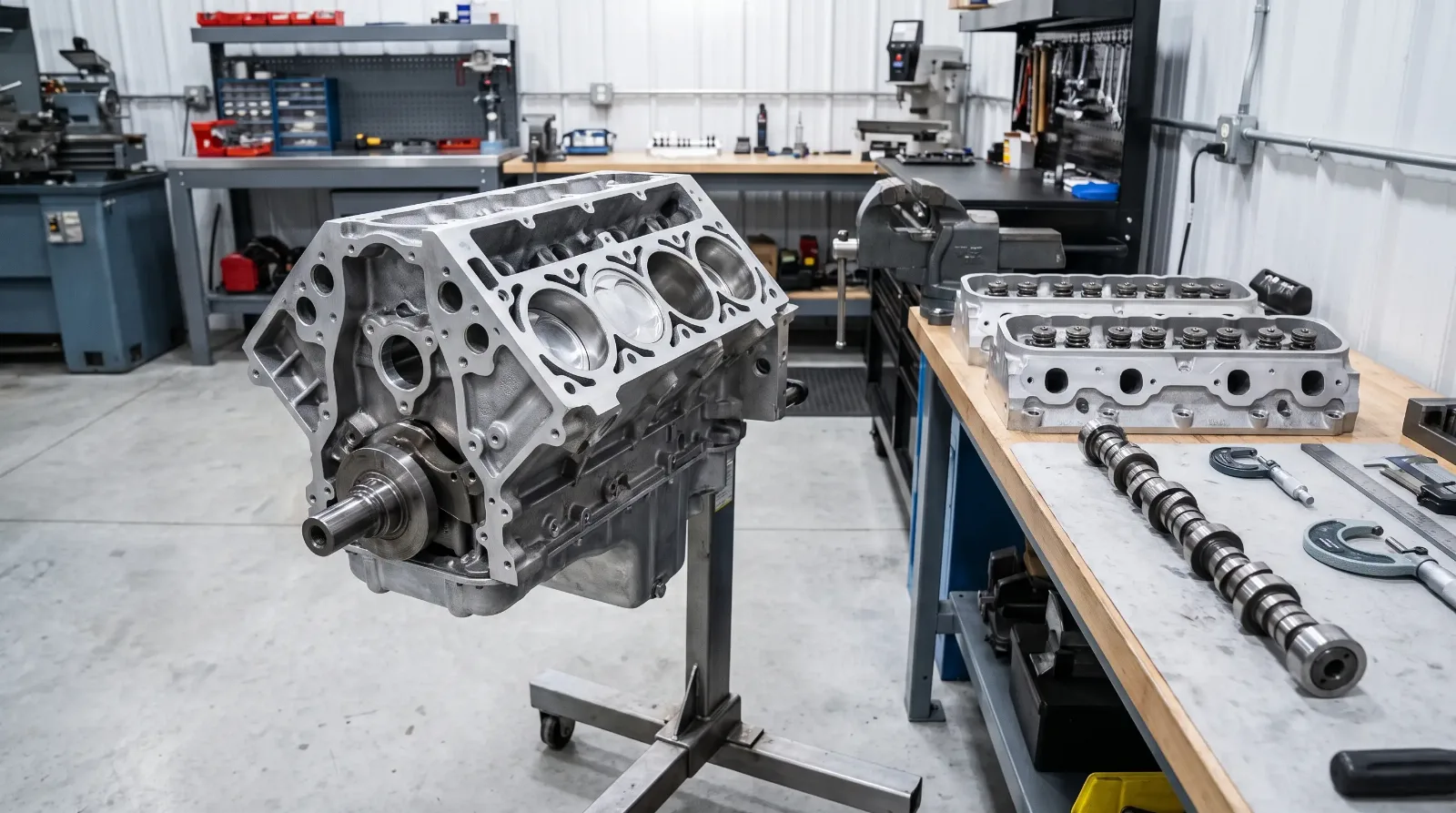
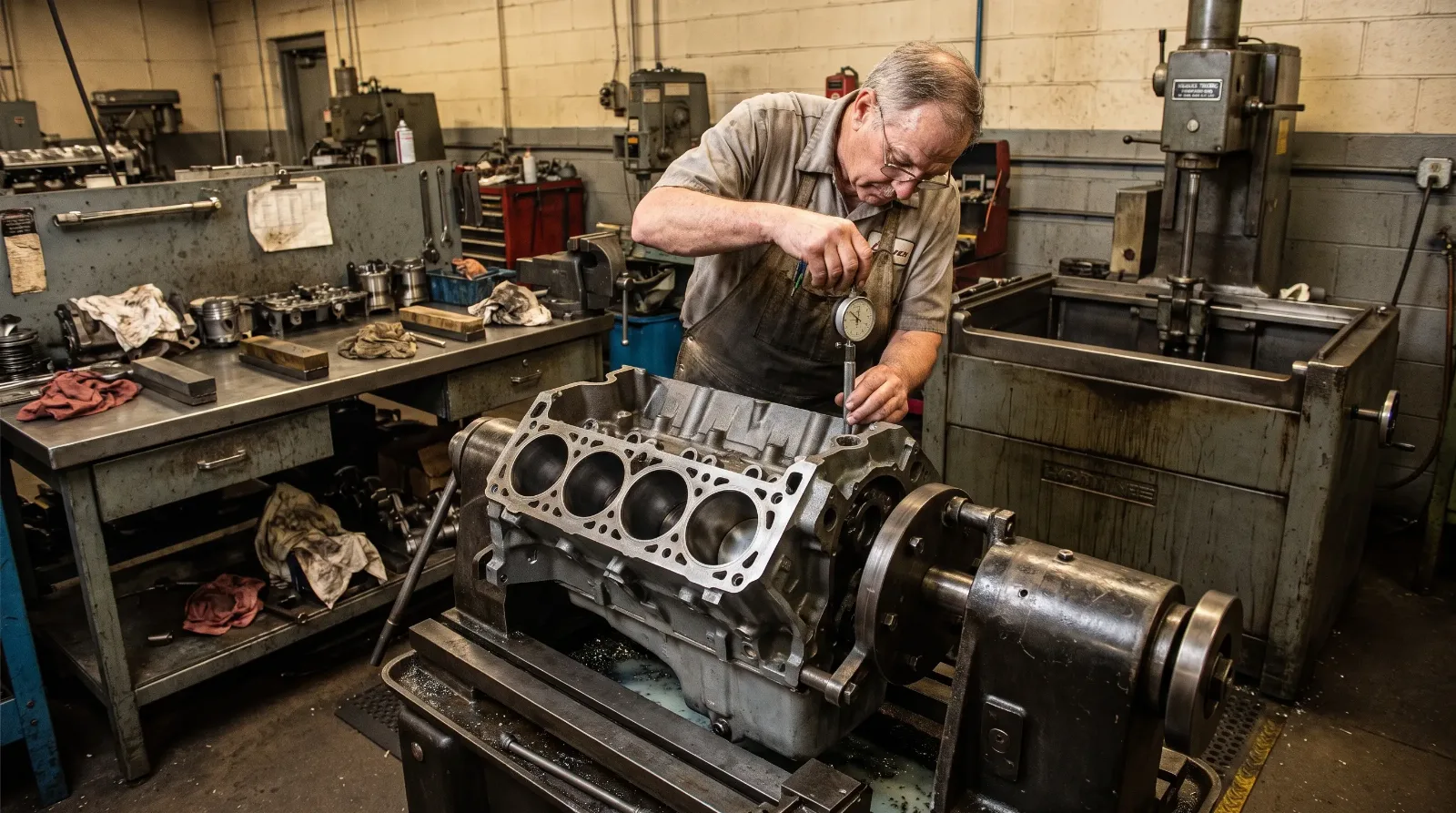
Boring cuts the cylinders larger to a new, round, straight diameter, so you can fit oversize pistons. Common steps are 0.020, 0.030 and 0.040 inch over stock, though what a given block can take depends on its wall thickness. A cylinder with a little wear and no taper may need only honing, which is a light finish that lets new rings seat.
The finish matters. With a torque plate bolted to the block to simulate head stress during the final pass, the bores are finished under conditions closer to the assembled engine, because tightening the head bolts slightly distorts the cylinders. Stock rebuilds can do fine without one, but it is worth asking whether the shop uses it. Boring and honing a V8 typically runs about $250 to $500.
| Operation | What it fixes | Typical cost (2026) |
|---|---|---|
| Hot tank and magnaflux | Dirt, hidden cracks | $100 to $300 |
| Bore and hone | Worn, tapered, out-of-round cylinders | $250 to $500 |
| Deck surfacing | Warped or uneven block face | $125 to $300 |
| Line boring or honing | Misaligned main bearing bores | $100 to $450 |
| Crank grind and polish | Scored or worn journals | $100 to $400 |
| Valve job, pair of heads | Worn seats and guides | roughly $400 to $1,200 |
Decking
Decking machines the top face of the block flat and square to the crank centerline. It fixes warpage, cleans up a corroded surface after a head gasket failure and sets a consistent deck height, so compression is the same in every cylinder. It is not always needed. If the surface is flat within the factory spec, leave it. Every thousandth you remove changes compression and, on some engines, intake fit, so cutting more than necessary is a mistake.
Line boring and line honing
The main bearing bores hold the crankshaft. Over decades, or after a spun bearing, they can go out of line or out of round. Line boring or line honing cuts them back to a straight, concentric line. You need it when a crank is tight in the block after fitting new bearings, or when a spun main has damaged a bore.
It removes metal, which moves the crank a hair closer to the cam and the heads. A competent shop accounts for this. Not every rebuild needs it, but a rebuild that ignores a misaligned main bore will wear out bearings quickly.
Crank, rods and heads
The crankshaft gets measured and, if the journals are worn or scored, ground to a standard undersize, commonly 0.010 or 0.020 inch, then polished. Connecting rods get their big ends resized and checked for straightness. Heads need a valve job, which cuts fresh valve seats and sets the seat angles, and the guides get checked for wear.
You will also hear about balancing. Spinning the rotating assembly on a balancer reduces vibration. It adds roughly $300 to $500, and on an engine you plan to rev, it is worth paying for.
"I've pulled apart enough of these to tell you that the machine shop is where the engine either gets built right or gets built twice. Ask for the numbers on paper."
Mike Sullivan
What a fair quote looks like
A good shop gives you a line-item quote, not a single number. It names each operation, the oversize it expects to cut and any parts it will supply, such as freeze plugs, cam bearings or a set of main bearings. If a quote says only "rebuild, $2,000," ask what is in it. Some shops include cleaning, inspection and assembly. Others quote machining only and charge by the hour for the rest.
Turnaround matters too. A busy shop may hold your block for weeks, and a rush job on a cracked or oddly sized block is how mistakes happen. If the shop finds something you did not expect, such as a cracked cylinder wall, it should stop and call you. Agree on that before you drop off the block, and keep the paperwork with the engine.
How to deal with the shop
Bring the engine apart and clean, or at least clearly labeled. Tell the machinist the plan: stock rebuild, mild performance, or something stronger. Ask them to list every operation they plan and the price for each, and to call you before doing anything not on the list. Get the finished measurements back with the block.
Then decide how the machine work fits the job. Our guide to the full engine rebuild places it in the order of the whole project. And before you buy parts, read short block vs long block, which explains how assembled engines package this machine work.
Sources and notes
- Torque plate honing: why it matters (BK Racing), supports why bores are honed with a torque plate and that stock rebuilds can do without one
- The art and science of cylinder honing (EngineLabs), supports honing finish, torque plates and ring seal
- Honing (metalworking), Wikipedia, supports the cross-hatch finish that helps rings seat
- Magnetic particle inspection, Wikipedia, supports how magnafluxing reveals cracks in ferrous parts
- Bullnose Garage: Common engine machine work definitions and costs, 2024 price ranges for hot tanking, magnaflux, boring, honing, decking, align honing, crank grinding and balancing
- EngineerFix: How much does it cost to rebuild a 350 engine?, machine work, assembly labor and total rebuild ranges for a small-block V8