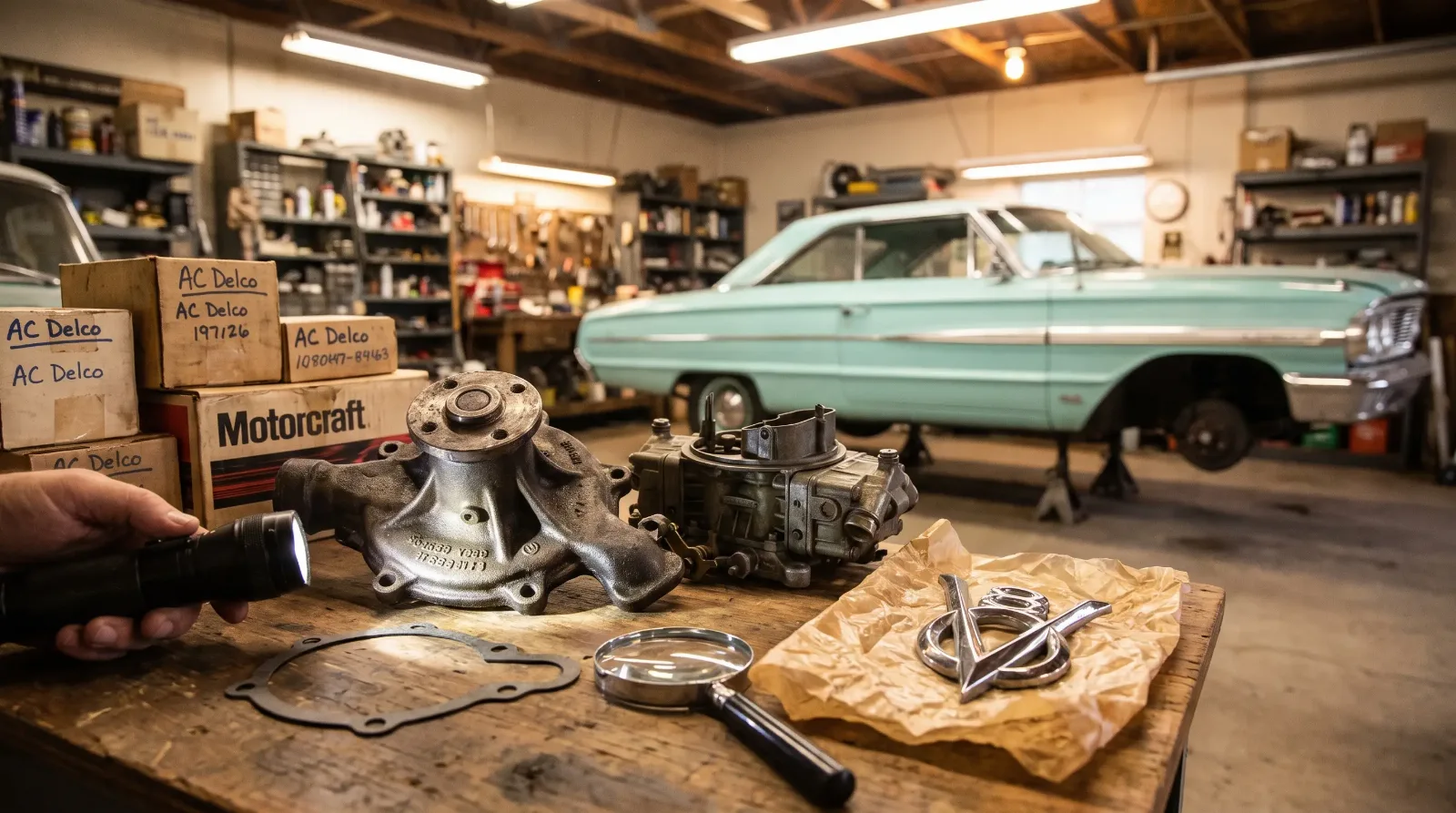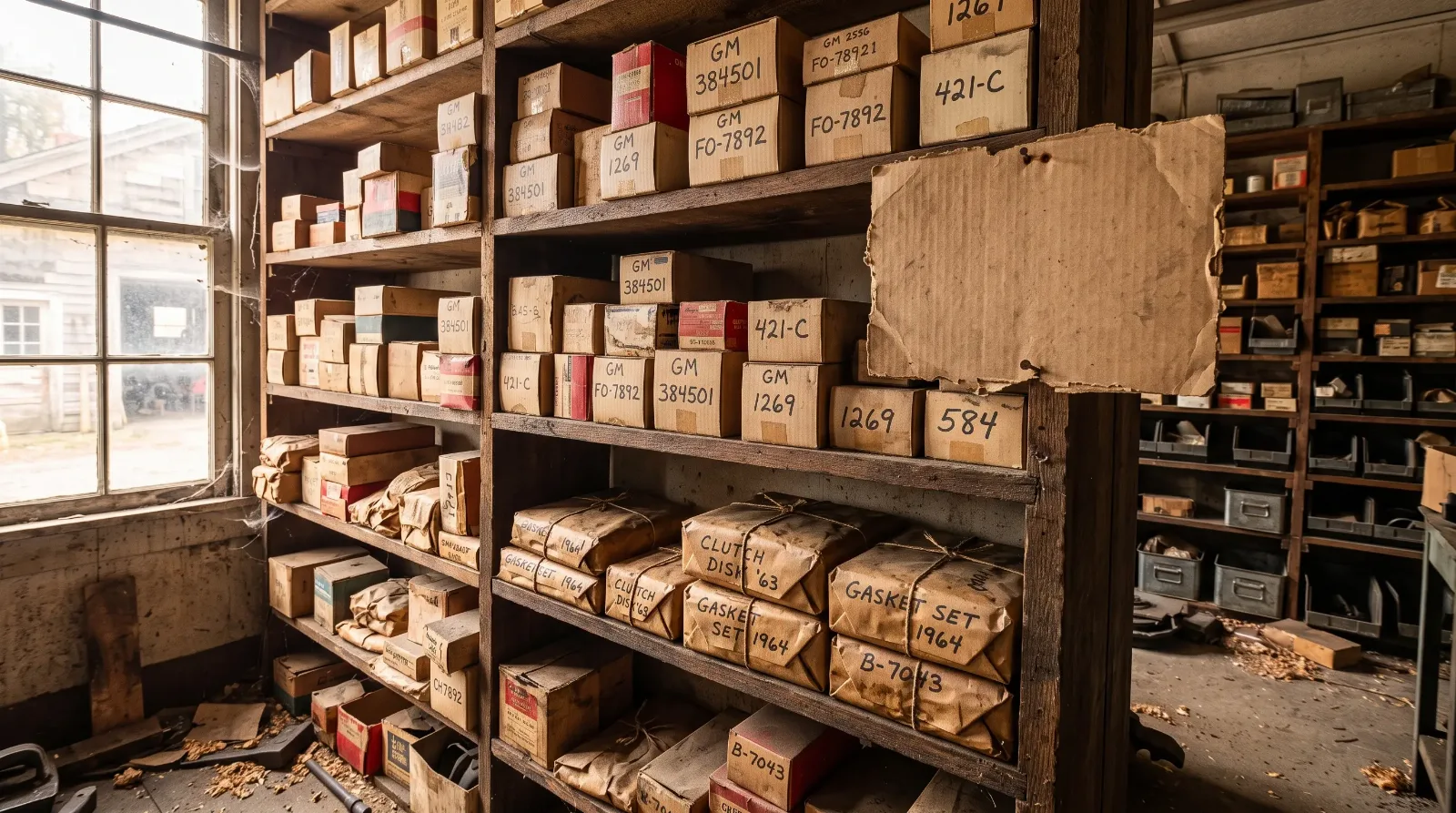
A genuine NOS part earns its price because it is original and unused. That is also why it is worth faking. The label moves money, and some sellers have worked out that the label is cheaper to produce than the part. Most of the trouble comes in three forms: a reproduction placed in an old box, a used part cleaned up and repackaged, and a real but wrong part presented as the right one.
None of these tricks is hard to spot if you know what to examine. The rule I use is simple. Never evaluate the box. Evaluate the part, and then check whether the box and the part agree with each other and with the record. If you want the grounding first, the parts sourcing guide explains where each kind of part belongs in a build.
The three ways a part gets faked
The first is the relabelled reproduction. A modern copy is boxed in vintage-looking packaging or sold in a repackaged original box with a convincing label. The packaging is the sales pitch. Old boxes are easy to buy in bulk, and the part inside may never have touched the same decade.
The second is the cleaned-up used part. Someone takes a good core, strips it, refinishes it and puts it in a box. At arm's length it looks new. Up close the wear shows in the places a rebuilder would not touch: threads, mating surfaces, bores and hidden corners.
The third is the near-miss. The part is genuinely old and genuinely unused, but it is for a different year, engine or application. It is an honest NOS part sold as the wrong one, or sold as the right one by a seller who does not care. For a restorer chasing correctness, a wrong-application NOS part is no better than a reproduction.
Check the packaging, but do not trust it
Packaging still tells you something. Look at the printing. Period boxes used the typefaces, inks and printing methods of their time, and a box printed on a modern digital printer looks too sharp and too uniform. Check the paper stock and the way it has aged. Real age shows as even toning, soft creases and faded ink. Fake age often looks blotchy, with the same stain pattern on every box.
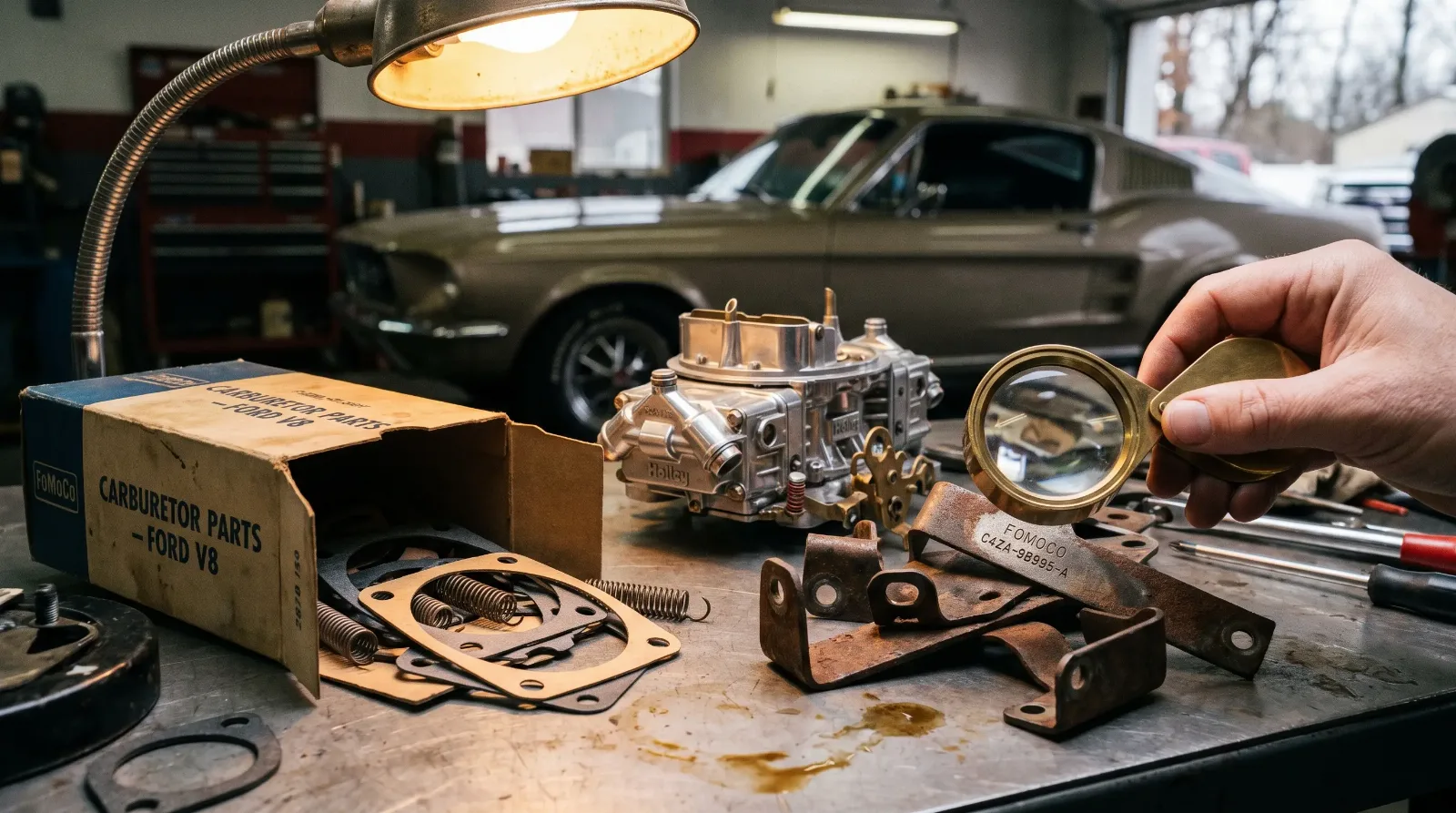
Check the labels. A part number label should match the format used by that supplier at that time. If the label uses a font, layout or numbering scheme that does not match other known examples, say so out loud and ask the seller about it. Compare it to photos of confirmed original packaging, and to the original parts catalog if you can find one for the car.
Check the part itself
The part gives the most honest answer. Start with the finish. Original plating, paint and casting texture have a particular look. Period zinc, cadmium and chrome finishes age differently from modern plating, and some reproductions arrive with a brighter or more uniform finish than the original had. Treat a part that looks too pretty for its age with suspicion, and compare it with a confirmed original. A bracket that is correctly painted black in the catalog but is shiny silver in the box has told you something.
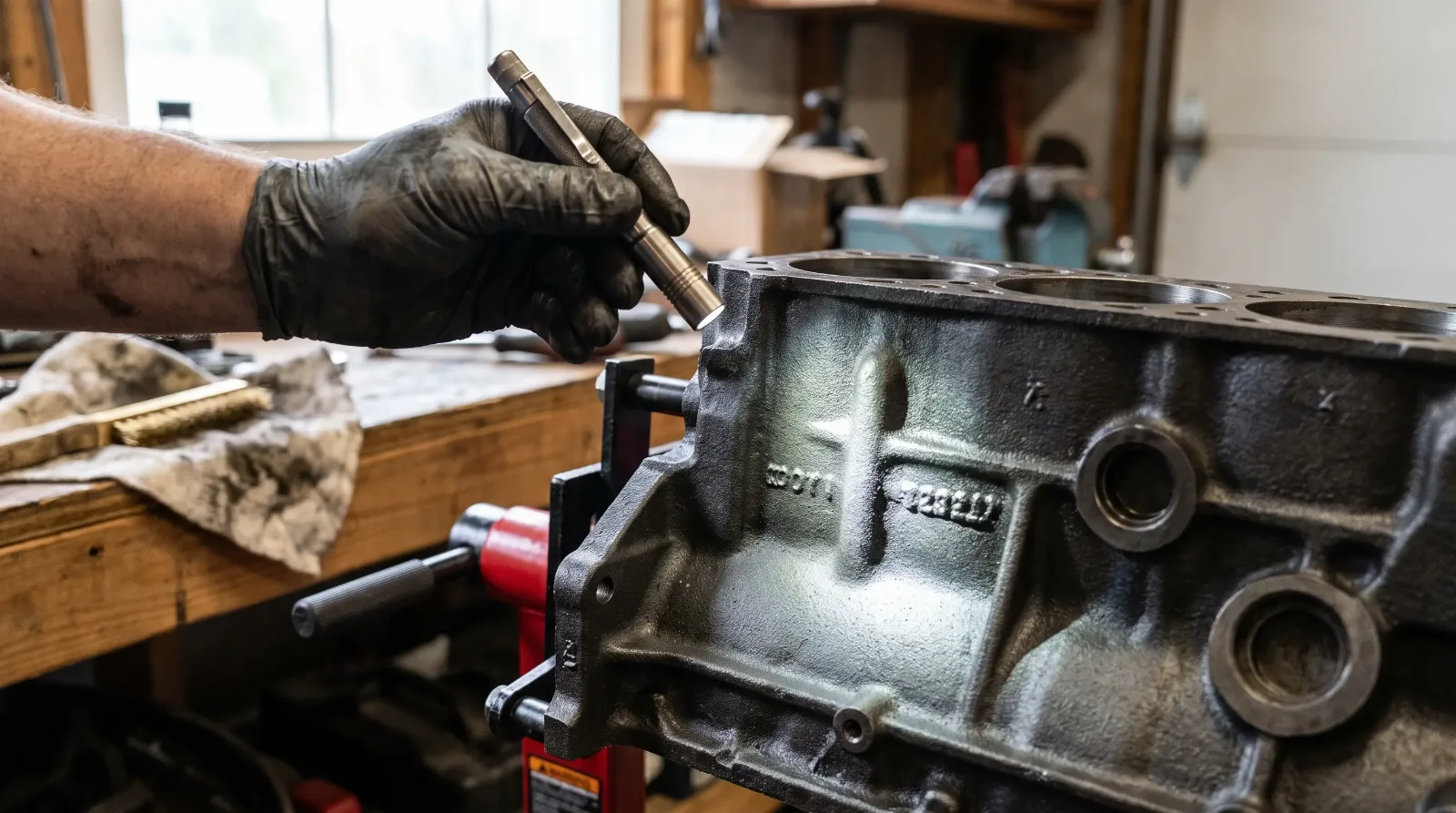
Look at the markings. Original parts carry part numbers and date codes stamped or cast in specific places. Numbers follow a logic: a Ford prefix, for example, encodes the decade, year and car line, so a number that does not fit the car is a flag. A reproduction may leave marks out, put them in the wrong spot, or use lettering that is too clean and too deep. Learning to read these takes practice, and the guide to casting numbers shows what you are looking at and what a plausible number looks like.
Check for wear in the wrong places. A truly unused part should show no marks from installation. If the mounting holes are scuffed, the threads are burred or the mating surface has a witness mark, it has been on a car. Check rubber parts by flexing them gently. Original rubber that is old but sound tends to feel stiff and dull, while rubber that is soft and glossy may be new. Treat this as one clue, not proof.
Paperwork and provenance
Ask where the part came from. A seller with a genuine find can usually say which dealership, warehouse or estate it came from and when. The story proves nothing alone, but a seller who is vague, changes the story or gets defensive is giving you information. Ask for photographs of the part from every side before you buy, and ask for a return window if the transaction is online.
Dates should also run in order: casting dates precede assembly dates, which precede the build date of the car, and a casting date after the car was built is a problem. Compare the part number to a parts book, a factory interchange list or the part numbers in the owner's club registry. If the part number does not appear for your car, or it appears for a different year, you have either a near-miss or a fake. Registries and marque clubs often have members who know individual part numbers well, and a quick question can save a lot of money.
"The documentation is the check. If the part number does not match the record, the rest of the story does not matter."
Tom Ramirez
Where the fakes tend to turn up
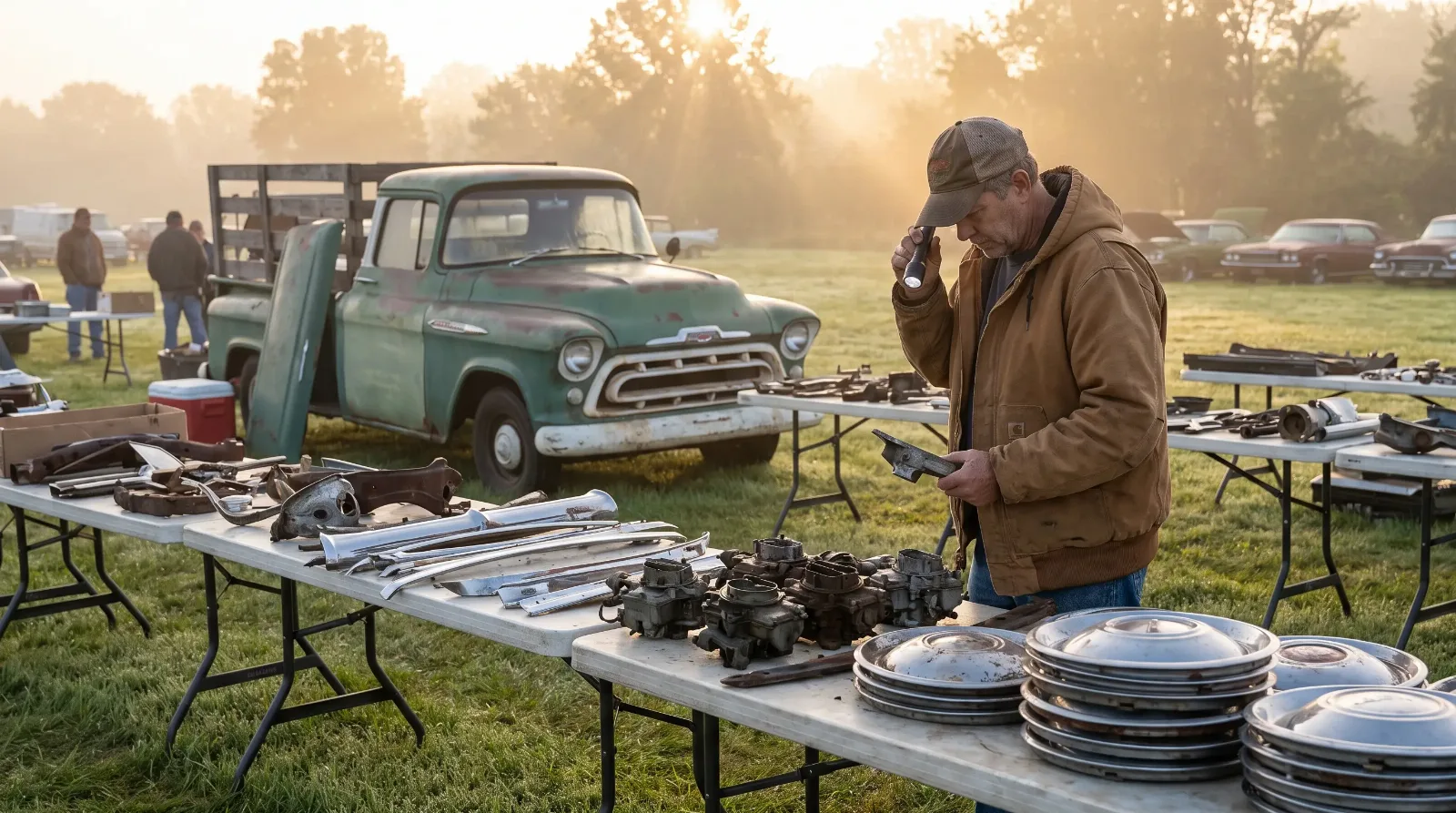
High-value, high-demand parts are the usual targets: emblems, trim pieces, badges, specific carburetors, ignition components and anything that appears on a judging sheet. If you are hunting items from the list of hardest muscle car parts to find, expect a higher share of questionable listings, because scarcity creates the temptation.
The safest sources are the ones with a reputation to lose. Specialist dealers who handle only one marque often know the parts better than any buyer does, and they stand behind what they sell. The article on finding muscle car parts specialists covers how to locate and vet them. A fair price from a known source usually beats a bargain from an unknown one.
When you cannot tell
Some fakes are good. If a part is expensive, ask an expert before you pay. Send photos to a registry, a judge or a specialist who handles that part regularly. Pay for the second opinion if you have to. It costs far less than finding out at judging time, or after the car is reassembled, that a piece you paid NOS money for is a reproduction.
And if the seller will not allow inspection, will not describe the origin and will not accept returns, walk away. A real NOS part is worth waiting for. A fake is worth nothing, and it will cost you twice: once to buy and again to replace.
Sources and notes
- New old stock, Wikipedia, definition of NOS as unsold, never-used stock in original packaging
- MustangSpecs: Ford part numbers and date codes, how Ford prefixes encode decade, year and car line
- Chevellestuff: engine stamp numbers, GM casting date format and casting versus assembly dates
- Numbers matching, Wikipedia, why dates and numbers must fall in chronological order
- AutoGuide: Ford boosts restoration parts inventory, licensed reproductions, master samples and club praise for near-identical copies