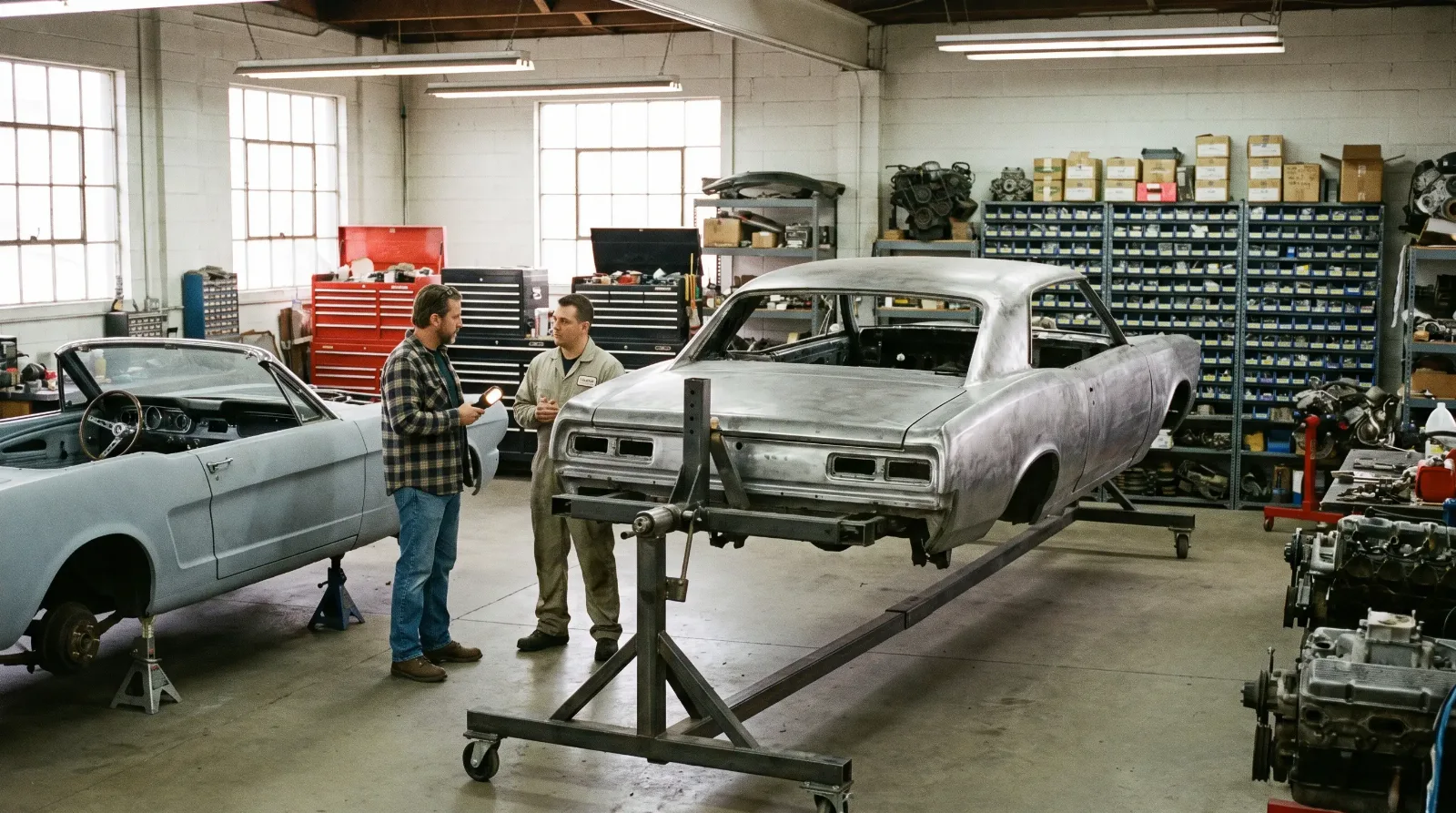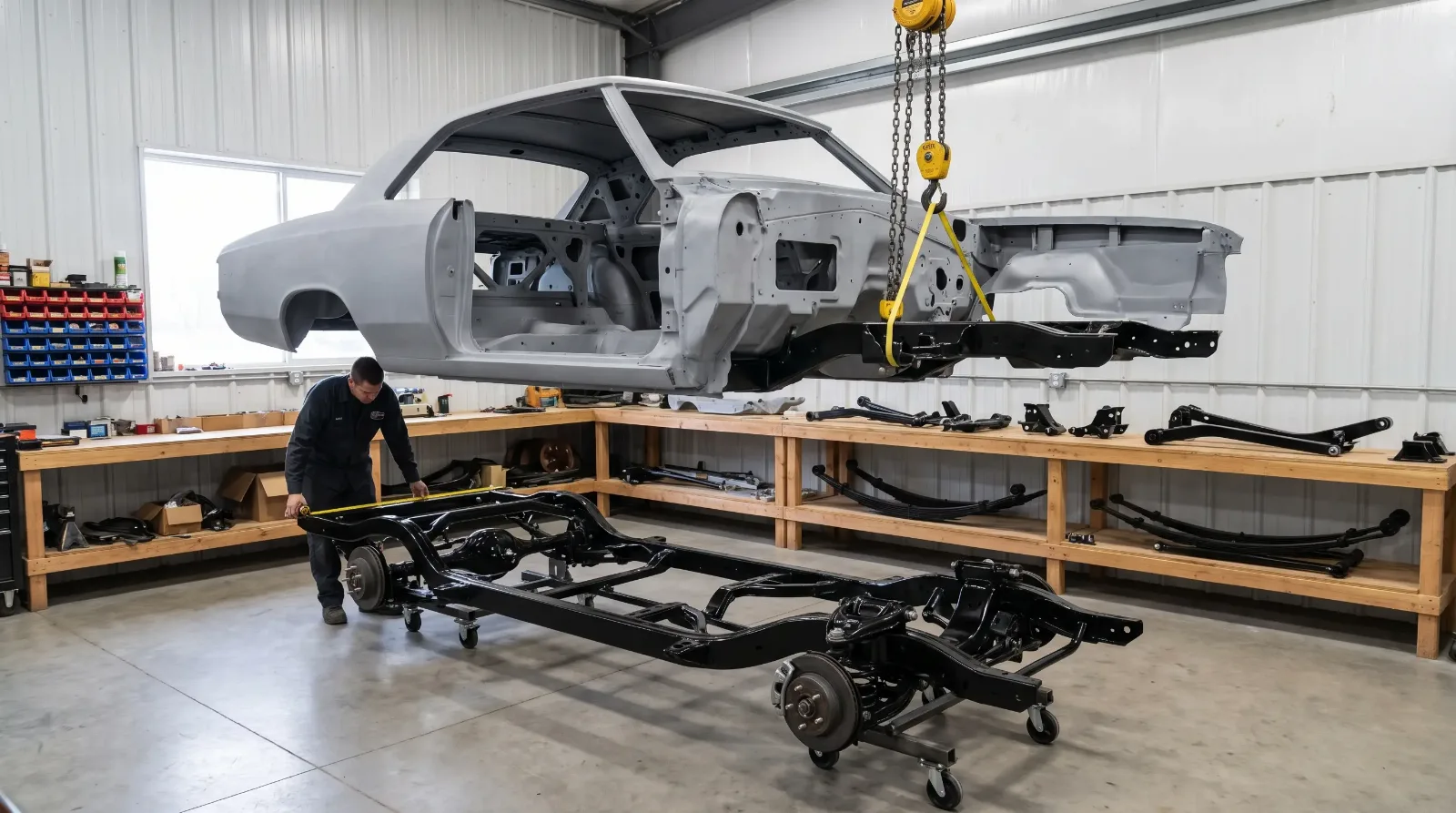
Before any metal gets straightened or any primer gets sprayed, the old finish has to come off. How it comes off decides what you learn about the car, how much damage you cause, and how much cleanup you are still doing six months later. There are four common methods: media blasting, chemical stripping, acid dipping, and sanding or grinding by hand. Each has a place. Each can also ruin a panel if it is used on the wrong car.
This is the sequence I follow when choosing, and the reasons behind it. It fits into the larger job covered in the paint and bodywork guide.
Media blasting
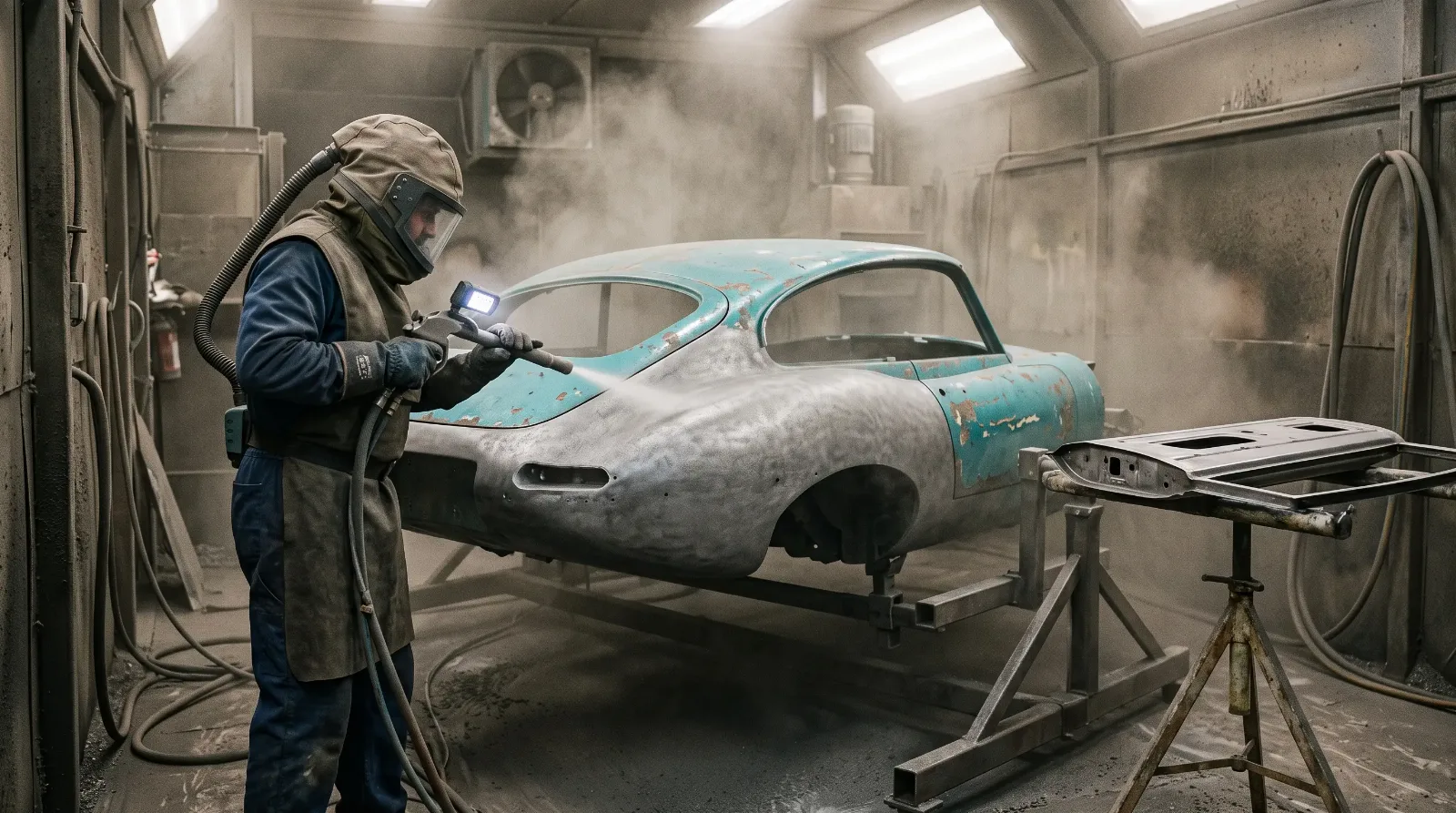
Blasting fires abrasive at the surface under air pressure. It is fast, it removes paint, filler and rust in one pass, and it leaves a profile that primer bites into. The method works because the media does the cutting, so the choice of media matters more than anything else.
Sand, aluminum oxide and other hard, sharp media cut quickly and are the usual choice for heavy frames and thick steel. They also generate heat, which is what warps thin panels. Used on thin body panels, they heat and stretch the metal. Large flat areas like roofs, hoods and door skins can oil-can, which means they pop in and out under finger pressure, and fixing that is hours of hammer and dolly work. Softer media such as plastic, walnut shell, or soda is gentler; walnut shell and plastic media are slower but do not warp thin panels. Soda blasting in particular strips paint without cutting steel much, though it does not remove rust well and it leaves an alkaline residue that must be washed out and neutralized before primer, or the coating can fail. Soda does not remove rust, so rusty areas still need a harder media.
A skilled operator uses low pressure, keeps the nozzle moving, holds it at an angle, and stays off flat panels. Pressure and distance are as important as the media. If a shop tells you it can blast the whole body at full pressure with sand, find another shop.
Chemical stripping
Chemical strippers soften the paint so it can be scraped off. Modern formulas are far better than the old methylene chloride products, which the EPA has banned for consumer paint removal since 2019 and has restricted for most commercial use under a 2024 rule. The work is slow and messy. You brush it on, wait, scrape, repeat, and clean the residue off thoroughly or the new primer will fail.
The big advantage is that it does not heat or distort metal. For thin panels, delicate trim pieces and areas with filler you want to keep inspecting, it is the safest path. The disadvantages are time, labor and disposal. Stripper in seams and under panel overlaps can bleed out later and lift new paint, so seams need to be flushed and sealed carefully. On a large car it is also not cheap, because the hours add up.
Acid dipping
In dipping, the body shell is submerged in tanks. A typical sequence is a hot caustic bath that removes paint and filler, then an acid bath that removes rust, then a neutralizing rinse and a quick coat of primer. It reaches every inside surface that blasting cannot: rails, pillars, rocker interiors, door bottoms.
That reach is the reason people choose it. It is also the reason people regret it. Fluid can hide in seams for a long time and creep out later. Seam sealer and lead in body seams can be stripped out. Aluminum parts must come off first, because the caustic dissolves them. Thin or heavily pitted metal may be weakened by acid. Many shops will warn you that a dipped car may need seams re-sealed and some areas re-welded afterward. It can also be hard to find a dipping facility that handles a full-size shell, and shipping a body shell is a real cost.
Dipping works best on a body that is solid, fully disassembled, with no lead work you value and no known heavy rust. It works worst on a rusty car with plenty of thin areas, because those are the places it will take more metal.
| Method | Speed | Reaches inside seams | Main risk | Cost notes |
|---|---|---|---|---|
| Sand or hard media blasting | Fast | No | Warped thin panels | Roughly $1,500 to $5,000 for an empty shell, by body size |
| Soft media or soda | Moderate | No | Poor rust removal, residue | Often a bit more than sand, since it is slower |
| Chemical stripping | Slow | Partly | Residue in seams, labor cost | Mostly labor, so it climbs with panel count |
| Acid dipping | Fast, but shipping adds time | Yes | Trapped fluid, lost lead work | Dip fee plus shipping, quoted by the facility |
Choosing for your car
Start with the metal. Thick, solid steel like frames, bumpers and heavy braces can take aggressive blasting. A body with original lead seams, such as a roof-to-quarter joint, should not be dipped or blasted hard, because you will lose the lead. Thin hoods and trunk lids from the 1950s and 1960s should not see sand at all. If the car has substantial corrosion, there is no point choosing a method on the paint alone. You are choosing how you will find every rotted spot, and that leads straight into rust repair decisions.
Think about the order of work too. Blast or strip first, inspect, repair, then prime as soon as you can. Bare steel flashes with surface rust quickly: within minutes after a dip, and in humid weather often within a day or so, so have epoxy primer ready the moment the metal is clean. Most failures I see come from a perfectly stripped car left to sit for weeks.
"Pick the method that tells you the truth about the metal without hurting it. The cheapest strip is not the cheapest car once a panel needs to be reshaped."
Ray Delgado
A worked example
Large flat steel is where the trade-offs show up. For a look at how blasting and surface prep go on a real project, see this walkthrough on sandblasting and prepping a pickup bed for primer. A truck bed is a good teaching case because it has heavy floor sections, thinner side walls and plenty of seams that trap media, so you see why technique matters.
Sources and notes
- EPA, Methylene chloride, 2019 consumer paint-remover ban and the 2024 commercial rule
- Kramer Industries, Stripping cars, media types, heat and warping on thin panels, plastic media cannot remove rust
- Old Cars Weekly, Non-abrasive soda blasting removes paint, soda produces no heat and does not remove rust
- Auto Restorer, Bad soda blasting, trapped soda residue corrodes and must be neutralized before primer
- Alliance Chemical, Car dipping 3-tank process, caustic, acid and neutralizing stages, aluminum risk, flash rust and priming timing