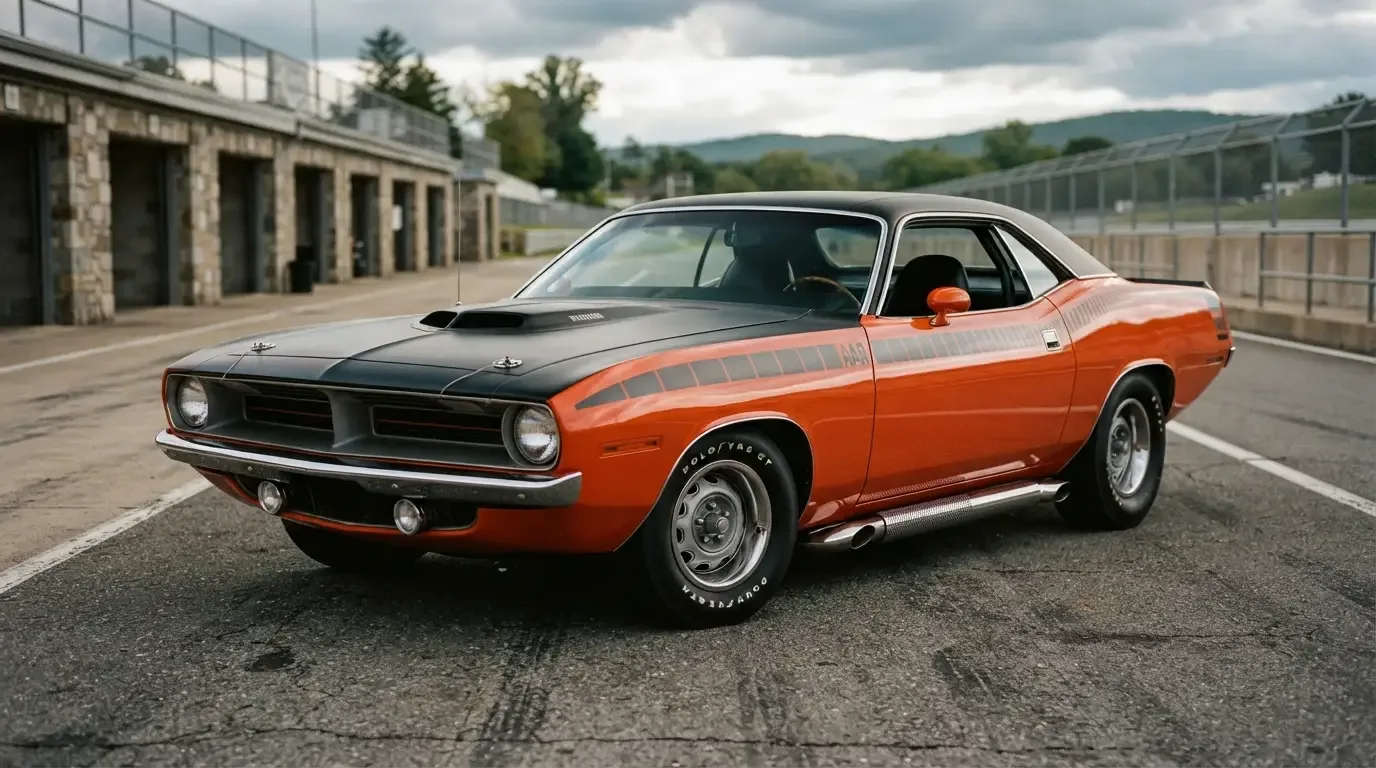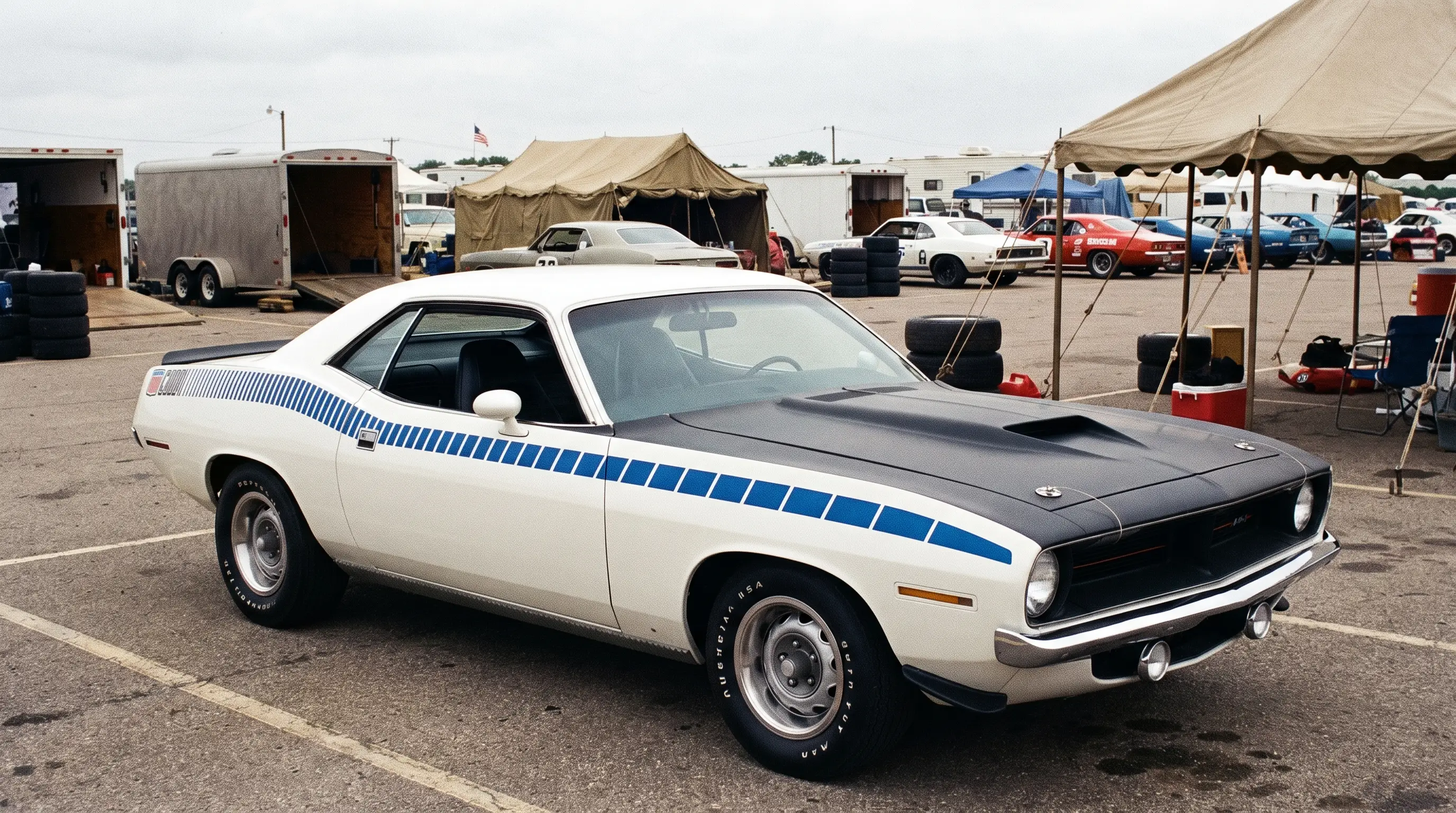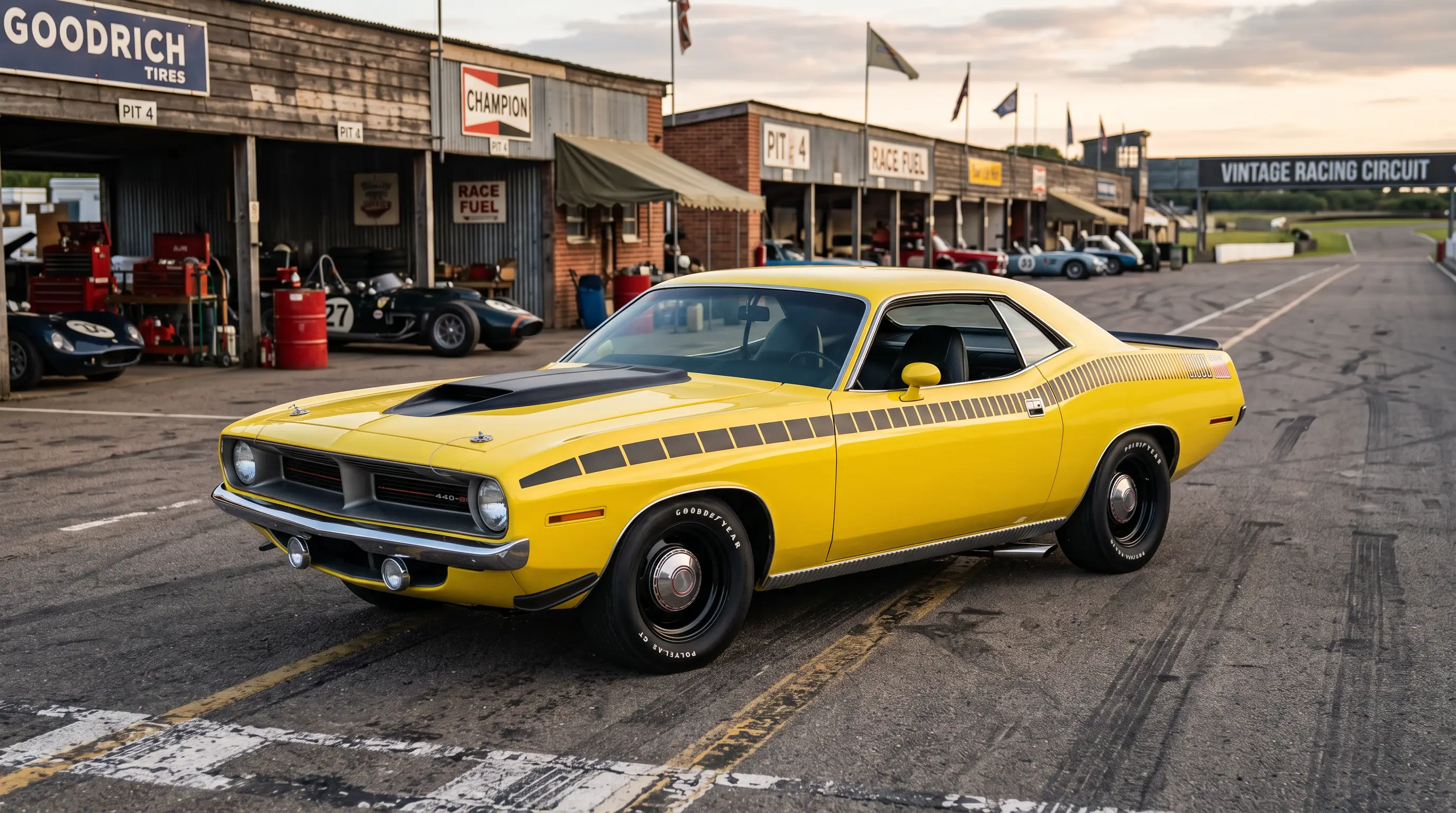
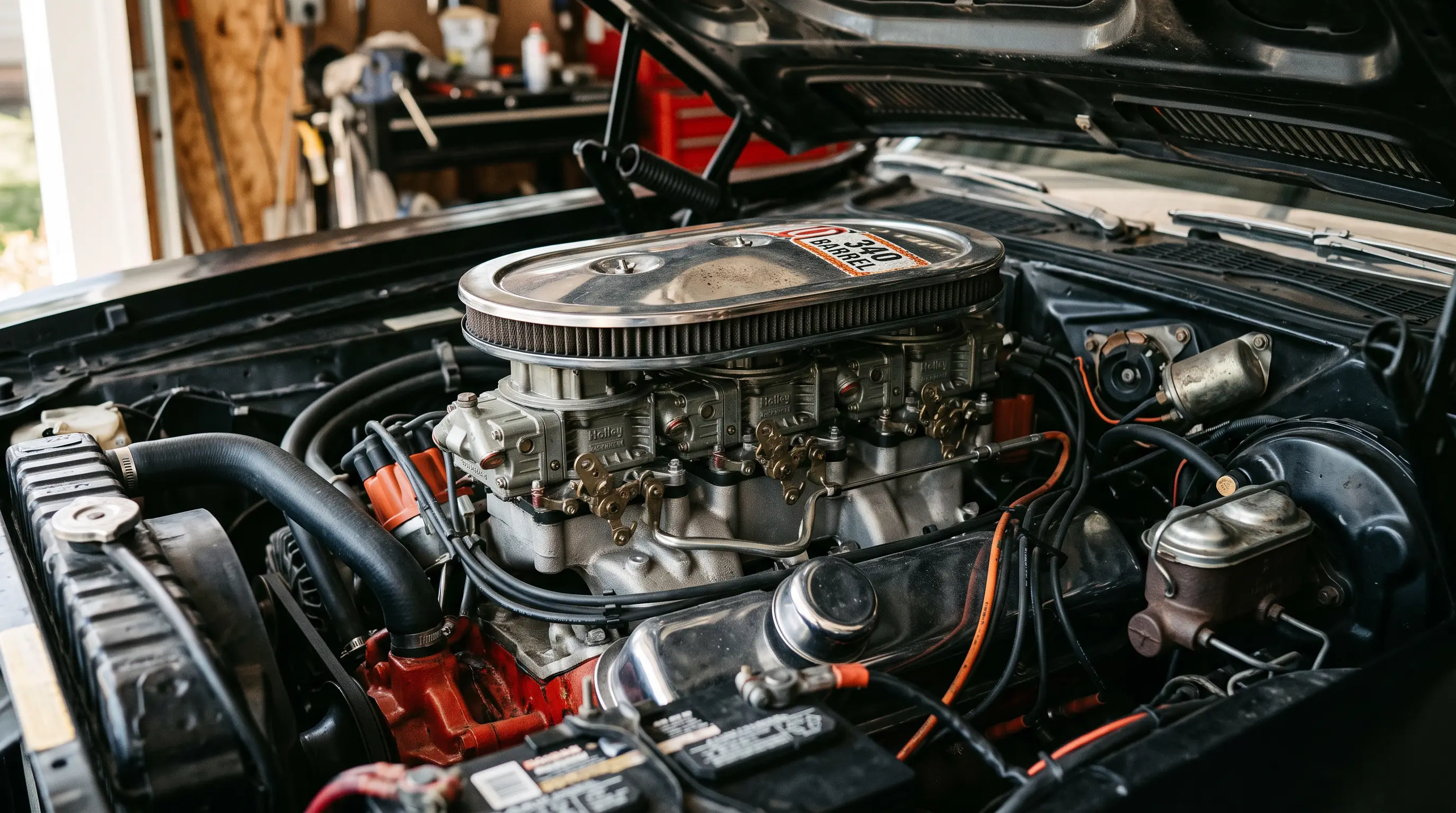
Three two-barrel carburetors on a 340 cubic inch small block sounds like overkill until you understand what problem Chrysler was actually solving. The aar cuda 340 six barrel engine was not built to chase a horsepower number on a spec sheet. It was built to give Dan Gurney's Trans Am race program a small block with the throttle response and mid-range torque that a single four-barrel setup could not deliver as cleanly, and the street version inherited that engineering logic whether or not the average buyer ever noticed.
Why three carburetors instead of one bigger one
A single large four-barrel carburetor is efficient at wide open throttle but tends to be less precise at part-throttle cruising, where a smaller carburetor's smaller throttle bores give better fuel atomization and throttle response. Chrysler's engineers solved this with a progressive three-carburetor arrangement, a small center carburetor handling normal driving duty and two outer carburetors that opened progressively as the throttle went down, effectively giving the engine the driveability of a small carburetor and the top-end breathing of a much larger one.
This was not a new idea invented for the AAR program. Chrysler had used multi-carburetor setups on other performance engines before, but the specific tuning applied to the 340 for this application, the cam timing, the carburetor sizing, and the exhaust manifold design, was calibrated with the AAR racing effort's requirements directly in mind, not simply borrowed wholesale from an existing parts bin engine.
What the numbers actually say
Plymouth rated the 340 Six Barrel at 290 horsepower, a figure that most period road testers and later engine builders considered understated relative to how the engine actually performed. Underrating engines for insurance and marketing purposes was common practice across Detroit in this era, and the 340 Six Barrel is frequently cited as one of the more conservatively rated engines of the period, with later independent estimates putting its real output closer to 325 horsepower.
What is not in dispute is the engine's real-world character. It pulled cleanly through the rev range, it revved more freely than the heavier big block options, and it gave the AAR Cuda a power-to-weight balance that made it genuinely quick without the nose-heavy handling compromise that came with a big block under the hood.
| Spec | 340 Six Barrel |
|---|---|
| Displacement | 340 cubic inches |
| Induction | Three two-barrel carburetors, progressive linkage |
| Factory rated horsepower | 290 hp at 5,000 rpm |
| Application | 1970 AAR Cuda exclusively within the E-body lineup that year |
Why this engine outlived its racing purpose
Homologation engines often disappear once the racing program that justified them ends, but the 340 Six Barrel kept a following well past 1970 because it solved a real problem for street enthusiasts independent of any racing connection. Buyers who wanted strong performance without the weight, fuel consumption, and maintenance demands of a big block found the 340 Six Barrel delivered nearly all the excitement with meaningfully better balance and lower running costs. That practical appeal is a large part of why the AAR Cuda and its distinctive engine have held collector interest for over five decades rather than fading as a racing footnote.
Restoration and enthusiast communities still treat a correctly configured 340 Six Barrel as one of the more satisfying small block Mopar engines to own specifically because of that everyday usability layered on top of genuine performance credentials.
"The three-carburetor setup looks like a gimmick until you drive one. It is a small engine that answers like a small engine in traffic and pulls like a much bigger one once you put your foot into it."
- Emily Chen
How the engine was built on the assembly line
Chrysler assembled the 340 Six Barrel using a specific block casting and cylinder head combination distinct from the standard single four-barrel 340, along with a unique intake manifold designed specifically to accommodate the three-carburetor layout. These parts carry their own casting numbers, which is exactly what restorers and appraisers check today when verifying that a car's engine is correct for its build sheet rather than a later substitution using standard 340 components dressed up to look like the Six Barrel setup. Getting this verification right matters more than most buyers realize, because the visual difference between a correctly built Six Barrel and a dressed-up impostor can be subtle enough to fool a casual inspection.
Chrysler did not build an enormous number of these specific engine and induction combinations, and because they were tied to a single model in a single year, the parts supply for correct, period-original components has always been tighter than for more common 340 variants. That scarcity adds another layer to why casting number verification carries real financial weight for anyone buying or restoring one of these cars.
What sets this engine apart from other small blocks of the era
Plenty of manufacturers offered performance small blocks in 1970, but few paired a genuinely clever induction solution with a documented racing pedigree the way Chrysler did with the 340 Six Barrel. The engine represents a specific engineering answer to a specific problem, carburetor response versus top-end airflow, rather than a marketing exercise bolted onto an existing motor. That distinction matters to engineers and enthusiasts alike, because it means the engine's reputation rests on a real technical solution rather than a badge or a stripe package. For the complete picture of how this engine fit into the car built around it, our complete history covers the AAR Cuda's full story from homologation requirement to production specification.
Why enthusiasts still rebuild these engines today
Decades after Chrysler stopped producing the 340 Six Barrel, specialty machine shops and Mopar restoration specialists still see steady demand for correct rebuilds of this specific configuration, driven by owners who want their AAR Cuda running exactly as it left the factory rather than modified with a more common single four-barrel setup. That demand has kept a small but dedicated supply chain alive for correct carburetors, manifolds, and linkage components, even as parts for more common engines from the era have become commodities. It is a modest but telling sign of how much weight enthusiasts still place on originality for this particular engine.
An engine built for a rule, kept for the driving
The 340 Six Barrel began as an answer to a racing sanctioning body's requirements and ended up as one of the most respected small block Mopar engines on its own merits. That arc, from regulatory necessity to genuine enthusiast favorite, is uncommon in automotive history and explains why this specific engine still draws attention from buyers who never cared about Trans Am racing at all. Readers ready to look at cars built around this engine can find a classic Barracuda and compare documented examples directly.