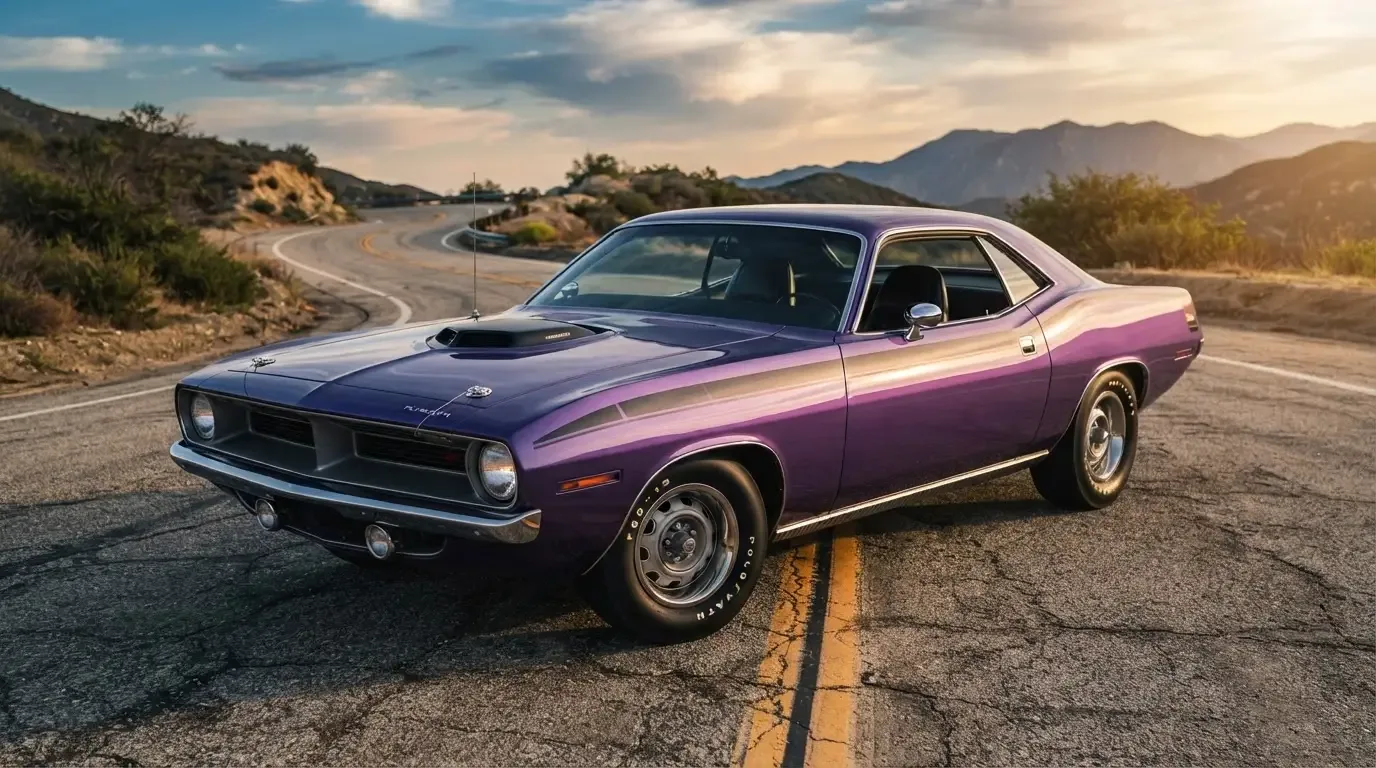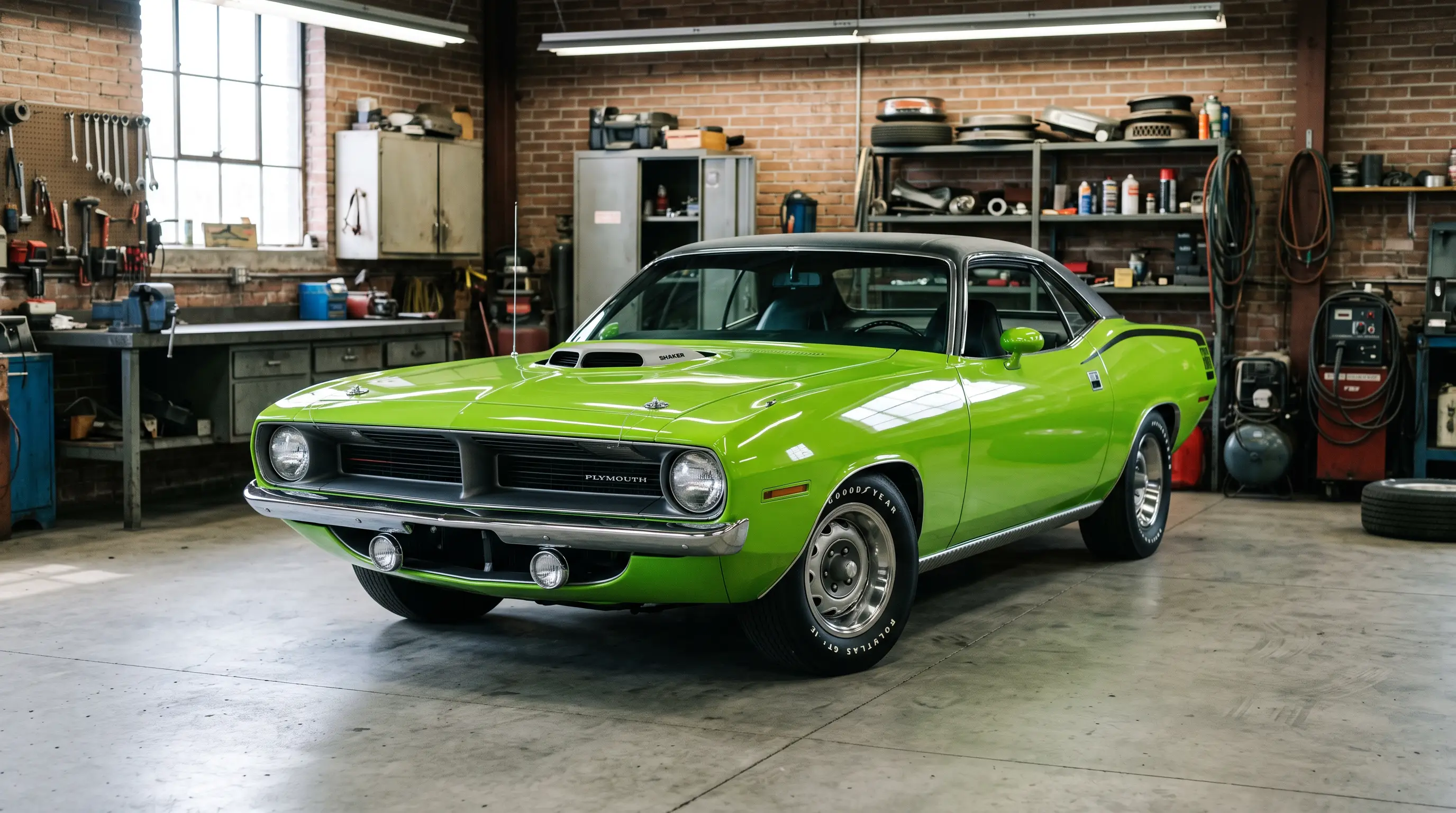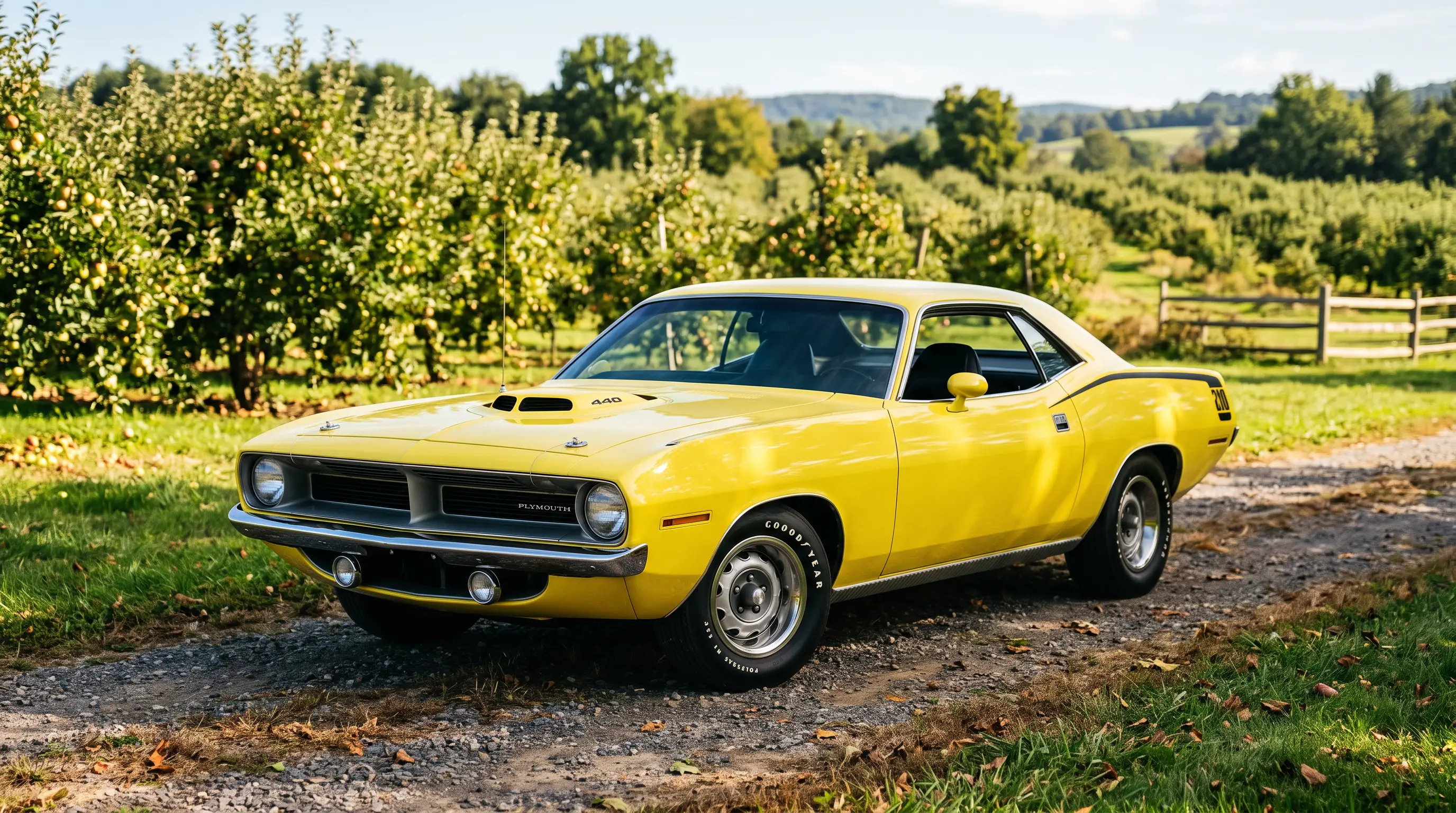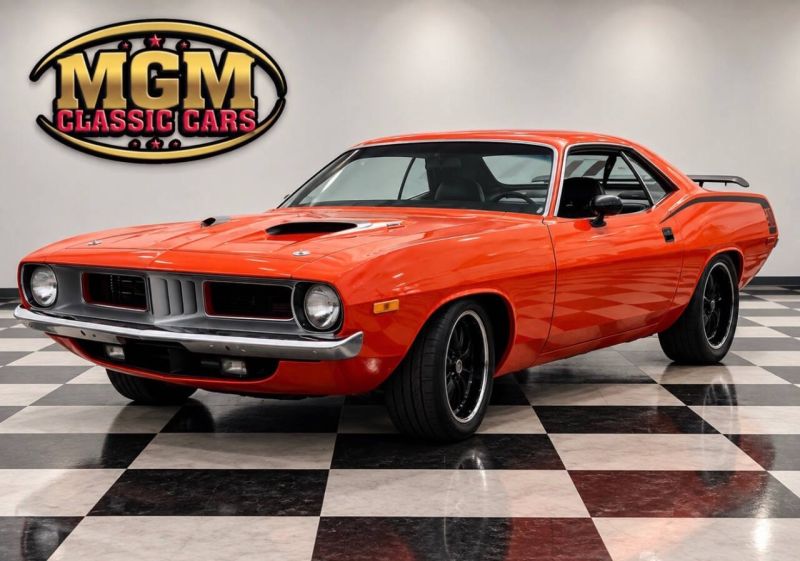
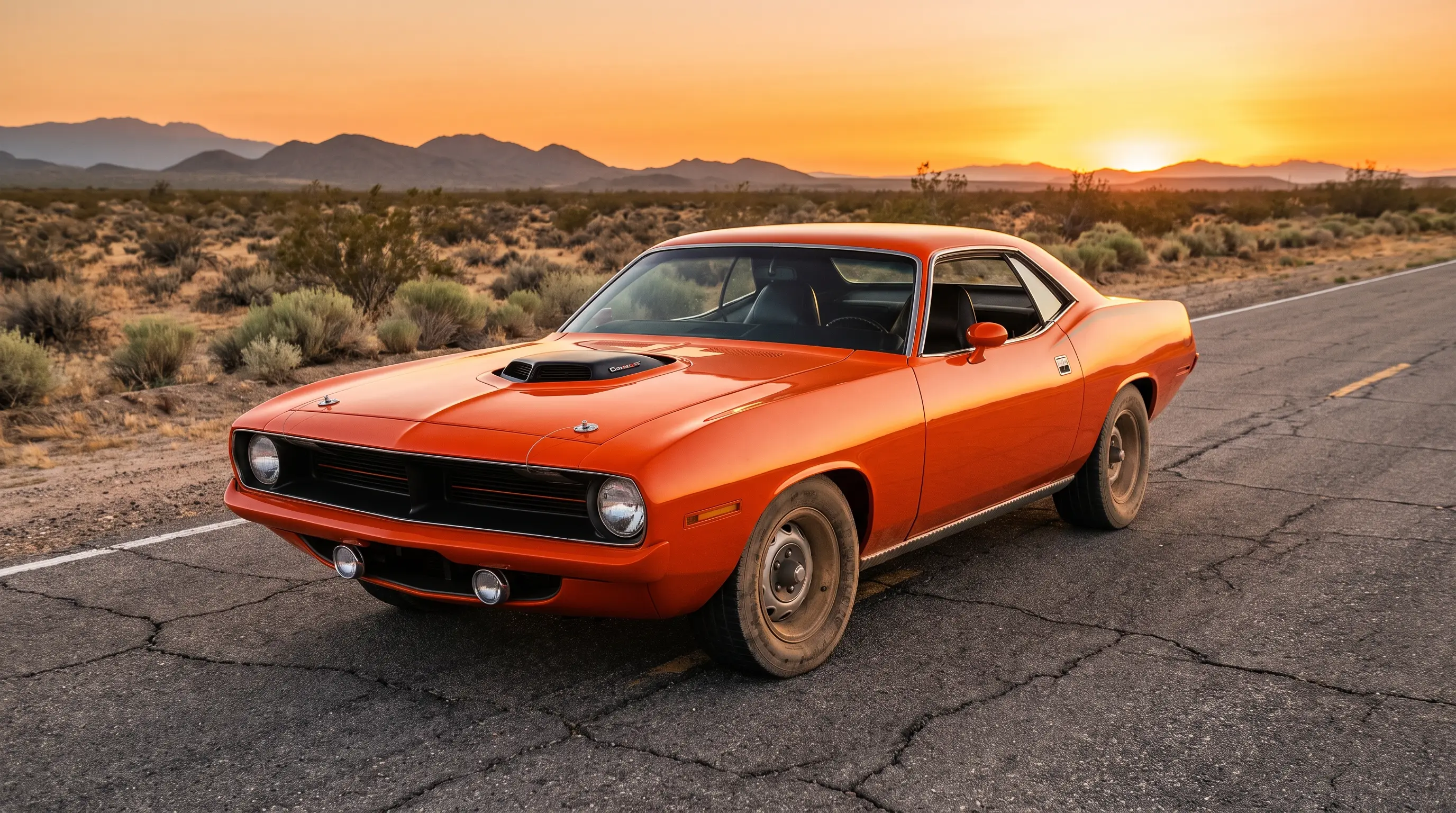
There is a specific orange that shows up in old Polaroids from drag strips and county fairgrounds, a color so warm it looks like it is generating its own heat in the photograph. Ask a Mopar person what it is called and you will get two different answers depending on which side of the Chrysler lineup they favor, and depending on which of two closely related oranges they actually mean. Dodge called its deeper, redder shade Hemi Orange, badged Tor Red on the Plymouth side, the color most associated with this tor red cuda story. A second, slightly more orange and faintly metallic shade ran alongside it, Go Mango on Dodge order sheets and Vitamin C on Plymouth's, and on the Barracuda both became defining colors of the whole High Impact era.
Two names, one attitude
The naming split says something about how Chrysler marketed these colors in the first place. Rather than a single corporate palette handed down uniformly, each division got to dress the same base formulas in language that fit its own personality. Dodge leaned into muscle and machinery with names like Hemi Orange and Go Mango. Plymouth, chasing a slightly younger and more playful buyer, went with Tor Red for the deeper shade and Vitamin C, something that sounded like it belonged on a soda can, for the lighter, faintly metallic one. Vitamin C did exactly what it was supposed to do. It made the color sound fun instead of aggressive, even though on the road it read as anything but subtle.
Owners and sellers today often use Vitamin C and Tor Red almost interchangeably, even though they are two distinct factory paint codes rather than the same formula under two names. Tor Red runs redder, Vitamin C leans more orange and carries a subtle metallic flake most people never notice. If precision matters to you, and on a car this documented it should, checking the actual paint code against the fender tag settles the question faster than any argument about naming conventions ever will.
A color built for a moment that did not last
Like the rest of the High Impact lineup, this orange belonged to a narrow window. Insurance surcharges and tightening emissions rules were already squeezing the muscle car market by the time the color reached its peak popularity, and within a few years Plymouth's whole approach to marketing performance had changed. A car ordered in this shade in 1970 or 1971 was ordered at almost the exact peak of a marketing philosophy that would not survive the decade intact.
That timing is part of why the color still carries weight. It is not just a bright orange car. It is a color that belongs to a specific, brief argument Detroit was making to young buyers, one that ended almost as suddenly as it started.
The people who chased this color down
I have talked to collectors who spent years hunting a specific orange Cuda not because of the engine or the options list, but because the color matched a memory, a father's car, a poster on a bedroom wall, a single photograph passed down without much context attached. That kind of searching has a different emotional shape than shopping for a car by spec sheet. It is closer to looking for a person than a machine, and sellers who understand that tend to price these cars accordingly.
One owner told me she bought her orange Cuda sight unseen from photographs because the shade in the listing photo matched, almost exactly, a toy car she had kept since childhood without ever knowing what the real one was called. She found out the name years later, at a swap meet, standing in front of a full-size version of the color she had been carrying around in miniature her whole life.
"She did not buy a Cuda that day. She bought back a piece of a bedroom shelf from thirty years earlier, and the car just happened to be attached to it."
- Nora Beckett
What fades and what does not
Original paint in this shade has a reputation among owners for fading unevenly, especially on horizontal surfaces that took the brunt of decades of sun exposure. A hood that has spent forty summers outside often reads noticeably lighter and warmer than the door jambs or trunk lid on the same car, which is not a flaw so much as a kind of honest record of where that particular Cuda actually lived its life. Some owners chase an even respray to erase that unevenness. Others leave it exactly as it is, treating the faded hood as part of the car's history rather than a defect to correct.
I lean toward leaving it. A car that looks brand new in this color almost always tells you it has been repainted, because genuine survivors this bright and this even are rare enough to raise a question on their own. The faded hood is, in its own way, more convincing than the perfect one.
What the color asks of a buyer now
Buying a car for its color alone is not irrational, but it does require discipline most buyers skip. The orange has to be checked against documentation, not assumed from a photograph or a seller's confident description. You can find more on the cuda high impact colors that lays out how this shade sat next to its siblings in the lineup, which is useful context before you get too attached to any single listing.
The Barracuda's own beginning is worth understanding too, since the story of how this whole nameplate came to exist, where this started, explains why Plymouth was willing to gamble on colors this loud in the first place. The car needed an identity fast, and paint was one of the cheapest, fastest ways to build one.
A color that photographs differently than it lives
Anyone who has tried to photograph one of these cars for a listing knows the frustration of a shade that looks completely different depending on the time of day, the camera, and even the phone screen it ends up viewed on. Midday sun pushes it toward a hot, almost fluorescent orange. Late afternoon light pulls it toward something closer to a deep amber. Buyers shopping from photos alone should factor in that the car in front of them, in person, on an overcast afternoon, may look nothing like the punchy image that drew them to the listing in the first place. That is not a trick on the seller's part. It is just what this particular pigment does under changing light, and it is worth seeing the actual car before committing to anything based on a screen.
If a warm orange Cuda has been living in your memory the way it lived in mine, classic Barracudas on the market are worth searching with the actual paint code in hand, not just the name that sounds closest to what you remember.
Sources and notes
- Chrysler Vitamin C Orange / Go Mango Paint Code EK2 - Custom Paints Inc
- Tor Red vs. Hemi Orange - For B Bodies Only Mopar Forum
- Chrysler Plymouth and Dodge High Impact Colors - Max Wedge
- Get H.I.P. to Mopar's High Impact Muscle Car Colors - Eastwood
- Mopar Paint: Dodge and Plymouth High-Impact Paint Colors - Classic Industries