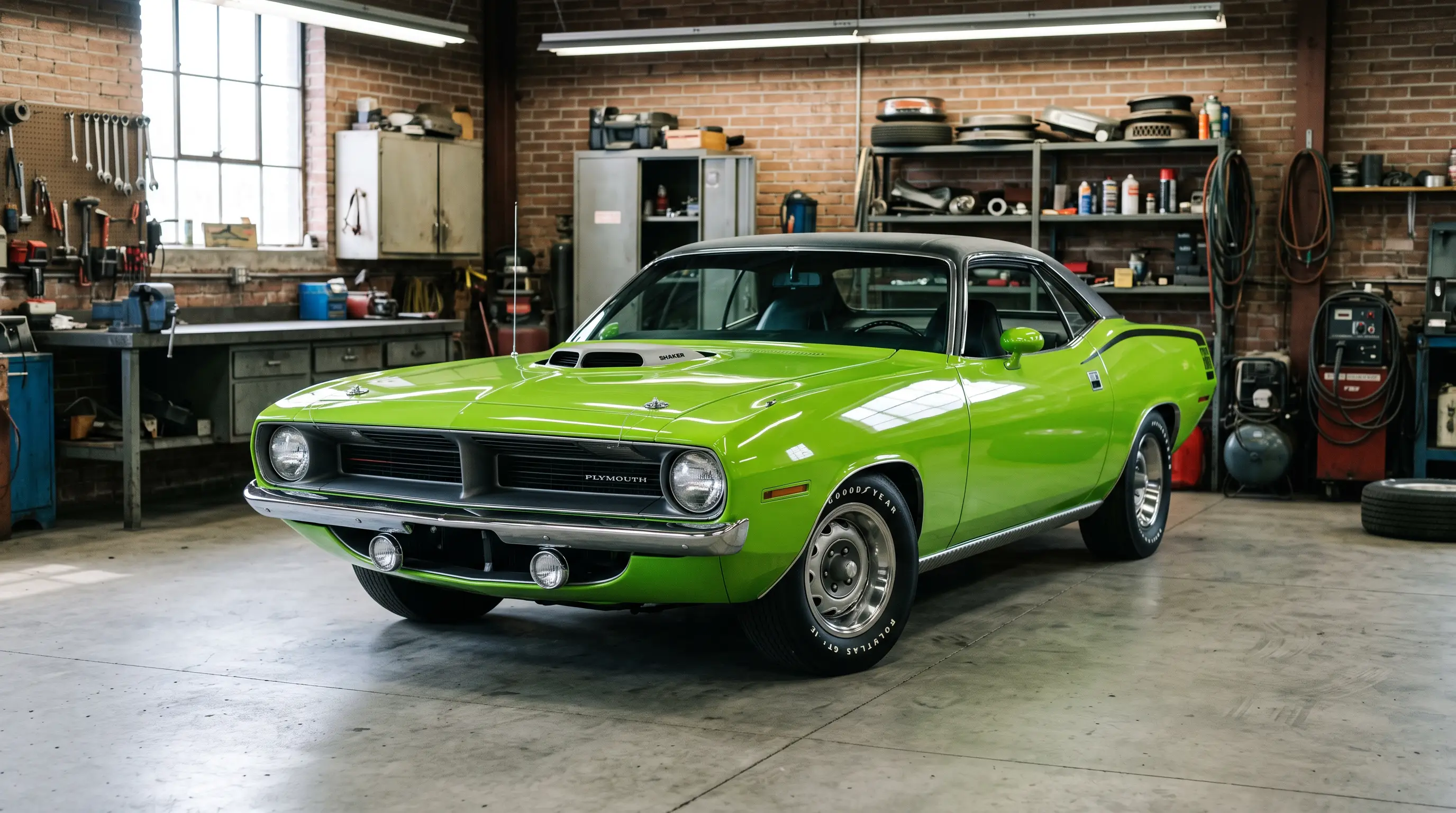
Of every color Plymouth threw at the Barracuda during the High Impact years, the acid green-yellow that most people now call Sublime is the one that gives me the most trouble in the shop, and I mean that as a compliment to whoever mixed the original formula. Plymouth's own paperwork actually called this color Lime Light, coded FJ5. Sublime was Dodge's name for the identical formula on cars like the Super Bee, but the two names have blurred together in the hobby, and most buyers today use Sublime for both. Getting a modern respray to actually read as sublime green cuda correct, rather than a generic lime that misses the mark, takes more care than almost any other color code from this era.
Most builders will tell you the hard colors to match are the deep ones, the blacks and dark blues where any inconsistency shows as a shadow. Sublime is hard for the opposite reason. It sits right on the edge between green and yellow, and your eye catches the smallest shift in either direction instantly.
What Sublime actually is
Plymouth introduced Lime Light for the 1970 model year only, as part of the same High Impact push that gave us Vitamin C and In-Violet. It reads yellow-green in bright sun and shifts noticeably cooler under overcast light, which is exactly the kind of color behavior that makes matching it off a swatch card alone a mistake. I have seen shops nail the color under shop lighting and then watch a customer bring the car back complaining it looks wrong in daylight, because they never test-sprayed a panel outdoors before committing.
The pigments involved have shifted since the original formulation, the same story as most High Impact colors, so a correct modern match means working from an actual original paint sample whenever one is available rather than trusting a cross-reference number blindly.
Working on a Sublime car
Bodywork on any of these cars needs to be invisible under the paint, but Sublime is especially unforgiving of filler work that is not properly sealed and primed, because any variation in surface texture reads differently under this particular shade than it would under white or black. I block these panels an extra pass compared to a standard job, specifically because the color has a way of finding flaws that other colors hide.
Masking is its own headache. Sublime cars from this era commonly carry black or white hockey stick side stripes, and the transition line between the body color and the stripe has to be razor clean, because a soft edge is much more visible against a bright green-yellow base than it would be against something muted.
| Detail | Note |
|---|---|
| Introduced | 1970 model year, High Impact palette |
| Light behavior | Shifts yellow-green in sun, cooler under cloud |
| Common pairing | Black or white hockey stick stripe |
| Shop difficulty | High, sensitive to surface prep and blend quality |
Before you take a Sublime car into any shop, read the background on the whole High Impact lineup, because knowing where this color sits next to its siblings will help you spot a bad match faster than trusting your gut alone.
Clear coat and the modern shortcut problem
A lot of shops today want to lay a modern clear coat over a base coat mixed to look like Sublime and call the job done, and on plenty of colors that shortcut is fine. It is not fine here. The original single-stage finish on these cars had a particular depth that a base-clear system does not naturally replicate, and on a color this saturated the difference between the two systems is visible side by side even to someone who does not know what they are looking at. If a car is being restored for judged shows rather than daily driving, I push customers toward a single-stage finish or a base-clear system tuned specifically to mimic single-stage depth, even though it costs more labor and more material.
I have also seen shops try to save time by skipping a dedicated sealer coat before laying Sublime over old primer, assuming the color is forgiving enough to hide inconsistencies in what is underneath. It is the opposite. Any variation in the substrate telegraphs through this particular green faster than through almost anything else in the High Impact lineup, and the fix after the fact costs more than doing the prep right the first time would have.
What buyers get wrong
I have had more than one customer bring me a car they were told was Sublime that turned out to be a different, more common green entirely, either from an honest mistake down the ownership chain or a seller who was not careful with the terminology. The two are not interchangeable, and the price difference between a documented Sublime car and a plain green one is not small. If you are shopping for one, get the fender tag color code confirmed before you get emotionally attached to the paint.
"I have redone the same panel three times on a Sublime car because the light in my shop lied to me twice before I finally rolled it outside to check."
- Jim Vasquez
Storing and handling parts during a build
One thing I tell every customer up front is that any Sublime parts pulled off the car during disassembly, trim, emblems, stripe sections, need to be bagged and labeled by location the moment they come off. It sounds like basic shop discipline that should apply to any color, and it does, but the stakes are higher here because sourcing a correct replacement stripe section in this specific green is harder than sourcing one in black or white. Lose track of an original piece on this car and you may be waiting months for a usable reproduction, if one even exists in the right shade.
Where it sits against the rest of the palette
Sublime never got quite the reputation that Plum Crazy or Vitamin C built for themselves, mostly because green has always had a harder time reading as aggressive compared to purple or orange. That undersells it. A correctly restored Sublime Cuda in good sun is one of the most striking cars from this whole era, and the relative lack of hype around the color means you are not fighting the same price premium as some of its more famous siblings. The Tor Red and Vitamin C story is worth a look too if you want to compare how the orange side of the palette handles the same kind of light-shift problem.
If you are hunting one of these down for your own build, shop classic Barracuda listings and ask directly whether the seller has ever confirmed the color against the original tag. It is the one question that separates a real Sublime car from a green car wearing the name.
Sources and notes
- Chrysler Sublime / Lime Light FJ5 - Tamco Paint
- 1970 Plymouth Barracuda Production Color Totals - E-Bodies.org
- Chrysler Plymouth and Dodge High Impact Colors - Max Wedge
- Limelight Trophy Winner: 1970 Plymouth Road Runner - Barn Finds
- Mopar Paint: Dodge and Plymouth High-Impact Paint Colors - Classic Industries