
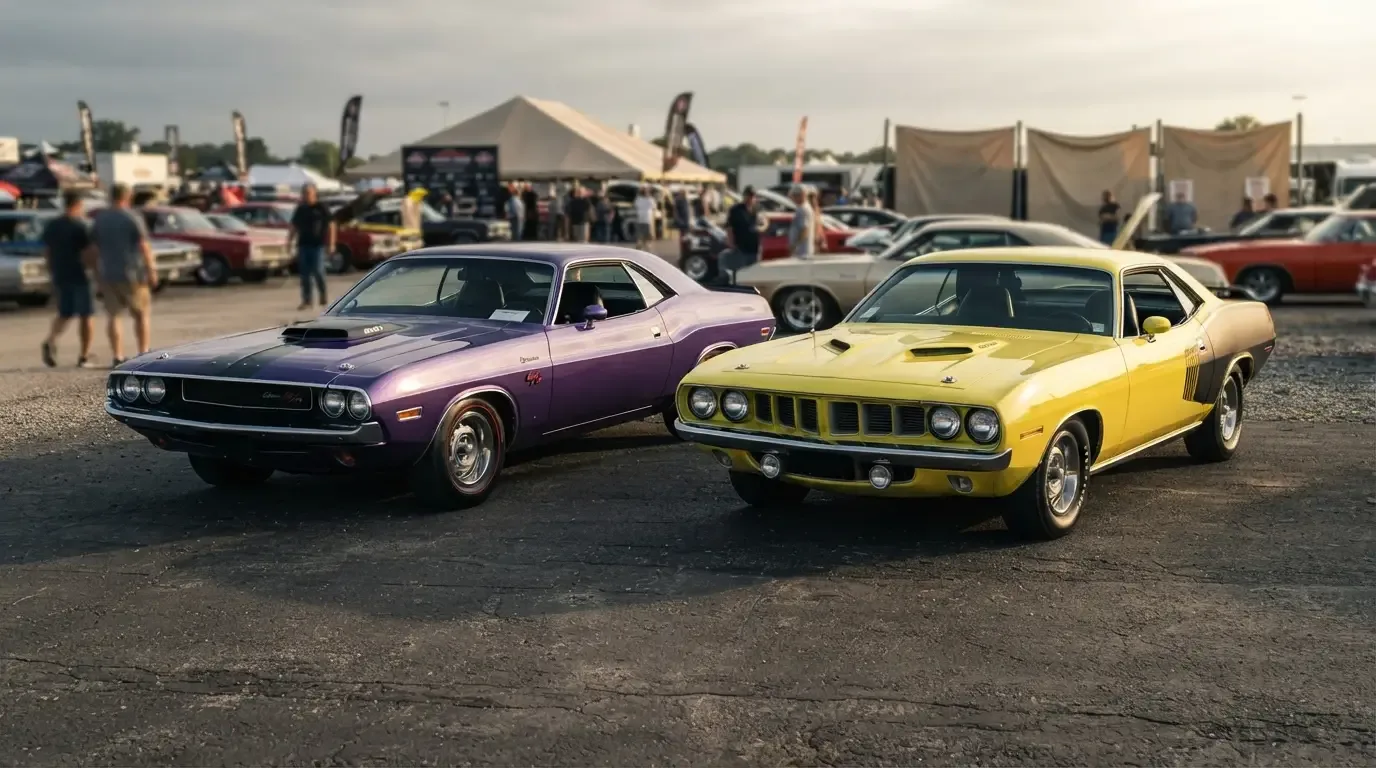
Put a Hemi Challenger and a Hemi Cuda on the same auction block and you get a fascinating natural experiment in what collectors actually pay for. Both cars share the E-body platform, both share the 426 Hemi engine, and both come from the same two model years that matter most, 1970 and 1971. Yet a hemi challenger vs cuda auction result rarely comes out even. The Cuda usually wins the bidding war, and the gap is wide enough that it tells you something real about how the collector market values styling, scarcity, and story separately from raw mechanical spec.
Car Features
7 min read
Hemi Challenger vs Hemi Cuda at Auction
A hemi challenger vs cuda auction matchup rarely ends even, and the reasons why reveal how collectors actually value scarcity, styling, and documentation.
The numbers behind the price gap
At major auction houses over the past decade, Hemi Cuda convertibles have repeatedly set price records that put them among the most valuable American muscle cars sold at public auction, with a numbers-matching 1971 Hemi Cuda convertible hammering at a record $3.5 million at Mecum's Seattle sale in 2014. Hemi Challenger convertibles from the same era, while genuinely rare and valuable in their own right, have generally traded for less at comparable events, with a 1970 Challenger R/T Hemi convertible reaching roughly $1.4 million at Mecum Phoenix and another lime green 1970 example bringing about $1.65 million in 2016, still well short of Cuda convertible territory.
Hardtop Hemi cars from both nameplates show a similar pattern at a lower price tier. A documented, numbers-matching Hemi Cuda hardtop tends to command a premium over an equivalent Hemi Challenger hardtop, even when production numbers, condition, and documentation are comparable. That consistency across body styles and across multiple auction cycles is what makes the pattern worth taking seriously instead of dismissing it as one outlier sale.
Why the Cuda pulls ahead
Production numbers explain part of the gap. Plymouth built fewer Hemi Cudas than Dodge built Hemi Challengers in the relevant years, and the convertible body style narrows the field further on both sides, but the Cuda's numbers are consistently the tighter of the two. Scarcity alone moves auction results, and this is a market where a handful of surviving cars can shift the entire price conversation for a whole model.
Styling and brand identity matter just as much as raw scarcity. The Cuda's shaker hood, its distinctive grille, and its association with the Plymouth brand's specific muscle car identity give it a visual signature that collectors respond to strongly. The Challenger is a handsome car in its own right, but it entered the market slightly later and inherited a reputation as Dodge's answer to an existing formula rather than the originator of one. Auction buyers, rightly or wrongly, pay a premium for cars they perceive as the trendsetter rather than the follower, even when the underlying engineering is nearly identical.
What documentation does to the equation
Neither car sells for its ceiling price without paperwork. A broadcast sheet, original fender tag, and factory build sheet turn a good story into a provable one, and auction houses will say plainly that undocumented Hemi cars, regardless of nameplate, sell for a fraction of what a fully documented example brings. This is where the Challenger and Cuda conversation gets interesting again, because a beautifully documented Hemi Challenger convertible will still outsell a Cuda with gaps in its paper trail, no matter what the nameplate premium usually suggests. Documentation is the great equalizer in this market, more powerful than badge loyalty in the specific case of an auction house cataloging a car for sale.
Buyers should also weigh where a specific car sits within the wider story of its own model. Readers curious about the broader arc of the Hemi Challenger's own history, separate from any comparison to its Plymouth cousin, can find where this started for a fuller picture of how this car earned its own reputation independent of auction comparisons.
"The Cuda usually wins the bidding, but a documented Hemi Challenger with a clean history beats an undocumented Cuda every single time. Paperwork outranks badge loyalty at this price point."
- David Mercer
What this means for a buyer today
If the goal is owning a genuine piece of Hemi muscle car history without paying Cuda convertible money, a Hemi Challenger, hardtop or convertible, is the more attainable entry point into this specific tier of the market, and the gap between the two nameplates has historically made the Challenger the relative value play among six and seven figure Mopar muscle cars. That does not mean cheap. It means comparatively reasonable given what a comparable Cuda demands.
Anyone weighing this exact tradeoff should look at more from this era to understand how values across the broader Hemi Challenger lineup have moved over recent auction cycles, not just at the very top of the market. That context matters more than a single headline sale, because most buyers are not chasing a record price, they are chasing a fair one.
For buyers ready to act on that value gap rather than just read about it, you can find a classic Challenger and compare what is actually available against the auction benchmarks discussed here.
How condition changes the math
Auction results also punish anything short of top condition harder on a Hemi car than they would on a lesser model, simply because the price stakes are so much higher. A driver-quality Hemi Challenger with older paint and a mismatched interior color can still bring strong money on the strength of the numbers-matching drivetrain alone, but it will not approach the price of a concours-level example, and the gap between those two condition tiers is larger in percentage terms than it would be on a small block car worth a tenth as much. Buyers evaluating either nameplate need to separate the value of the engine and documentation from the value of the cosmetic condition, because auction houses often blend those numbers together in a way that can mislead a first-time bidder.
Regional differences in auction results add another layer worth knowing about. Cars sold at marquee events with international bidder pools, heavy media coverage, and a curated docket tend to bring stronger prices than comparable cars sold at smaller regional auctions, independent of the car itself. Two identical Hemi Challengers, same options, same documentation, same condition, can post meaningfully different hammer prices depending on which auction house catalogued them and who happened to be bidding that particular weekend.
The bottom line on the comparison
A hemi challenger vs cuda auction matchup is not really a question of which car is better built or better engineered, since the mechanical case is nearly a wash. It is a question of scarcity, styling identity, and documentation, three factors that consistently favor the Cuda at the very top of the market while leaving real opportunity for buyers willing to own the Challenger side of this story instead. Anyone bidding at this level should walk in understanding which of those three factors is actually driving a specific sale, rather than assuming the nameplate alone explains the number on the gavel.
Sources and notes
- ClassicCars.com Journal: Hemi Cuda convertible record $3.5 million at Mecum Seattle
- Motor Authority: Plymouth Hemi Cuda convertible hits $3.5 million
- TopSpeed: Most expensive Hemi-powered Mopars ever sold at auction
- Supercars.net: Hemi Challenger tops Mecum Phoenix
- Mopar Insiders: Black Ghost Hemi Challenger sale details
Related Reading
Have a
Dodge Challenger
for Sale?
Reach thousands of serious classic car collectors across the US.
Sell It Here →
Are You a Classic Car Dealer?
List your full inventory and connect with targeted classic car buyers.
Join as a Dealer →

About the author
David Mercer
Classic car market analyst with two decades of experience tracking collector car valuations, auction results, and investment trends.
Related Listings - Dodge Challenger




Comments
Be the first to comment on this article.