
Sit inside a 1969 Chevrolet K5 Blazer and the first thing you notice is what is not there. No console eating up floor space, no wall of switches, no padding trying to convince you this is a luxury cab. The k5 blazer 1969 interior was built for a truck that expected to get dirty, and Chevrolet did not apologize for that. It is one of the clearest cabins General Motors ever shipped, and understanding why it looks that way says a lot about what the Blazer was actually for.
Car Features
7 min read
Inside the 1969 K5 Blazer: Spartan by Design
The 1969 K5 Blazer's cabin was pulled straight from the C/K pickup line, built for work rather than comfort. Here is why that spartan design still reads as honest today.
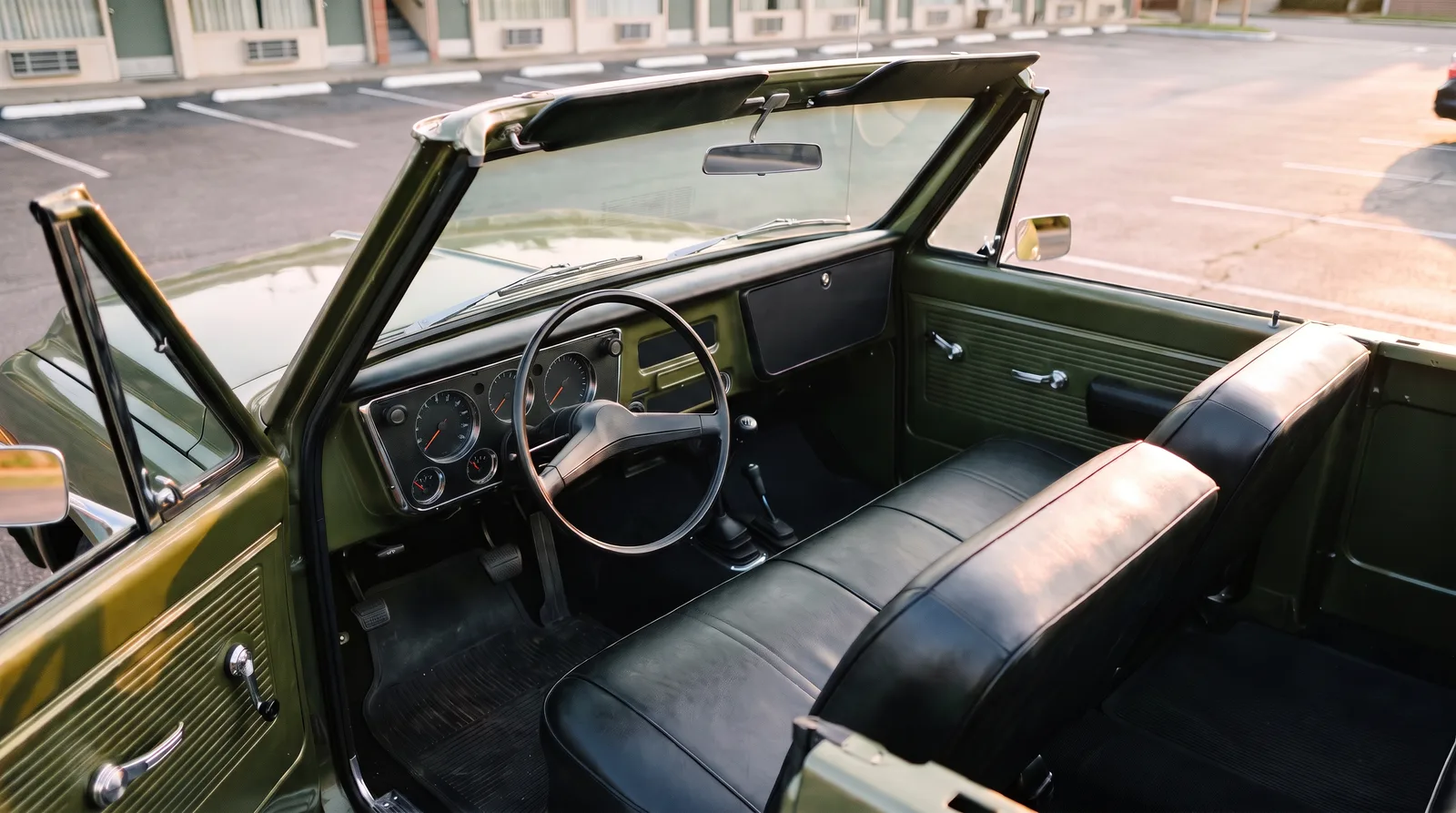
A cab borrowed from a work truck, on purpose
The 1969 Blazer shared its cowl, dash structure, and much of its trim with the C/K pickup line, and that parentage shows the moment you sit down. The instrument panel is a flat, painted metal face with round gauges set in simple bezels. There is no wraparound cluster, no faux wood, no chrome overlay pretending to be something it is not. Chevrolet took the pickup dash, trimmed it to fit the shorter Blazer body, and called it finished. That decision was not laziness. It was the same logic that shaped the whole vehicle: reuse the truck architecture, keep tooling costs down, and let the removable top do the differentiating.
Base Blazers came with a rubber floor mat, a bench seat trimmed in vinyl, and door panels that were closer to a work van than a passenger car. Roll-up windows, manual everything, and a heater that worked hard but never quite won against an open cab. Buyers who wanted more could step up to the Custom trim, which added carpet, extra sound insulation, and a nicer two-tone vinyl on the seats, but even the dressed-up version never strayed far from its utilitarian bones.
The bench, the buckets, and what people actually ordered
A full-width vinyl bench was standard, split by a folding armrest on nicer builds. Bucket seats were optional and became one of the more collectible configurations today, mostly because so few original buyers checked that box on a truck they intended to use for hauling and hunting. Rear seating was minimal by design in 1969, a folding bench that could be pulled or flipped forward, because the whole point of the Blazer was a cargo area that opened up in minutes once the top came off and the tailgate dropped.
Color choices followed the exterior palette rather than a separate interior design language. Black, blue, red, and a saddle tan vinyl were common, and none of them hid dirt particularly well, which was fine, because dirt was the expected condition. The full, factory-exact code-by-code interior color list for 1969 is not something a general source lays out cleanly, so any specific code claimed for a given truck should be checked against that truck's own build sheet rather than taken as a blanket industry fact. Original build sheets and dealer invoices remain the best way to confirm what a specific truck left the factory wearing, since reupholstery over five decades has scrambled a lot of the historical record.
Why the sparseness reads as honest, not cheap
There is a difference between a cheap interior and a spartan one, and the 1969 Blazer sits firmly in the second category. Every surface has a job. The dash is legible at a glance. The seats are durable rather than plush. Nothing is there to impress a passenger, because in 1969 a Blazer buyer was usually the one doing the impressing, not the truck. That restraint is part of why the cabin still photographs well today. It has not aged into looking dated the way a heavily chromed interior from the same era can, because it never tried to chase a trend in the first place.
Collectors and restorers who spend time in these cabs tend to describe the experience the same way: it feels like sitting inside a tool. You can read our 1969 k5 blazer retrospective for the full model story, but the interior on its own tells a tighter version of that same tale, a company building a truck for people who wanted a truck, not a statement.
"You climb into a base '69 and every switch does exactly one thing. Nothing is dressed up to look like it does more than it does. That is the whole personality of this truck in one cabin."
- Jim Vasquez
What restorers watch for today
Original vinyl on a 1969 Blazer rarely survives five decades of sun and use without cracking, so most surviving trucks wear reproduction covers by now. The parts that matter most to originality-minded buyers are the small stampings, the correct door panel pattern for the trim level, and the dash bezel finish, since those details get overlooked or mismatched more often than the big-ticket items like the seat itself. A well-documented interior restoration, matched to build-sheet data where it survives, adds real weight to a truck's story even when every yard of vinyl inside it is new.
How the interior changed as the first generation aged
By the early 1970s Chevrolet had softened the cab slightly, adding more sound deadening and a few extra trim options as buyers started cross-shopping the Blazer against more comfort-oriented rigs. The core layout stayed put, though. The dash kept its flat, upright face through the entire 1969 to 1972 run, and the bench seat remained standard even as bucket seats grew slightly more common on Custom-trim orders. That consistency is useful for anyone trying to date a truck by its cabin alone, since the changes within the removable-top generation are small enough that they rarely mislead a careful eye, unlike the more dramatic interior redesign that arrived with the squarebody generation in 1973.
For a buyer today, that narrow window of change is a small mercy. A 1969 dash, gauge cluster, and door panel set is close enough to a 1971 example that sourcing parts across those years rarely causes headaches, and it means a restoration does not hinge on finding one specific year's obscure trim piece. The interior's simplicity, in other words, extends past the cabin itself and into how forgiving the truck is to keep original decades later.
None of this is a restoration checklist, and it should not be treated as one, since the point here is the story the cabin tells rather than a set of instructions for rebuilding it. The story the interior tells, plain, durable, built for work first, runs through a related story about the whole first-generation Blazer, and it is one reason these trucks keep finding buyers who want honesty over polish. If you are shopping rather than reading, K5 Blazers for sale now turn up in every condition from barn-find bench seats to fully trimmed Customs, and knowing what the cabin was supposed to look like in 1969 is the first step toward judging any of them fairly.
The takeaway is simple enough. Chevrolet did not design the 1969 Blazer interior to be remembered. It designed it to work, and worked, and that is exactly why it still reads as authentic more than fifty years later, in a market that has learned to be suspicious of anything trying too hard.
Sources and notes
Related Reading
Have a
Chevrolet Blazer
for Sale?
Reach thousands of serious classic car collectors across the US.
Sell It Here →
Selling a classic? Here's how: sell my classic car
Are You a Classic Car Dealer?
List your full inventory and connect with targeted classic car buyers.
Join as a Dealer →
#classic truck interior
#K5 Blazer
#chevrolet blazer
#1969 Blazer
#Blazer restoration
#squarebody history

About the author
Jim Vasquez
Southern California hot rod and custom car builder with roots in the traditional kustom kulture scene.
Related Listings - Chevrolet Blazer

Comments
Be the first to comment on this article.