
A front end rebuild changes how a classic car feels more than almost any other job. Wander on the highway, a clunk over bumps, a wheel that shimmies at 50, tires that wear on the inside edge: all of it traces back to rubber bushings, ball joints, and a steering box that has more play than a screen door. Here is how I would approach it, and where it fits next to the drivetrain guide and the rest of a mechanical restoration.
Restoration & Tech
7 min read
Suspension and Steering Rebuild: Bushings, Ball Joints, Steering Box
A front end rebuild fixes wander, clunks and uneven tire wear. Learn how to check play and replace bushings, ball joints, tie rods and the steering box.
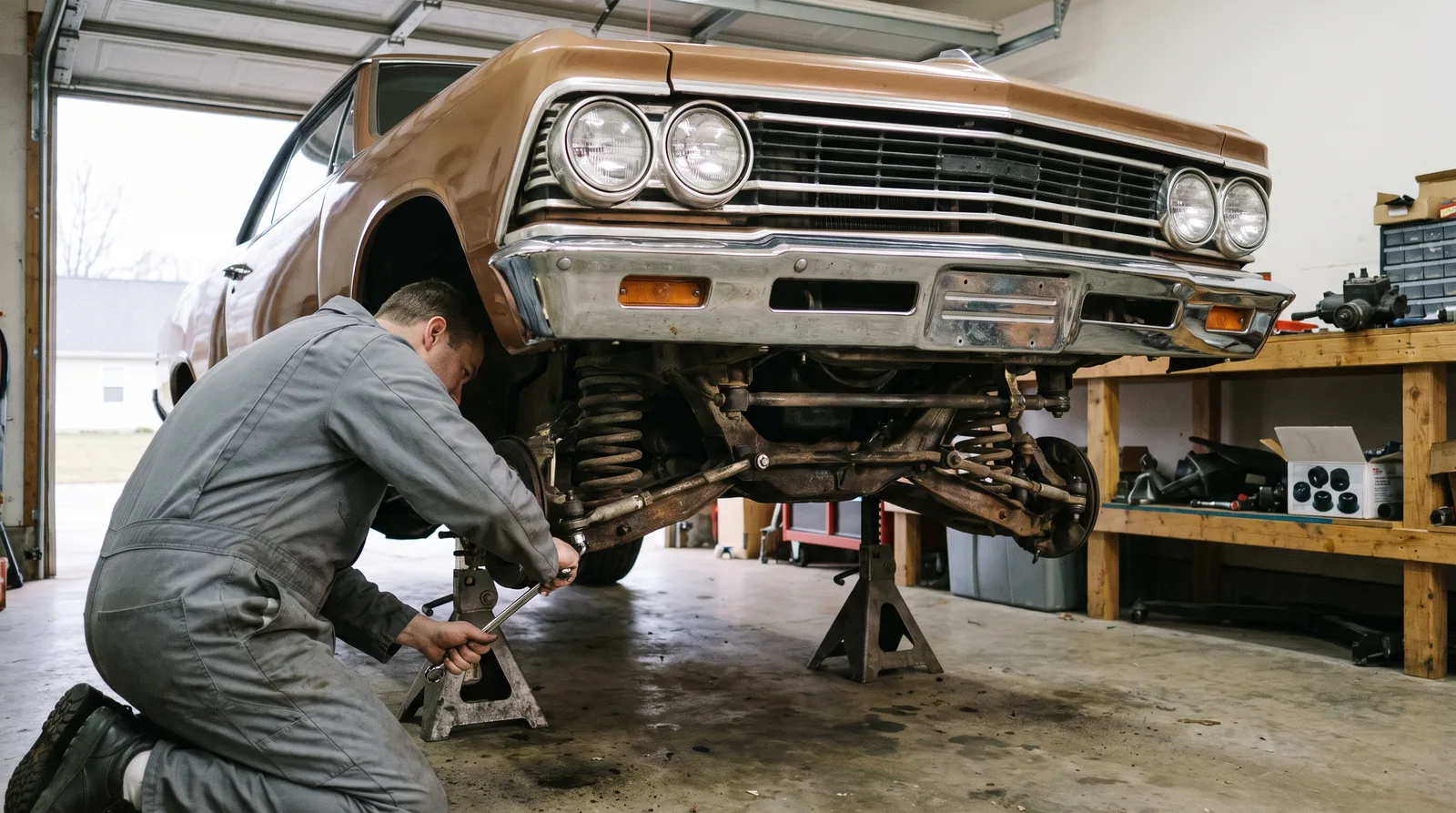
Start with a play check, not a parts list
Put the front end on stands and measure. Grab each wheel at the top and bottom and rock it, then at three and nine o'clock. Movement at the top and bottom points to ball joints or wheel bearings. Movement side to side points to tie rod ends or the steering linkage. Pry on the control arm bushings and idler arm. A dial indicator on the lower ball joint gives you a number to compare to the spec in the shop manual.
Check the frame mounts and spring pockets too. Rusted spring pockets and cracked control arm mounts are rarely mentioned in the glossy photos, and they can make a rebuild pointless.
Bushings, ball joints, and tie rods
Rubber bushings dry out, crack, and collapse. Replace them with new rubber for a stock feel, or polyurethane for a firmer ride that squeaks more and transmits more road noise. Rubber is the right answer on a numbers-correct car, and polyurethane suits a driver. Control arm bushings often press in and out, which needs a press and the right tools, so many people send arms to a shop.
Ball joints on many classic cars are riveted or pressed into the arm. Parts are not the expensive part: complete front suspension kits with ball joints and bushings for some classics list for a few hundred dollars, though prices vary widely by model. Tie rod ends, idler arms, and center links wear out as a group. Replace them together, since new parts working against worn ones will not fix the slop. Replace the shocks and the springs if they sag. Measure ride height against the spec and do not guess.
The steering box and linkage
A steering box leaks and wears in the sector shaft and worm gear. First check the adjustment with the linkage disconnected. If there is notch or tight spots at center, the box is worn. A specialist rebuild is usually a few hundred dollars or more depending on the model, and reman units are commonly available for popular models. Replace the pitman arm if the splines are chewed, and check the steering shaft coupler.
Rack and pinion on later cars has its own wear in the inner tie rods and boots. Replace the boots at the first sign of splits, because grit destroys the rack. Power steering pumps and hoses also deserve replacement during a rebuild, since old hoses burst and pumps whine. Use the fluid the manual calls for.
Alignment and where it fits in the project
Align the car only after everything is torqued at ride height, not while the car hangs on a lift. A proper alignment sets caster, camber, and toe. Many classics call for a little positive caster and modest camber, but follow the spec for your model. A shop that works on older cars will know how to adjust with shims or eccentric bolts.
If the plan includes upgrades, look at what a modern setup changes. Our article on restomod chassis, suspension, and brakes compares stock rebuilds with upgraded systems. For the work itself, the mechanical restoration shops that specialize in suspension can save you hours and money on press work and alignment.
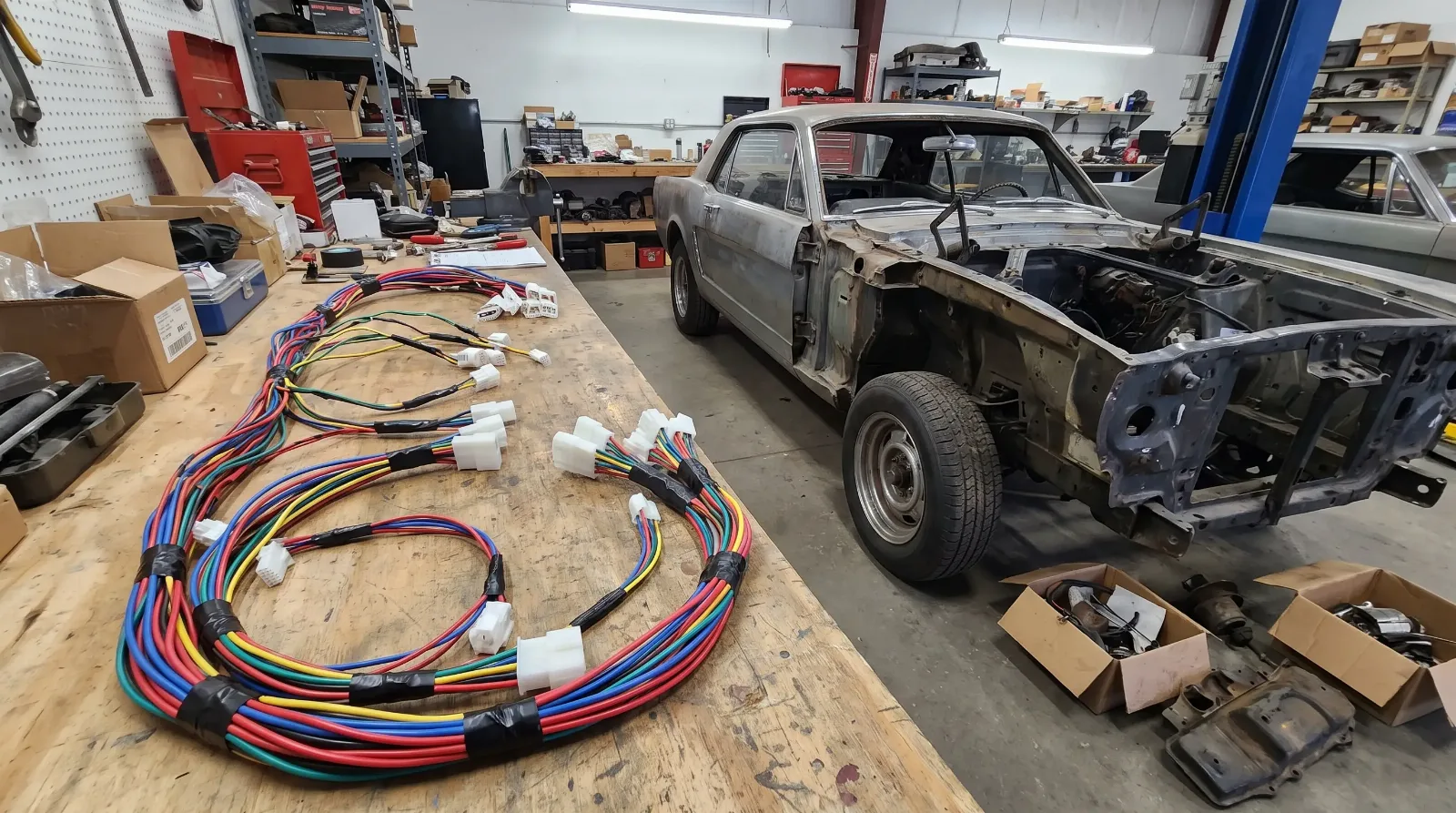
Plan the wiring too. A front end rebuild often means removing the harness from the core support area, and if the original wiring is brittle, a new wiring harness is the sensible time to install it.
🔧 Inspection Priorities
- Ball joints and wheel bearings. Check vertical and horizontal play.
- Control arm bushings and mounts. Look for cracks and rust.
- Tie rods, idler arm, and center link. Replace as a group.
- Steering box and pitman arm. Check for center play and leaks.
- Springs and shocks. Compare ride height to spec.
Do not forget the tires. A rebuilt front end on old, hardened tires will never feel right. Look at the date code, and replace anything old regardless of tread depth. Many vehicle makers advise about six years, and tire safety sources say they can become unsafe sometime after six to ten years, especially at speed or in heat. Balance the wheels, check the runout of the rims, and make sure the spare is in good condition too.
The order of work matters. Strip the front end, clean and inspect every part, and replace the wear items before you assemble anything. Sandblast and paint the control arms and crossmember with a durable coating, because bare steel rusts again in one winter. Assemble with new fasteners and torque them to the manual's values. Use thread locker where the manual calls for it, and use new cotter pins and locking nuts everywhere they are specified. Then finish with a road test on a smooth road to check for pull, vibration, and noise before you book the alignment.
What it costs and what you get
A thorough front end rebuild at a shop is commonly a four-figure job, depending on the car and how much is replaced, and it sits inside the suspension, steering, and brakes line of a full restoration budget. Doing it yourself with a press and a good manual can cut the labor, though not the parts. What you get back is a car that tracks straight, steers with a defined center, and wears tires evenly.
"A car that wanders is tiring to drive. Fix the front end and you will want to drive it more."
Mike Sullivan
Sources and notes
- Recirculating ball steering mechanism explained, adjuster screw sets sector-to-rack lash, over-tightening causes binding and slow return, common wear points
- Manual steering gears study guide (ASE A4), adjustment order and effects of over-adjustment, typical wear in sector shaft bushings
- Recirculating ball (Wikipedia), found in older automobiles, replaced mostly by rack and pinion
- Wheel alignment (Wikipedia), caster, camber, and toe and their role in tire wear and stability
- Moss Motors front suspension rebuild kit, example of what a kit contains (ball joints, A-arm bushings, sway bar bushings) and a parts price for one classic
- Wayne's Garage, tire age, six to ten year range, date code reading, old stock risk
Related Reading

Have a
Classic Car
for Sale?
Reach thousands of serious classic car collectors across the US.
Sell It Here →
Selling a classic? Here's how: compare the places to sell classic cars
Are You a Classic Car Dealer?
List your full inventory and connect with targeted classic car buyers.
Join as a Dealer →

About the author
Mike Sullivan
Detroit-area muscle car enthusiast and restoration specialist with three decades of hands-on experience working on American iron.
More in Restoration & Tech
Comments
Be the first to comment on this article.