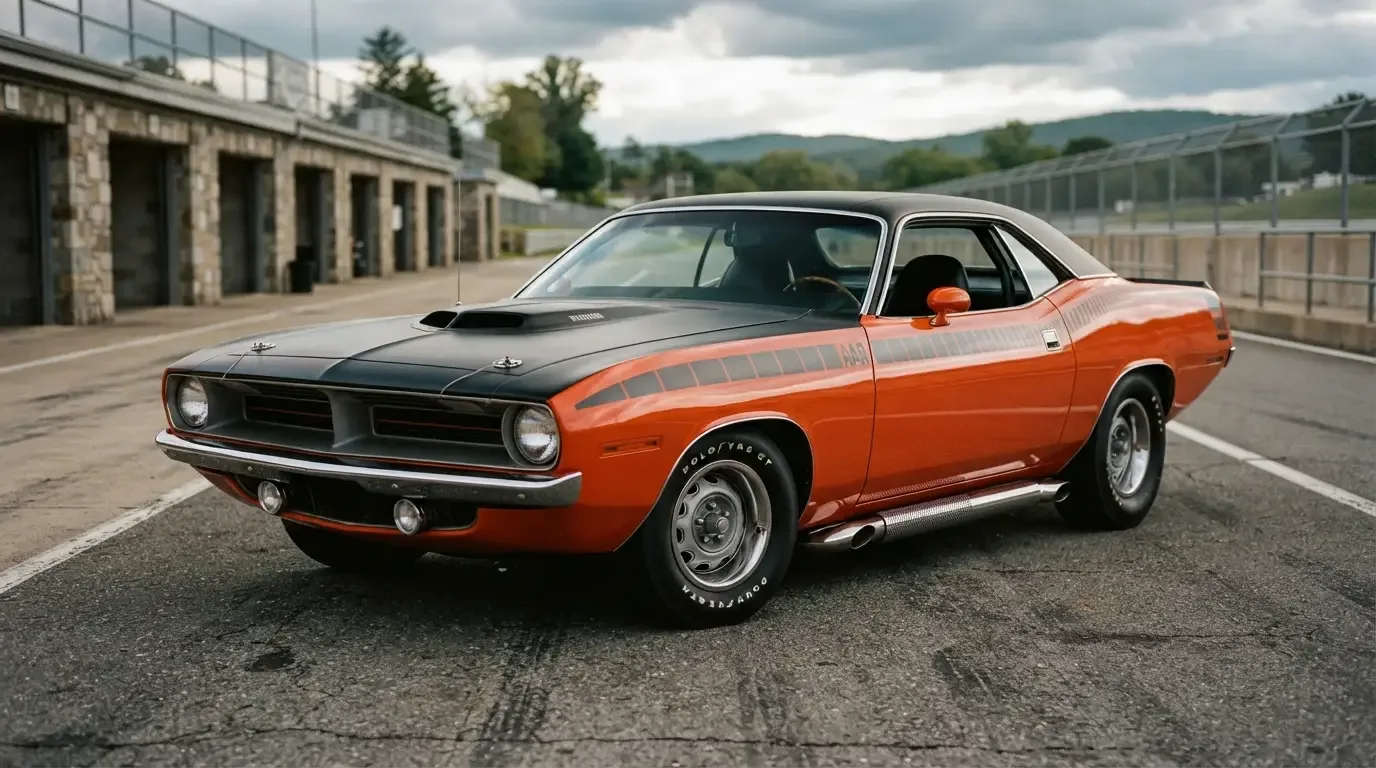
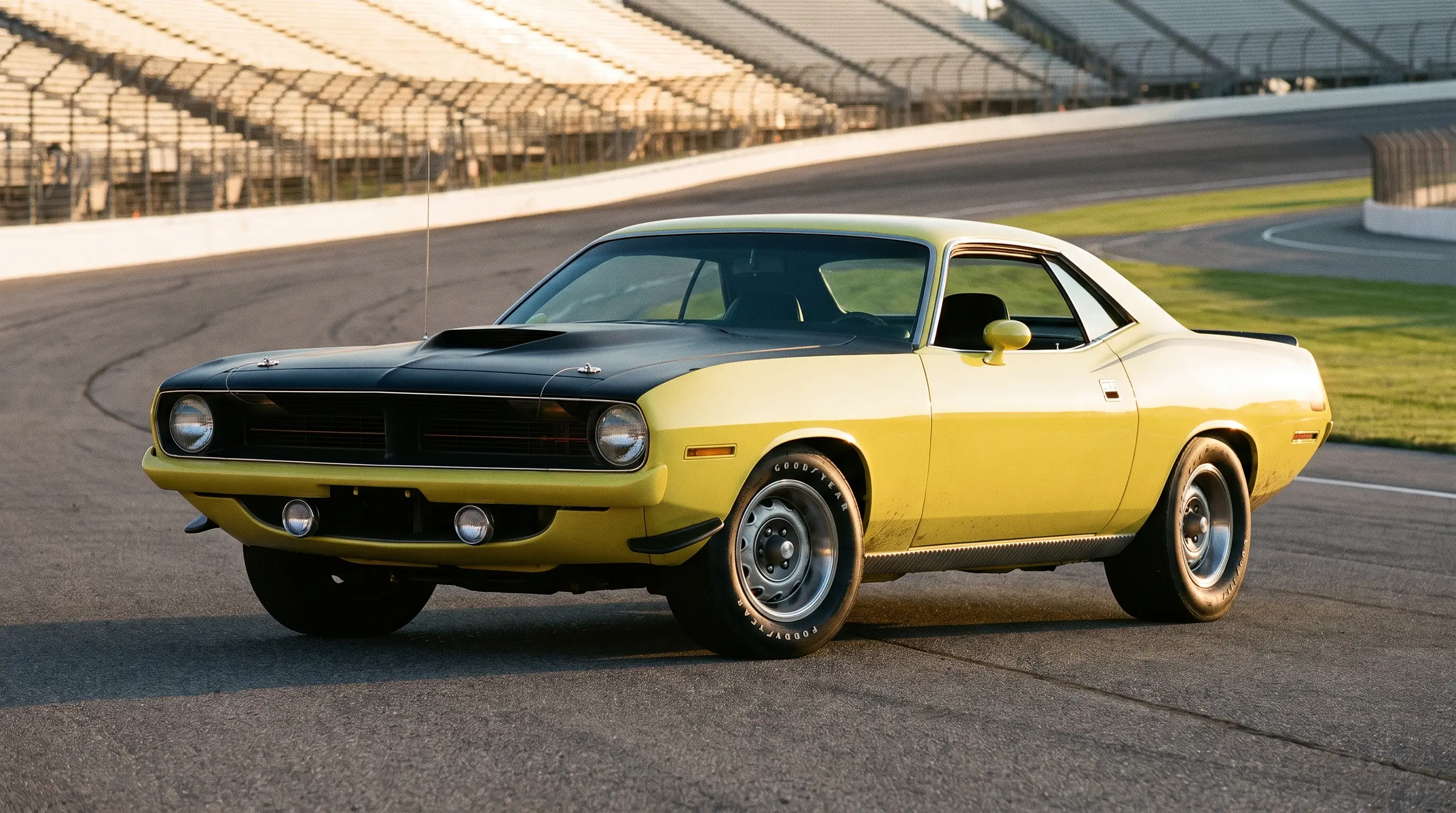
First time I put a tape measure across the front and rear tires on a real AAR Cuda, I figured somebody had swapped something at some point. They hadn't. The aar cuda wheels setup came from the factory with narrower tires up front than in the back, a genuinely odd spec for a production car in 1970, and once you understand why, it stops looking like an oddity and starts looking like good engineering.
The staggered spec, laid out plainly
The AAR Cuda left the factory with E60-15 tires on the front and G60-15 tires on the rear, mounted on matching steel wheels dressed up with factory trim rings. That is a real width difference between front and rear, not a rounding error or a running change, and it was intentional from the start of the program rather than something added partway through the model year.
Most production muscle cars of the period ran the same tire size at all four corners, so seeing a factory car with visibly different front and rear rubber was unusual enough that plenty of period buyers assumed something was mismatched on the showroom floor.
Why the factory did it on purpose
Staggered sizing on the AAR is a direct carryover from the car's Trans-Am racing intent, tuning the front-to-rear grip balance to work with the specific suspension calibration Plymouth built for this model, heavy-duty torsion bars up front, upgraded rear leaf springs, and a rear sway bar not standard on other Barracudas that year. Wider rear rubber puts more contact patch behind the differential where the power actually gets delivered to the road, while the narrower front tire keeps steering feel lighter and reduces the tendency to plow through a corner under load.
It is the same logic road racers use when setting up a car's suspension and tire package together as one system rather than picking tire sizes in isolation. Plymouth essentially handed showroom customers a small piece of race car chassis tuning without requiring them to understand a word of the theory behind it.
What this means for driving impressions
Owners consistently describe the AAR's handling as noticeably different from a standard Barracuda, more planted under power, with a front end that feels lighter and quicker to respond than the rear tire size alone would suggest. That is the staggered setup doing its job, and it is a big part of why period road tests treated the AAR as a genuinely different driving experience from other 340 and 383-powered Barracudas on the lot that year, not just a louder, more aggressive-looking one.
It also means the car has real handling character that a lazy modern tire swap can undo. Put matching sizes front and rear on one of these and you have quietly erased part of what the factory engineered the car to do.
Restoration and originality checks
Because staggered sizing is unusual and correct period-style tires are a specialty item, it is common to find AAR Cudas on the road today wearing modern equivalent sizes rather than exact factory dimensions, which is a reasonable practical choice for a driver but a point deduction at a serious judged show. Buyers evaluating originality should confirm not just tire size but wheel width and offset, since a correct staggered look depends on the whole wheel and tire package matching factory geometry, not just the tire sidewall number.
- Confirm front and rear tire sizes actually differ per factory spec, not matched for convenience
- Check wheel width and offset match documented factory specifications
- Verify the rear sway bar and suspension components are present, since the staggered tires were tuned around that specific setup
For the fuller context on how this detail fits with the rest of the AAR's factory specification, our complete history covers the side-exit exhaust, the fiberglass hood, and the graphics package that round out the same homologation story.
"People see mismatched tire sizes and assume something's wrong with the car. Plymouth did that on purpose, and once you drive one with the setup intact, you understand why."
- Mike Sullivan
How the suspension package ties into the tires
The staggered tires did not arrive as a standalone decision. Plymouth paired them with a specific Rallye suspension calibration built for this model, and the two need to be evaluated together rather than separately when judging how original a given car really is. A car wearing correct tire sizes but running softened or mismatched suspension components will not deliver the handling character the factory intended, and conversely a car with the right suspension parts but incorrect tire sizing loses some of that same character from the other direction. Serious restorations treat the whole rolling chassis package, springs, sway bar, and tire sizing, as one interconnected system rather than a checklist of individual boxes to tick separately.
Wheel design and factory trim details
Beyond the tire sizing itself, the wheels wearing those staggered sizes carried their own factory-specific trim, steel wheels dressed with trim rings and a hub cap treatment distinct from other Barracuda trims that year. Getting this detail wrong is a common giveaway on cars presented as originals but actually running aftermarket wheels of roughly similar appearance. A careful buyer checks not just the tire size stamped on the sidewall, but the wheel width, the trim ring pattern, and whether the whole package matches documented factory photos rather than a generic period-style wheel that happens to look close.
Reproduction trim rings exist and mostly do a good job of replicating the factory look, but subtle differences in ring width and mounting hardware show up under close inspection, the same way stripe reproductions sometimes miss on taper even when the overall impression reads correctly from a distance.
What to look for when buying
If handling character and factory authenticity both matter to you, do not just glance at the tires and move on. Get down and check actual sizes, confirm wheel specifications, and ask whether the suspension components tied to this setup are original or have been swapped over the decades. A car with the wrong wheel and tire package is still a real AAR underneath, but it is not delivering the full experience the factory engineered, and that is worth knowing before you buy rather than after.
To compare wheel and tire condition across cars currently for sale, browse classic Barracuda listings and look closely at photos before assuming a listing's setup matches factory spec.
| Position | Factory tire size |
|---|---|
| Front | E60-15 |
| Rear | G60-15 |
| Shared program car | Dodge Challenger T/A, same staggered spec |
The staggered stance is one of those details that looks like an error until you understand it was the point all along, a small piece of race car engineering that Plymouth handed straight to a showroom customer without asking them to know why it worked.