There is a photograph most old Ford dealers used to keep somewhere behind the counter, a black and white shot of a rancher leaning on a fender with one boot up on the running board, hat pushed back, squinting at something past the camera. The truck under his elbow is a Ford F-100, and you could show that picture to almost anyone born in the twentieth century and they would tell you they know exactly what kind of man he is. That is the strange power of this truck. The ford f100 was never the fastest thing on the road or the most luxurious, and for most of its life it was sold as a tool, priced like a tool, and worked like one. Yet somewhere along the way it stopped being just a work truck and became a piece of how America pictures itself. This is the story of how that happened, told the way the trucks themselves were built, one honest piece at a time.
Before the F-100 there was the F-1
To understand the F-100 you have to start a few years earlier, in the winter of 1947 and the spring of 1948, when Ford did something it had not really done since before the war. It designed a truck from scratch. The pre-war Ford pickups were car-based things, sheet metal borrowed from the passenger line and bolted onto a heavier frame, and they had soldiered through the Depression and the war years because there was no reason and no money to replace them. When peace came and gasoline stopped being rationed, Ford's product planners understood that the men coming home wanted something built for them, not a passenger car in overalls.
The answer was the Bonus Built line of 1948, and the half-ton version was called the F-1. Ford ran advertisements bragging about the wider cab, the bigger windshield, and a seat you could actually sit three men across without one of them riding the gearshift. The company had interviewed farmers and contractors and delivery drivers before drawing a single line, which was a genuinely new idea at the time. The F-1 was not glamorous. It had a flathead V8 or a straight six, a three-speed on the column if you paid for it, and vacuum wipers that quit whenever you climbed a hill. But it was the first Ford truck that treated the driver as the customer instead of an afterthought, and it sold well enough that Ford knew it had found the shape of its future.
The F-1 ran from 1948 through 1952 with small changes along the way, and if you want the honest version of the story, the truck that everyone remembers, the one on the calendars, came next. But the F-1 laid the groundwork. It established the F-series naming, it proved that buyers would pay for comfort in a work truck, and it gave Ford five years of hard field data before the redesign that would define the whole idea of a classic pickup.
"People forget that the F-100 did not appear out of nowhere. Ford spent five years learning what a working man actually wanted from a truck, and the F-1 was the classroom. By the time the redesign arrived, they were not guessing anymore. They knew."
- Patrick Walsh
1953 and the birth of the F-100 name
In 1953 Ford celebrated its fiftieth anniversary, and to mark it the company threw out the old numbering and introduced a new family. The half-ton, the one that had been the F-1, became the F-100. The three-quarter ton became the F-250, the one ton the F-350, and those names have stuck for more than seventy years now, which tells you something about how right they got it. The 1953 truck was lower and wider than the F-1, with a one-piece curved windshield, a wider grille that looked like it was smiling, and a cab that Ford advertised as the "Driverized" cab, complete with a wider seat and better sound insulation.
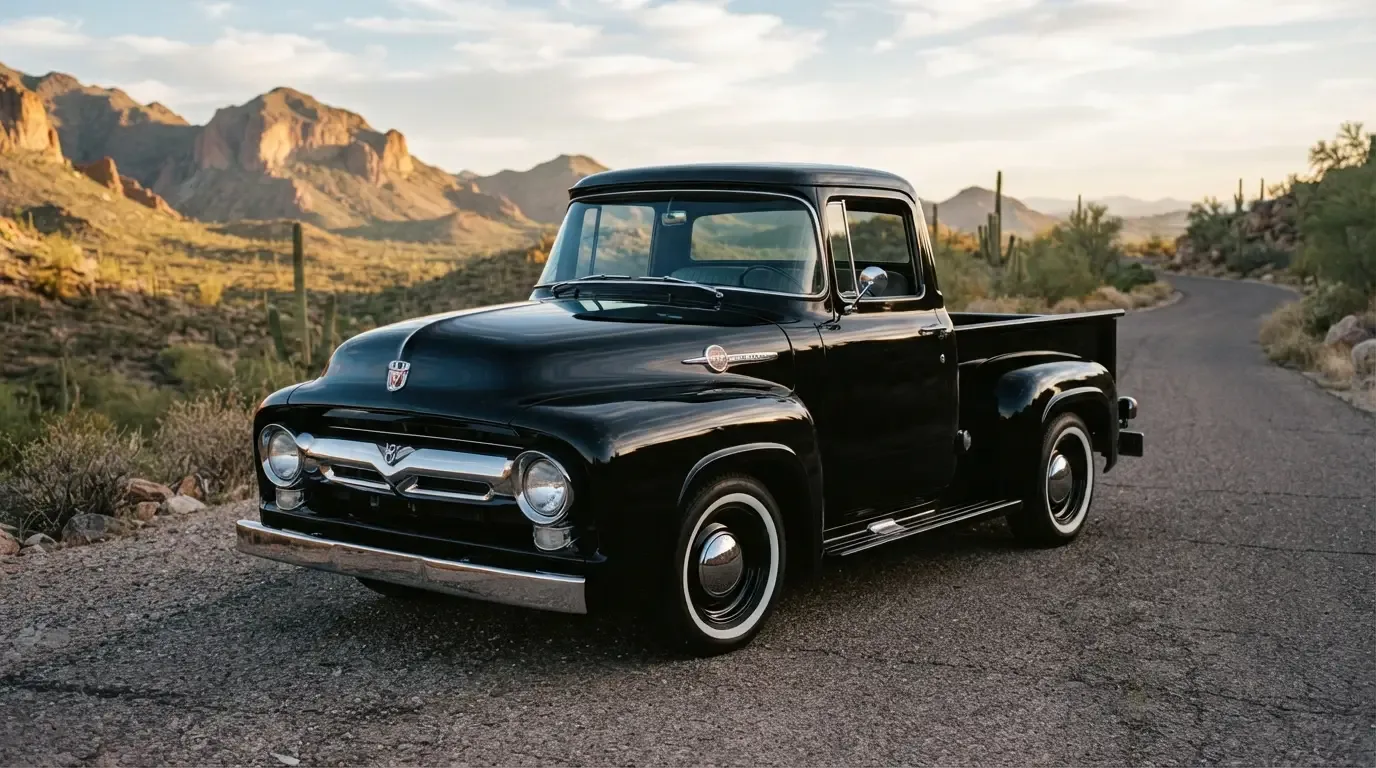
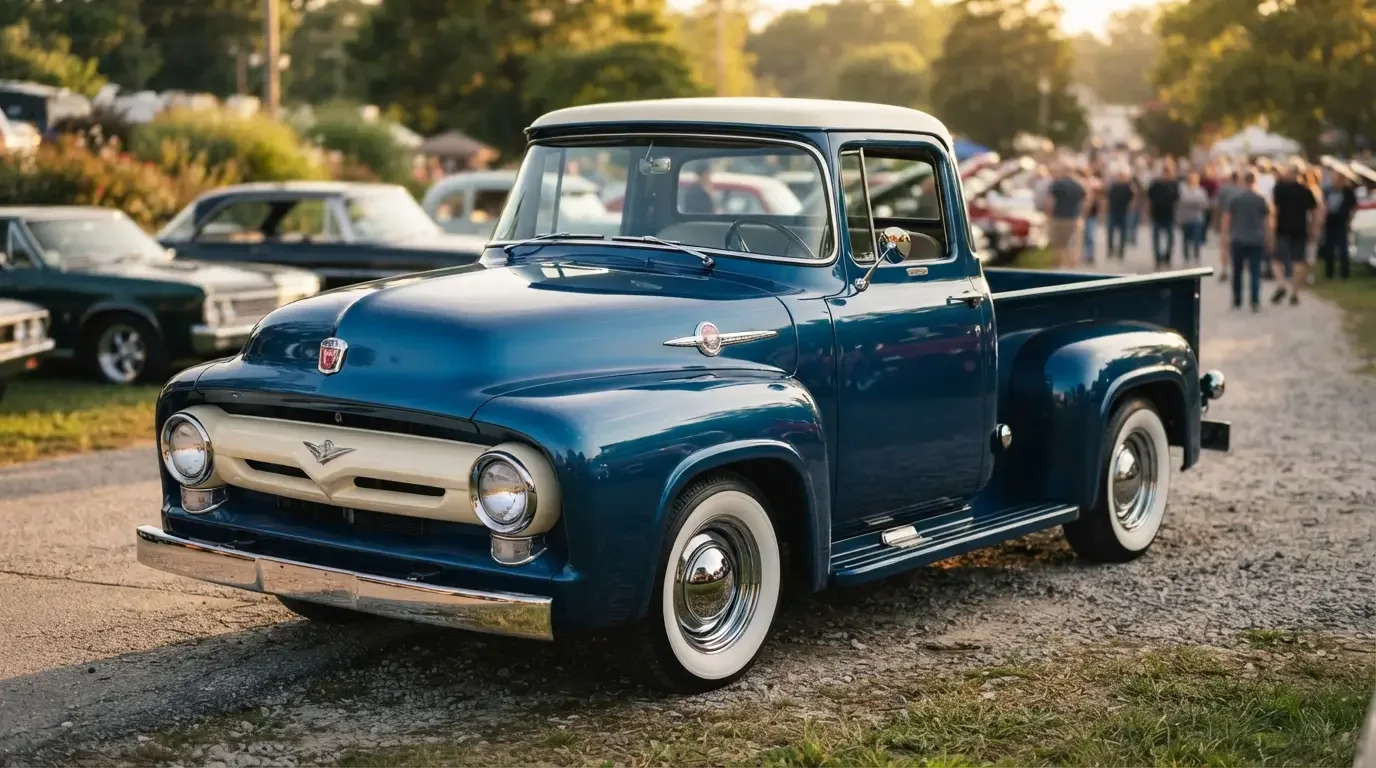
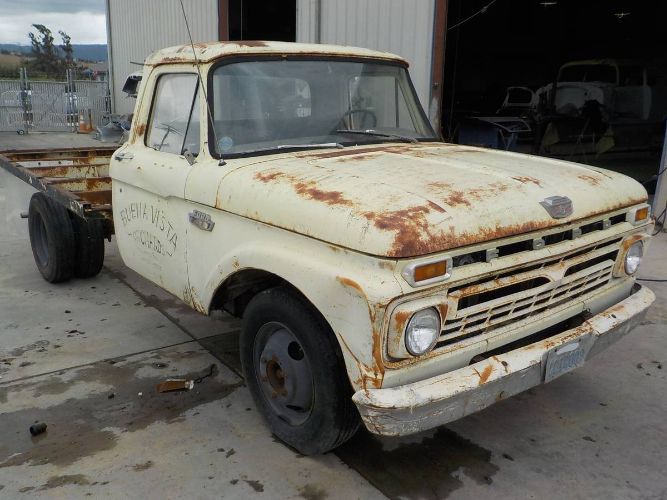
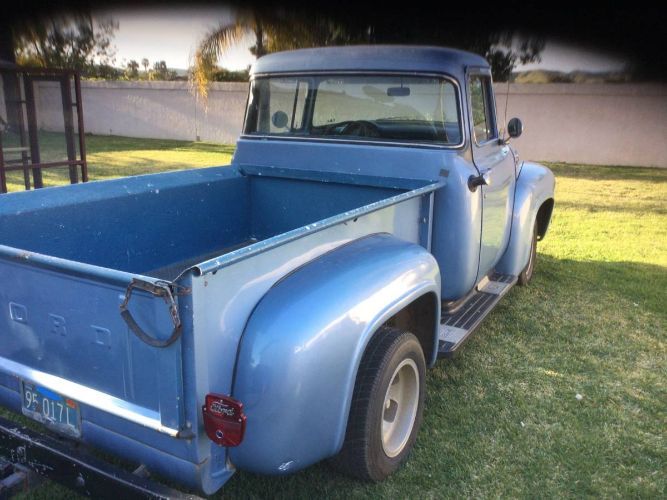
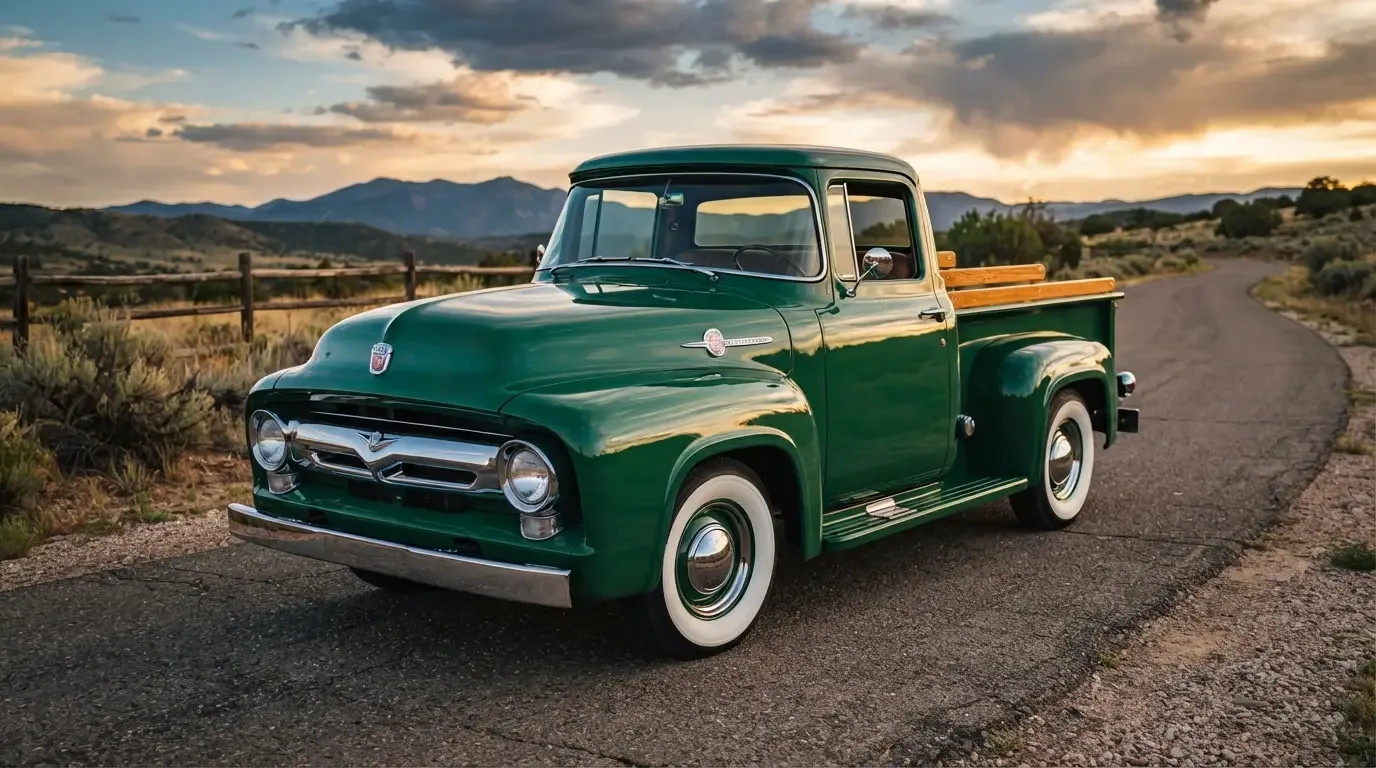
This first F-100 generation, running from 1953 to 1956, is the one a lot of collectors consider the sweet spot of the whole run. The 1953 through 1955 trucks share a family look, and then 1956 arrived with the wraparound windshield and the big glass that makes those final first-generation trucks instantly recognizable. Under the hood the flathead V8 finally gave way, in 1954, to the overhead-valve Y-block V8, a modern engine that breathed better and made real power. A rancher who traded his F-1 for a 1956 F-100 was climbing into a genuinely different machine, one that could keep up with highway traffic and haul a full bed without wheezing.
| Generation | Years | Signature trait |
|---|---|---|
| First | 1953-1956 | Curved windshield, Y-block V8 from 1954, 1956 wraparound glass |
| Second | 1957-1960 | Flat hood, integrated fenders, Styleside bed introduced |
| Third | 1961-1966 | Unibody option early, then twin I-beam front suspension in 1965 |
| Fourth | 1967-1972 | The "bumpside" and Ranger trim, plush interiors arrive |
| Fifth | 1973-1979 | Bigger, squarer "dentside" body, last of the F-100 name |
The second generation squares its shoulders
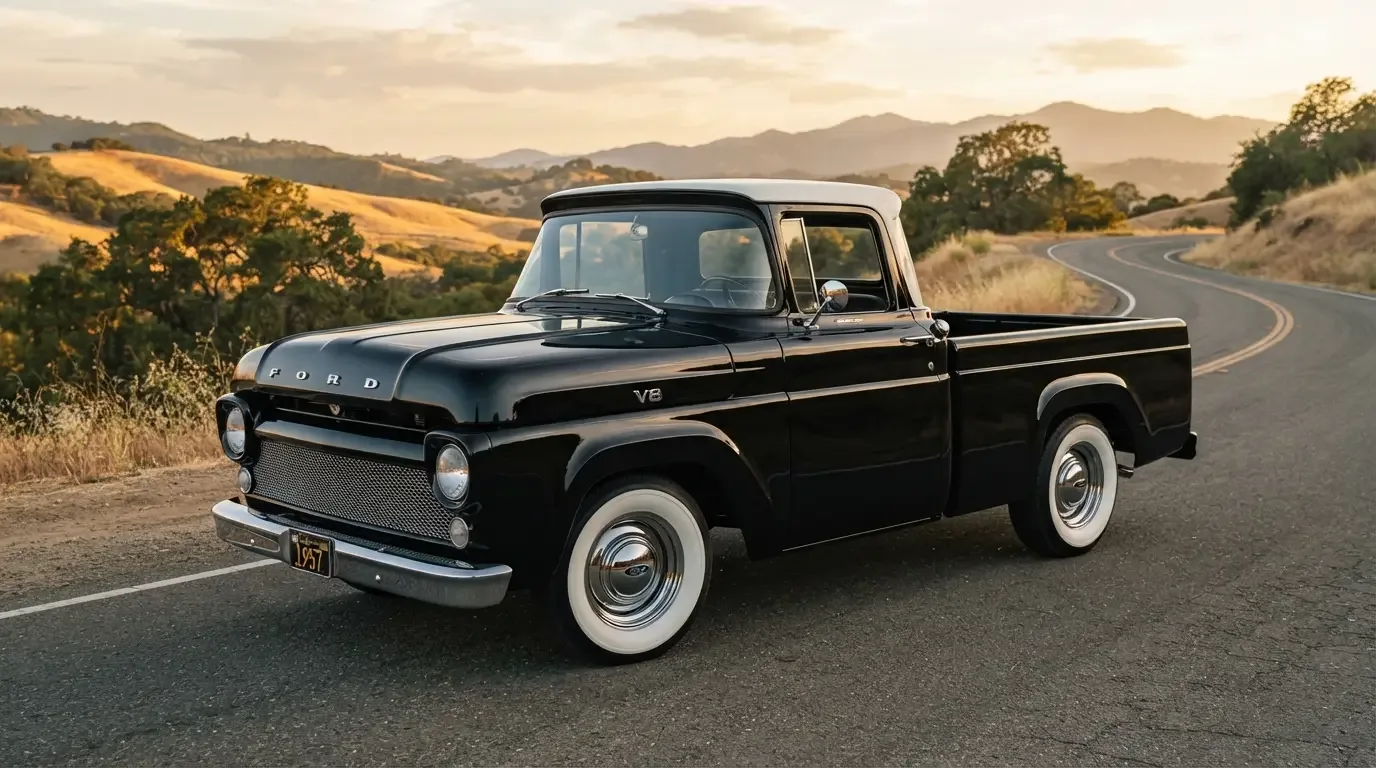
The 1957 redesign is one of those moments where you can watch a truck grow up. Gone were the separate, bulging front fenders that every pickup had worn since the Model T. In their place Ford gave the F-100 a flat hood that sat level with the tops of the fenders, so the whole front of the truck read as one clean slab. It looked modern in a way that made the 1956 truck suddenly look old, and that was the point. Ford was fighting Chevrolet hard in these years, and styling was a weapon.
This generation also introduced the Styleside bed, a smooth-sided cargo box with the bed walls flush to the body, sold alongside the traditional Flareside with its separate fenders. The Styleside is the ancestor of every modern smooth-sided pickup bed, and buyers took to it immediately because it looked cleaner and carried wider loads. The 1957 to 1960 trucks are sometimes overlooked between the beloved first generation and the popular trucks that came later, which honestly makes them one of the better values for someone who wants a genuine classic without paying the premium that the calendar trucks command.
"I have a soft spot for the 1957 to 1960 trucks precisely because nobody fusses over them. You get real 1950s design, a flat hood that still looks sharp, and prices that have not gone to the moon. That is the enthusiast's quiet secret."
- Patrick Walsh
The third generation and the great engineering fight
The 1961 to 1966 F-100 is where the story gets complicated, in a good way. Ford tried something bold at the start of this run, offering an integrated cab-and-bed design, a so-called unibody pickup where the cab and cargo box were a single stamped unit with no gap between them. It looked sleek and it was cheaper to build, but it had a real problem. If you loaded the bed heavy and the frame flexed, the doors could bind shut, and word got around fast. Ford quietly went back to the traditional separate cab and bed by 1963, and the short-lived unibody trucks are now a curiosity that collectors seek out precisely because Ford would rather have forgotten them.
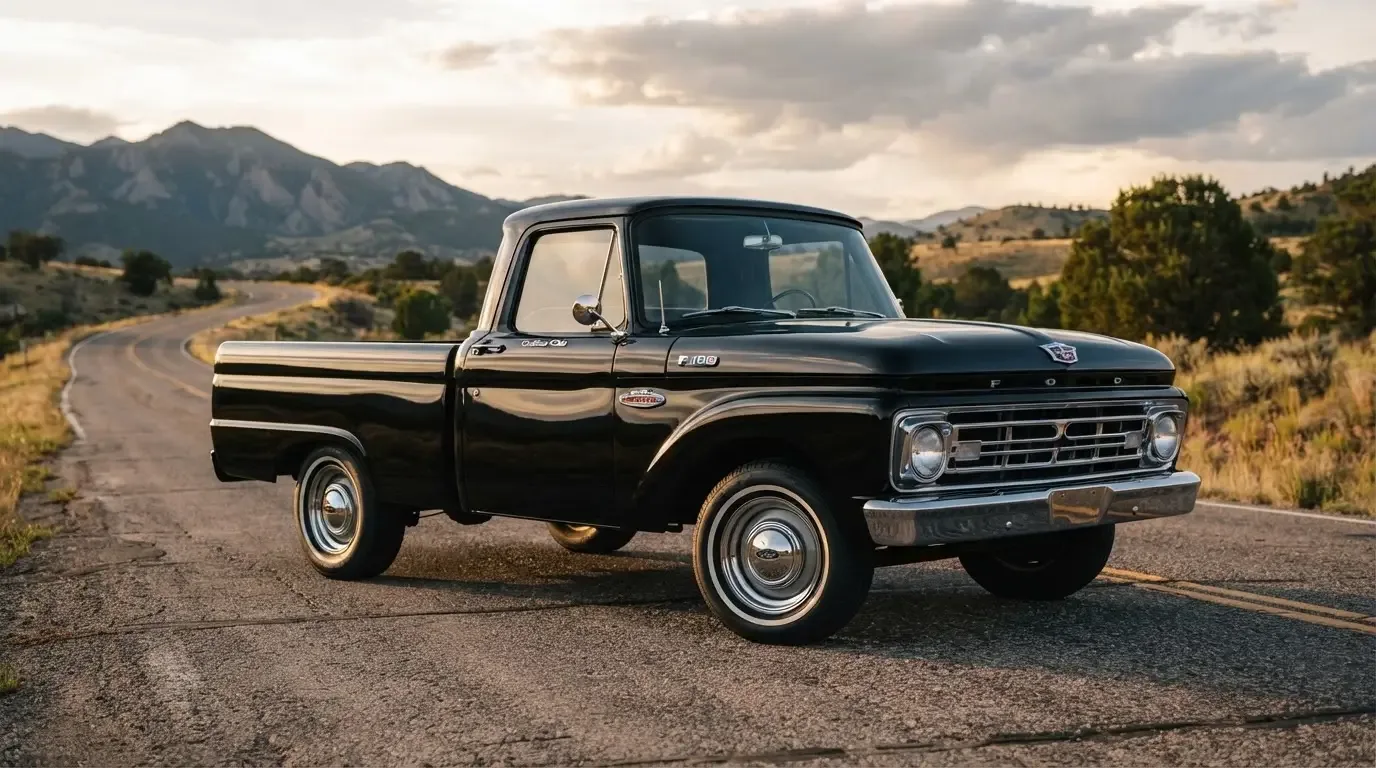
The bigger news came in 1965, when Ford introduced Twin I-Beam front suspension. This was independent front suspension built tough enough for a truck, and Ford advertised it relentlessly, promising a smoother ride without giving up the durability a work truck needed. It worked, and it stayed in Ford trucks for decades. The 1965 and 1966 trucks with Twin I-Beam ride noticeably better than anything before them, and if you are shopping this generation, that is the feature to look for. Ford also broadened the engine choices in these years, offering bigger sixes and V8s as buyers started asking their trucks to do more than crawl around a farm.
The fourth generation, when the truck learned to be comfortable
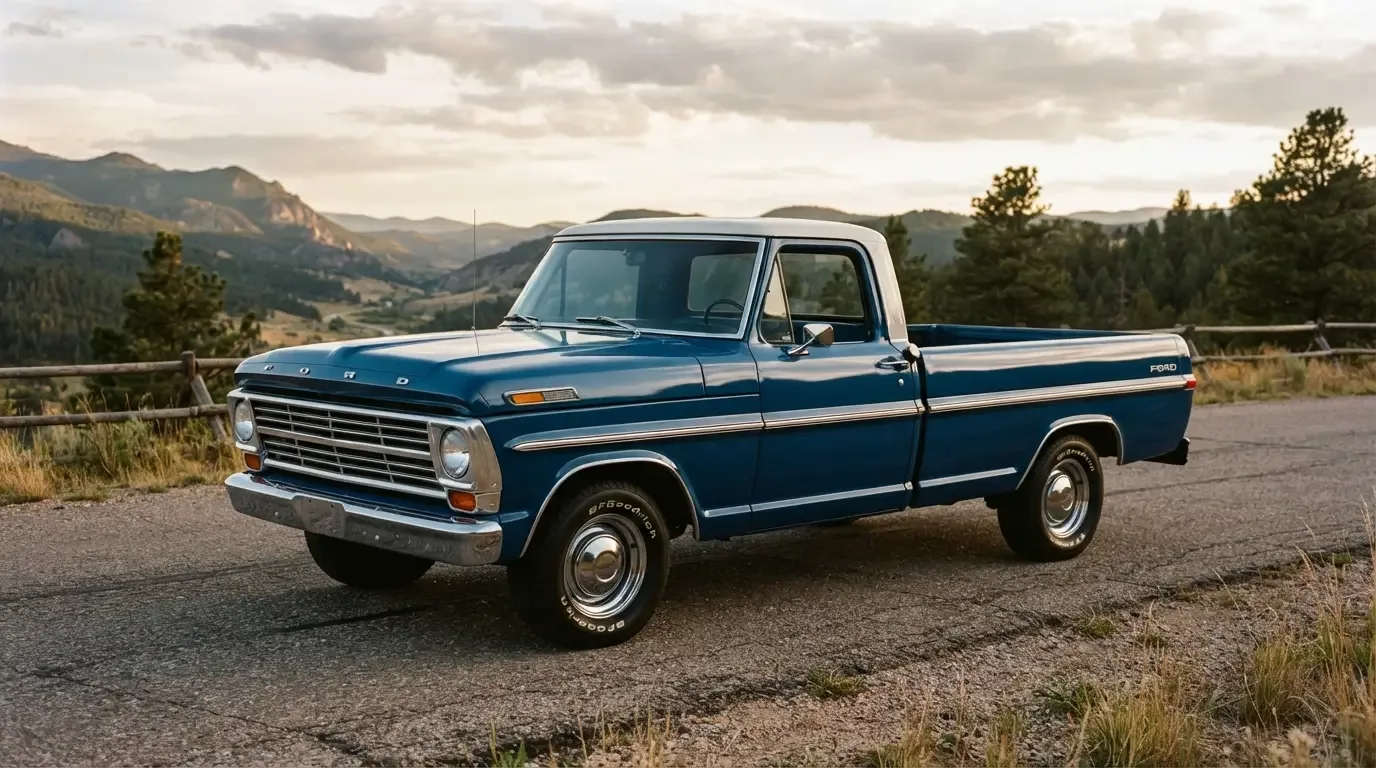
If there is one generation that turned the F-100 from a tool into something people actively wanted to be seen in, it is the 1967 to 1972 run, known to enthusiasts as the "bumpside" for the character line that runs along the body. These trucks are handsome in a square-jawed, honest way, and they arrived just as America was starting to think of a pickup as something other than strictly a farm implement.
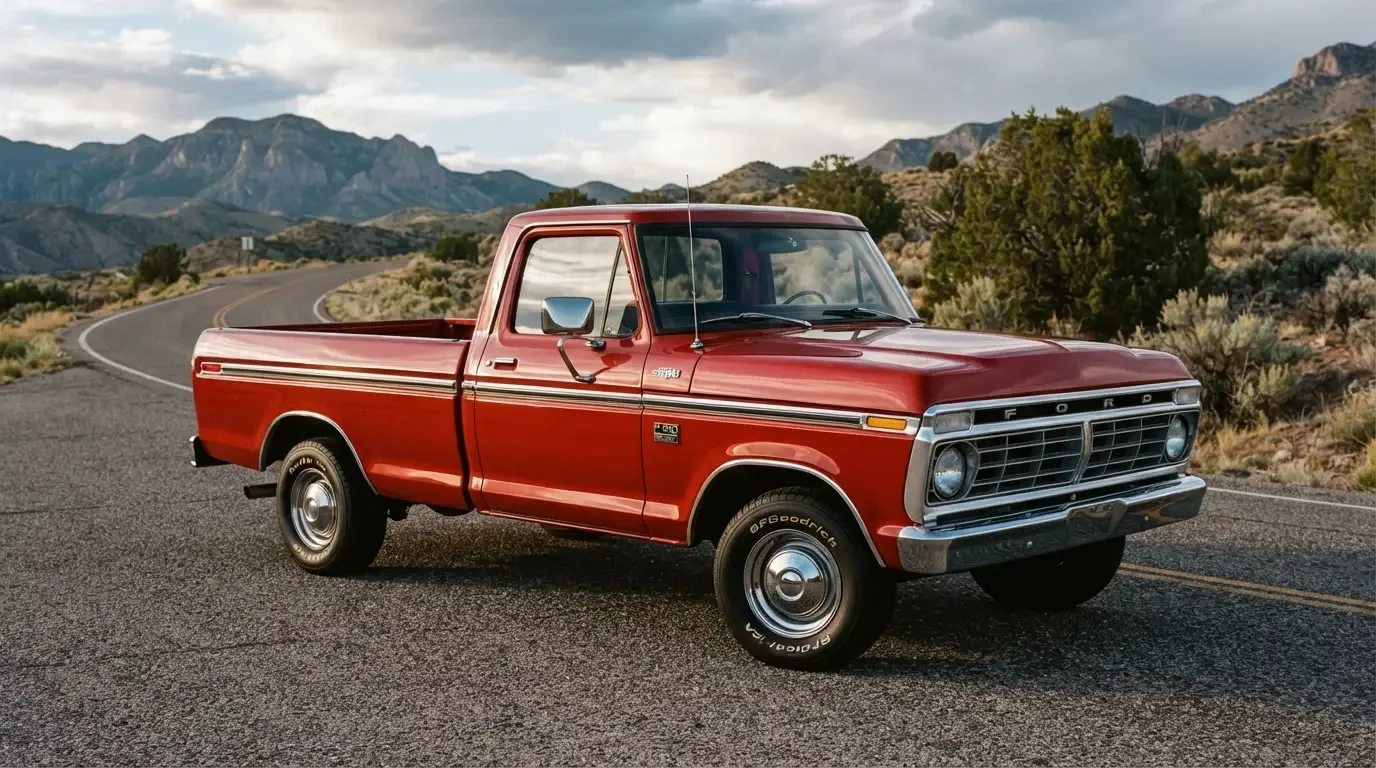
The key was the Ranger trim package. For the first time you could order an F-100 with bright trim, a nicer interior, cloth and vinyl seats, and enough chrome to make the truck feel like it belonged in a driveway instead of only a barn. Ford understood that suburban buyers, weekend haulers, and small business owners wanted a truck that could work all week and still look presentable on Sunday. The bumpside trucks sold in huge numbers, and they survive in huge numbers too, which makes them one of the friendliest entry points into F-100 ownership. Parts are everywhere, the community is deep, and a decent driver-quality truck from this era still trades at prices that will not require a second mortgage.
This is also the generation where the F-100 started showing up in the background of American life in a way that stuck. It was the truck parked outside the diner, the one the electrician drove, the one a teenager inherited from a grandfather and learned to drive a clutch in. Those emotional connections are a real part of why these trucks command loyalty today, and they are worth understanding if you want to grasp why people spend what they spend. When someone finally goes looking for a classic Ford F-100 for sale, more often than not they are chasing a specific memory, and the bumpside is the truck attached to more of those memories than almost any other.
The fifth generation and the end of an era
The 1973 redesign gave the world the "dentside" F-100, named for the indented body line that replaced the bumpside's raised one. These trucks were bigger, squarer, and roomier, built for an America that was starting to use pickups as family vehicles and long-distance haulers. The dentside ran a long time, from 1973 all the way through 1979, and over those years the interiors got plusher, the option lists got longer, and the trucks got heavier.
By the late 1970s, though, the F-100 name was living on borrowed time. Ford had introduced the F-150 in 1975 as a heavier-duty half-ton, partly to sidestep certain emissions and regulatory thresholds that applied to lighter trucks, and buyers gravitated toward the beefier F-150. The F-100 hung on as the lighter, cheaper half-ton until 1983, when Ford finally retired the name for good and let the F-150 carry the half-ton banner alone. So while the classic-truck world generally treats 1979 as the close of the great F-100 era, the badge itself technically staggered on a few more years as a budget option before disappearing. Either way, the truck that had been born in 1953 as Ford's fiftieth-anniversary half-ton had run its course.
Engines, colors, and the culture that grew around them
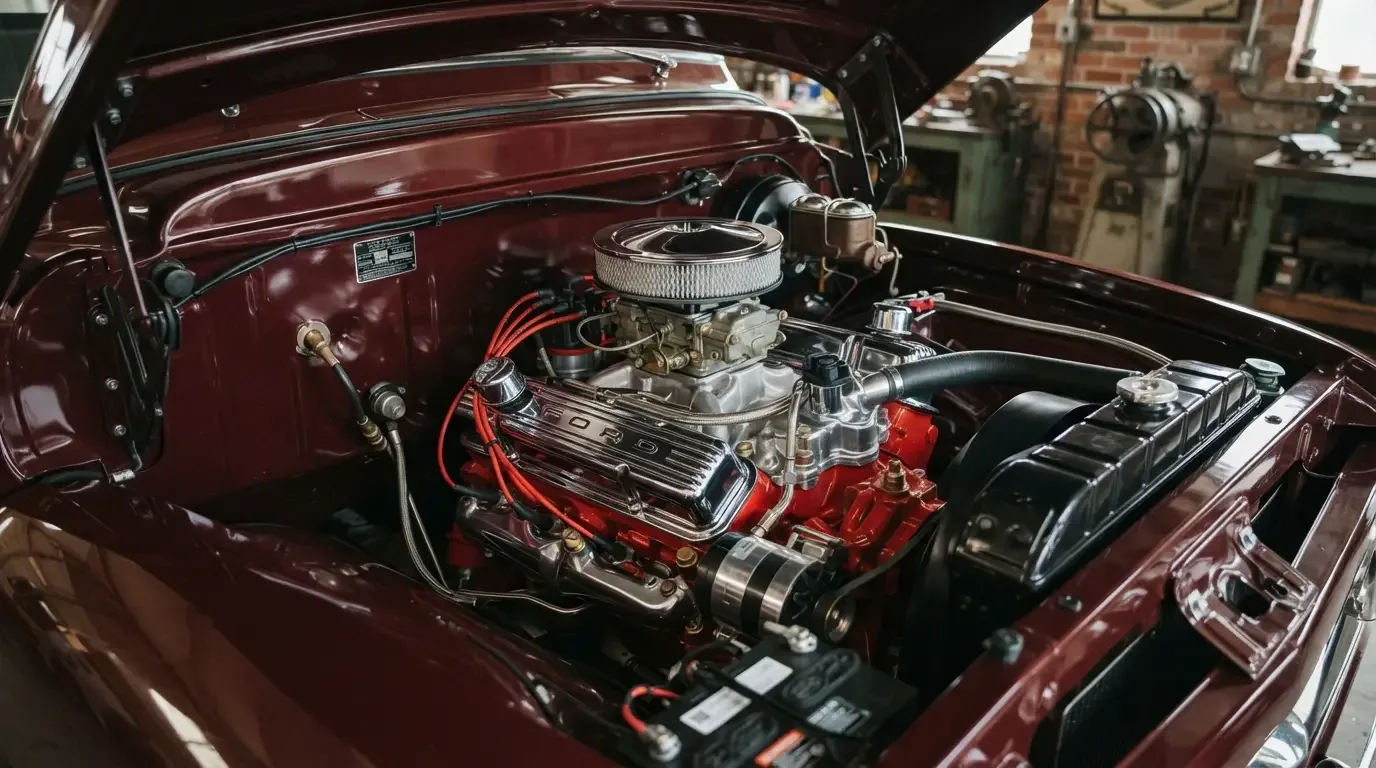
Part of what makes the F-100 story rich is the sheer range of what rolled out of the factory. Early trucks ran flathead V8s and stout inline sixes. The Y-block V8 modernized things in the mid 1950s. By the 1960s and 1970s you could get the famous FE big-block V8s in the heavier applications and a whole ladder of small-blocks and sixes in between. None of these engines were exotic, and that is exactly the point. They were simple, rugged, and fixable with hand tools in a gravel driveway, which is why so many of these trucks are still running today on their original blocks.
Then there is the color, which matters more than people expect. Ford painted these trucks in the shades of their decades, the soft two-tone pastels of the 1950s, the bolder single colors of the 1960s, and the earthy oranges, greens, and creams of the 1970s. A correctly colored F-100 tells you what year it is from across a parking lot, and among collectors the original factory color codes are treated with real seriousness. A truck wearing its born-with color, documented and correct, is worth more than the same truck resprayed in something that looks good but never left Dearborn that way.
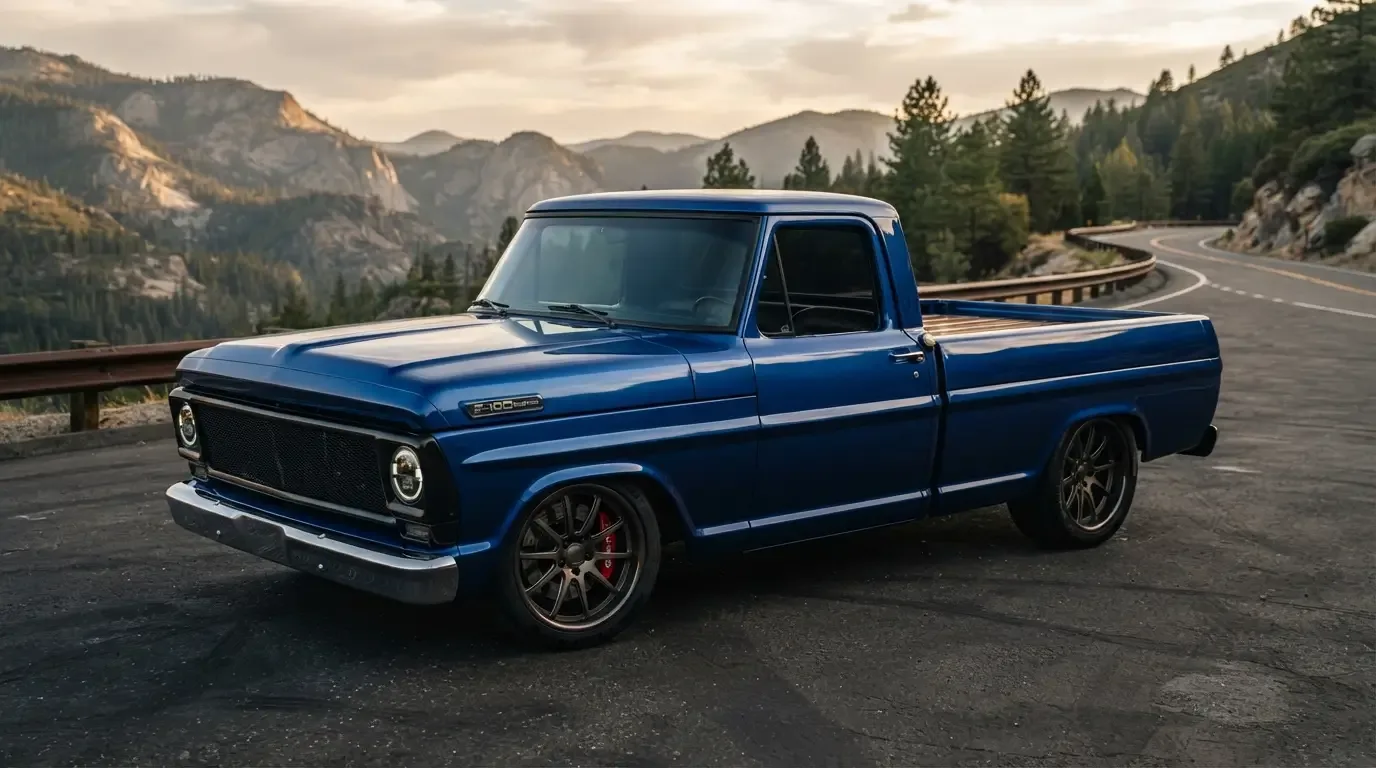
The custom scene deserves its own mention, because the F-100 became a favorite canvas for builders. The clean lines of the 1953 to 1956 trucks and the honest slab sides of the bumpsides make them ideal starting points, and today you will find everything from mild lowered cruisers to full restomods hiding modern running gear under vintage sheet metal. That builder culture is a genuine part of the F-100 legacy, and it keeps the trucks visible and desirable in a way that pure originality alone never could. It is worth saying that a heavily modified truck and a documented original are two different collectibles serving two different buyers, and neither is wrong.
Why the F-100 still matters
It would be easy to explain the F-100's enduring appeal as simple nostalgia, and nostalgia is part of it. But that is not the whole answer. The deeper reason is that the F-100 got the fundamentals right for almost thirty years running. Every generation was designed around the person driving it, which was Ford's original insight back in 1948 with the F-1 and the reason the redesigned 1953 truck earned its own name. The trucks were simple enough to fix, tough enough to survive decades of hard use, and handsome enough that people kept them long after the work was done.
There is also the matter of numbers. Ford built these trucks by the millions across all their generations, which means survivors are plentiful, parts are reproduced, and knowledge is everywhere. That accessibility is a gift to the hobby. You do not need to be wealthy to own a running, driving piece of American history, and you do not need to be a master mechanic to keep one on the road. Compare that to a rare sports car that spends more time in a shop than on the road, and the appeal of an honest old pickup becomes obvious.
And then there is the feeling, which is harder to put into words but impossible to ignore once you have had it. There is something about sitting up high in one of these trucks, hand on a big thin steering wheel, the straight six or the small V8 loafing along, that connects you to every rancher and carpenter and kid who ever drove one. The F-100 was built to work, and in working it earned a place in the American imagination that no marketing department could have engineered on purpose. That is why, more than seventy years after Ford stamped out the first one, people are still restoring them, still driving them, and still stopping to look when one rumbles past. The rancher in that old dealership photograph would probably find the whole thing a little funny. To him it was just a truck. To the rest of us, it turned out to be a lot more.
The shape of a legend
Trace the whole arc and you can see the story clearly. The F-1 taught Ford what a driver wanted. The 1953 F-100 gave the idea a name and a shape. The late 1950s trucks made it modern, the 1960s trucks made it ride well, the bumpsides made it comfortable, and the dentsides made it big before the F-150 finally took the crown. Every step was an honest improvement on the last, and none of them ever forgot the original point, which was to build a good truck for a working person at a fair price.
That consistency of purpose is the real legend of the F-100. It never chased fashion for its own sake, it never priced itself out of reach, and it never pretended to be anything other than what it was. Cars come and go, and plenty of flashier machines have been forgotten, but the plain old Ford half-ton kept doing its job so well and for so long that it became something close to a national heirloom. Not bad for a truck that started life as a way to sell farmers a better seat.