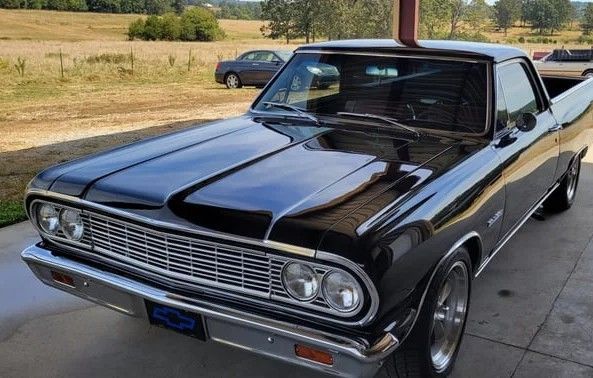
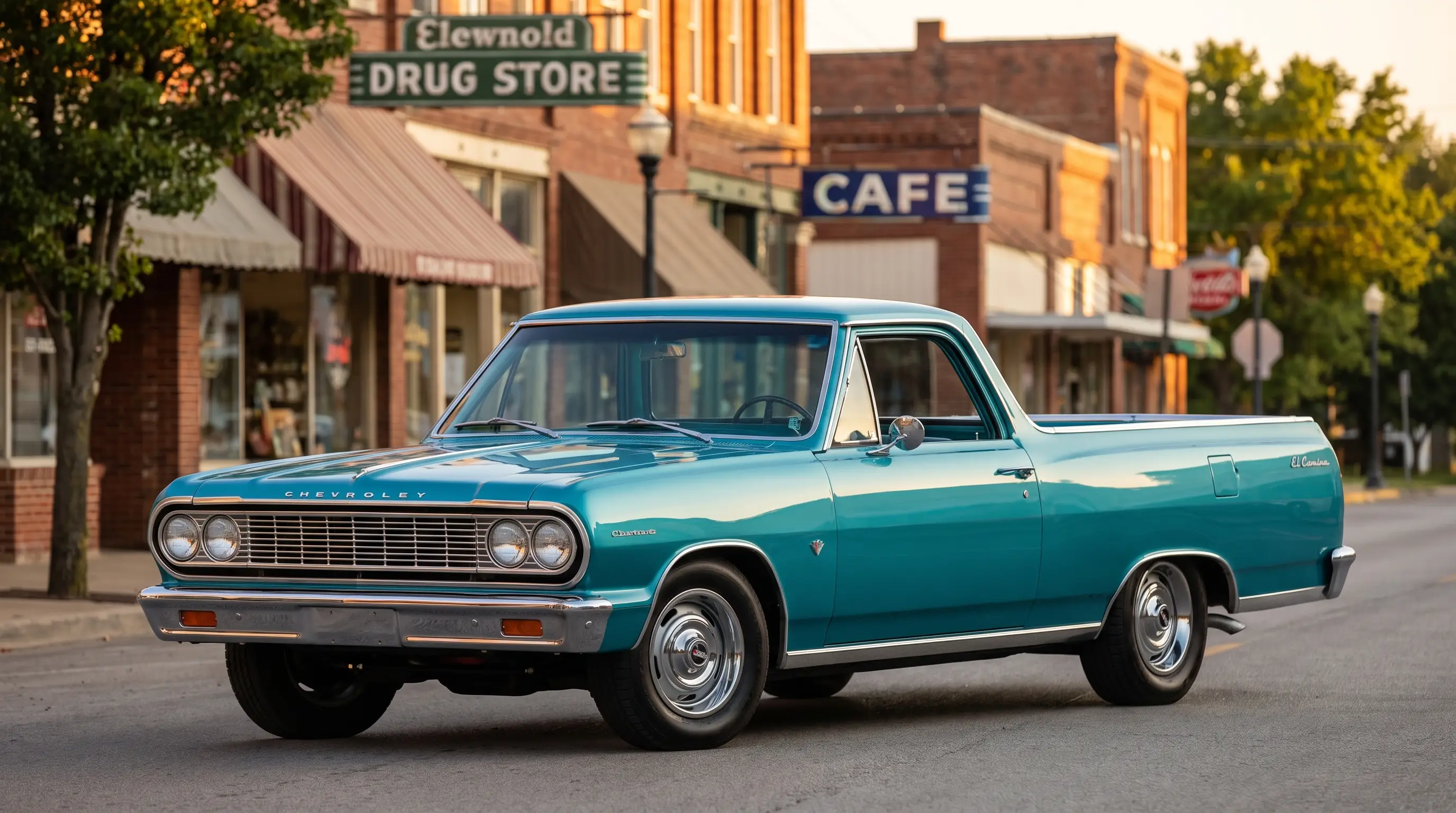
To understand the 1964 el camino properly, you have to accept that it is a second act rather than a debut. Chevrolet had already built and abandoned an El Camino once. The full-size 1959 and 1960 cars, with their gullwing rear styling, sold modestly and then vanished from the lineup after two seasons. When the name returned for 1964, it came back attached to an entirely different car and a different idea about what this vehicle was supposed to be. That distinction is the whole story, and it is the one most often blurred.
The revived El Camino was built on the new Chevelle, the intermediate A-body that Chevrolet introduced for 1964 to fill the gap between the compact Chevy II and the full-size line. Placing the car-based pickup on the intermediate platform was the decision that gave the nameplate its lasting form. Everything the El Camino became over the next two decades traces back to this platform choice, so it rewards careful attention.
A different car wearing a familiar name
The 1959 and 1960 El Caminos were large vehicles, sharing their architecture with the full-size Chevrolet passenger cars of the period. They were dramatic to look at and awkward to place in the market. Ford's Ranchero had established the car-based pickup format, and Chevrolet's first response was to build a bigger, flashier version of the concept. It did not find a durable audience, and the name was shelved.
The 1964 car corrected the sizing. By adopting the mid-size Chevelle platform, Chevrolet produced a vehicle that was neither too small to be useful nor too large to be sensible. The wheelbase sat at 115 inches, and the proportions were right for a buyer who wanted a light hauler with the manners of a passenger car. This was the format that worked, and it is the reason the 1964 revival endured where the 1959 experiment had not.
The complete arc, from the finned original through every generation that followed, is documented in our chevrolet el camino retrospective. For the purposes of this account, the important point is that 1964 is where the nameplate found the body it would keep, in spirit, for the rest of its production life.
The 1964 to 1967 generation as a set
The first Chevelle-based El Caminos form a coherent group across the 1964 to 1967 model years. They share the first-generation Chevelle body, with annual revisions to grille, trim, and detailing that let a careful observer date a given car. The 1964 and 1965 cars are closely related, with the 1965 season bringing revised styling touches and an expanded engine list. The 1966 and 1967 cars carry the restyled second series of the first-generation Chevelle body, again with year-specific identifiers.
Treating this generation as a set is useful because it clarifies what changed and when. The El Camino in these years followed the Chevelle almost exactly from the doors forward, inheriting the passenger car's interior appointments, instrumentation options, and available trim levels. A buyer could order the El Camino close to Malibu specification, which meant chrome, better upholstery, and a finished cabin rather than a bare work interior. That optionality is part of why these cars appealed beyond the fleet market.
Engine availability grew across the generation. The early cars offered inline sixes, from the 194 up through the 230 and, by 1967, a 250, alongside small-block V8 options, and the V8 choices broadened as the years progressed, with the 283 (in 195 and 220-horsepower tune) giving way to a range of 327 small-blocks, up to 300, 325, and the L79's 350 horsepower, joining the list by the middle of the run. This was still before the big-block muscle era that would define the following generation, so the 1964 to 1967 cars are better understood as capable, well-mannered vehicles than as performance machines. The performance chapter came later.
Trim, identity, and the question of sport
One point that deserves precision concerns sporting identity. Enthusiasts sometimes project the later SS mystique backward onto these early cars. The Super Sport identity that became central to the El Camino story arrived in full with the following generation. During the 1964 to 1967 years the car was available with sporty equipment and dressier trim, but there was no El Camino SS package during this generation, and the buyer's experience was closer to a nicely optioned intermediate than to a badged muscle car. The SS identity arrived only with the restyled 1968 model. Keeping that distinction clear matters when assessing what an early car actually is.
This is the kind of detail that separates careful history from received wisdom. The market rewards the muscle era cars, and there is a temptation to describe the earlier ones in the same vocabulary. The artifact itself resists that. A 1964 El Camino is a document of Chevrolet's mid-1960s intermediate strategy, a sensible vehicle for a practical buyer, and it should be read on those terms rather than dressed up as something it was not built to be.
The colors and interiors of the period reward the same careful reading. Chevrolet's mid-1960s palette favored the restrained hues of the era, and the El Camino shared the Chevelle's paint and trim catalog rather than receiving a separate work-vehicle scheme. A correctly presented early car wears finishes that a passenger Chevelle of the same year would have worn, which is one more sign of how fully the pickup was integrated into the family. When a survivor turns up in a factory-correct color with its matching interior code intact, it tells a more complete story than any restoration in a fashionable modern shade ever could.
Assembly and distribution details matter to the historian as well. These cars were built across several plants and sold through Chevrolet's enormous dealer network, which means examples turn up today with regional histories that can often be traced through their documentation. A cowl tag records the body build information, and where original paperwork survives it can place a car at a specific plant and specify how it was equipped when new. For a vehicle that was, in its working life, treated as a disposable tool, the survival of that paper trail is what elevates an ordinary early El Camino into a documented artifact worth preserving.
Period context: where it sat in the market
The mid-1960s were a competitive moment for the car-based pickup. Ford had moved its Ranchero downward to the compact Falcon platform and would later reposition it on the intermediate Fairlane, so the two rivals circled the same idea from different directions across these years. The Chevelle-based El Camino gave Chevrolet a direct intermediate answer, and the sales record suggests the format resonated with buyers who wanted utility without the bulk of a full-size truck.
It is worth situating the vehicle within Chevrolet's own lineup as well. The Chevelle was a strategically important car for the division, and the El Camino benefited from riding on a platform that received real engineering attention and a full options catalog. The pickup was not an orphan built from leftover parts. It was a proper member of the Chevelle family, and the surviving cars reflect that in their fit, finish, and the range of ways they could be ordered.
| Attribute | 1964-1967 El Camino detail |
|---|---|
| Platform | First-generation Chevelle A-body |
| Wheelbase | 115 inches |
| Generation span | 1964-1967 |
| Engines | 194/230/250 cu in sixes; 283 and 327 cu in V8s, up to the L79's 350 hp |
| Trim relationship | Followed Chevelle, up to Malibu-level appointments |
| Predecessor | Full-size 1959-1960 El Camino |
| Successor | Restyled 1968 A-body and the SS396 era |
Collectibility and how survivors present today
Because these were working vehicles, the survival rate skews toward cars that were cared for by owners who valued them beyond mere utility. A well-kept 1964 El Camino today is an approachable classic. It is old enough to carry genuine period character, common enough that parts and knowledge exist, and modest enough in value that it has not attracted the wholesale reproduction and misrepresentation that plague the later muscle cars. In artifact terms, an honest early car is often more truthful than a heavily restored later one.
Originality is the quality to prize. A first-generation El Camino that retains its correct trim, its documented drivetrain, and its factory configuration is a more valuable historical object than a repainted, re-optioned car chasing a look. The generation's relative affordability means the incentive to falsify is lower, which works in the careful buyer's favor. What you see is generally what the car is, and that is a pleasant thing to be able to say about any classic.
The condition of surviving cars tends to sort into recognizable categories. There are the honest drivers, cars that were used gently and kept up over the decades, wearing an older repaint perhaps but structurally sound and mechanically correct. There are the barn finds, cars pulled from long storage that require judgment about how much to preserve and how much to renew. And there are the restored cars, where the central question becomes whether the restoration respected the factory specification or reinterpreted the vehicle to modern taste. For the historically minded, the honest driver often carries the most information, because it has not had its evidence sanded away in the name of perfection.
"The 1964 car is where the El Camino found its permanent shape. Everything the muscle era gets credit for was built on the platform decision made here, and a well-documented early example is one of the most honest artifacts in the whole lineage."
- Sarah Whitfield
Why the revival year still matters
The 1964 El Camino is easy to overlook precisely because the cars that followed were louder. But the historian's interest lies in origins, and this is the origin of the El Camino that people actually remember. The full-size cars were a false start. The Chevelle-based revival was the real beginning, and every subsequent development, from the SS396 restyle to the downsized cars of the 1980s, descends from the choice made for this model year.
For anyone assembling a complete picture of the nameplate, the early generation is essential context rather than a footnote. It explains why the El Camino took the form it did and why that form proved so durable. The revival also demonstrates something about how Chevrolet learned from its own missteps. The company did not simply reissue the full-size car that had failed. It reconsidered the entire premise, matched the vehicle to a platform the market actually wanted, and in doing so turned a two-year experiment into a design that would run, in one form or another, for more than two decades. That is a rare thing in the industry, a second attempt that so thoroughly corrects the first. The rivalry that shaped both this car and its Ford counterpart is a subject in itself, and readers who want to keep exploring will find the competitive story rewarding. Those looking to study surviving examples firsthand can review a classic El Camino for sale and see how originality and documentation shape the market for the earliest of the Chevelle-based cars.